

Description
Crassostrea virginica, also known as the American or Eastern Oyster, is the reef-building oyster species found within
the estuaries and bays of the northern Gulf of Mexico and
along the Atlantic coast of North America. C. virginica
has a free-swimming larval stage, lasting 14–30 days, after
which the larva goes through a settling or spatting process,
in which it must permanently attach itself to the bottom
(Kennedy et al., 1996). During the larval stage, the oyster
is susceptible to the multitude of estuarine hydrodynamic
processes that distribute the larva throughout the estuary.
C. virginica is a filter feeder, so it needs to settle and attach
to a site which will permanently keep it out of the fine bay
bottom mud to avoid suffocation by fine-grained sediment
as well as to optimize the supply of nutrients (Lenihan,
1999; Schulte et al., 2009). It also needs to settle within
the intertidal to subtidal portion of the bay, to allow it access
to tidal flow and nutrients (Kennedy et al., 1996).
For oyster reefs to form and persist, oysters need to accumulate on a stable substrate that keeps them elevated above
the muddy bay bottom. Over time, for oyster reefs to survive, they need to form atop a substrate capable of
supporting the weight of the reef. Coastal plain estuaries
primarily form within partially filled incised river valleys
(Pritchard, 1956). These river valleys have an inherited or
“antecedent” geology resulting from the valley incision
and valley fill. Studies on the geological controls on oyster
reef distribution and occurrence within Copano Bay in
Texas reveal that the major oyster reefs had been
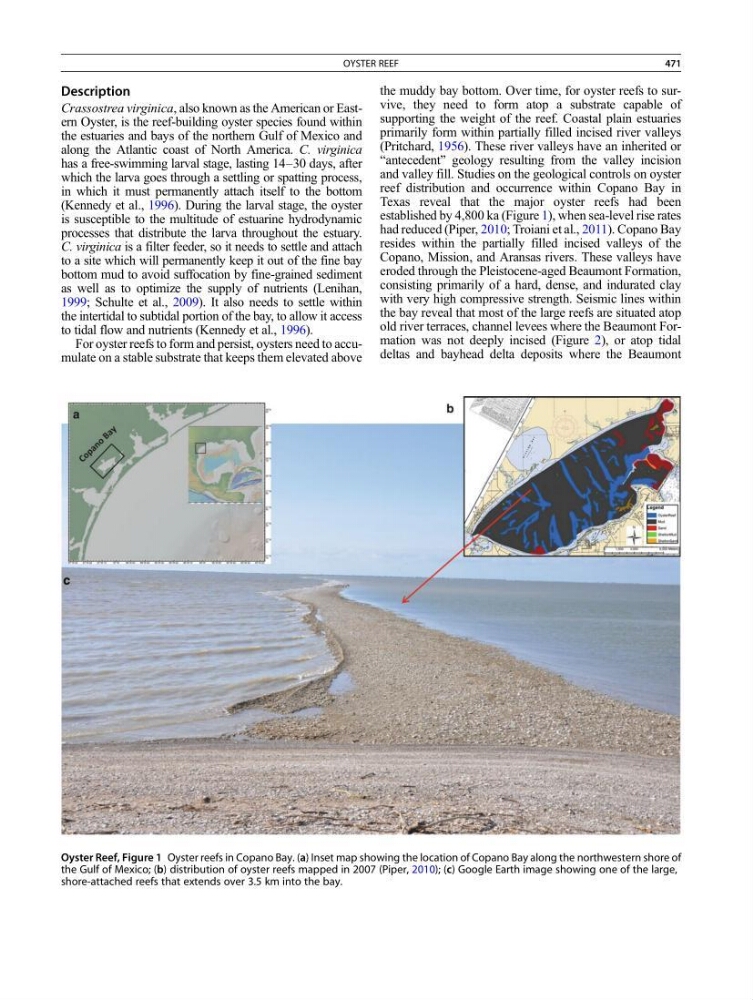
established by 4,800 ka (Figure 1), when sea-level rise rates
had reduced (Piper, 2010; Troiani et al., 2011). Copano Bay
resides within the partially filled incised valleys of the
Copano, Mission, and Aransas rivers. These valleys have
eroded through the Pleistocene-aged Beaumont Formation,
consisting primarily of a hard, dense, and indurated clay
with very high compressive strength. Seismic lines within
the bay reveal that most of the large reefs are situated atop
old river terraces, channel levees where the Beaumont Formation was not deeply incised (Figure 2), or atop tidal
deltas and bayhead delta deposits where the Beaumont
Oyster Reef, Figure 1 Oyster reefs in Copano Bay. (a) Inset map showing the location of Copano Bay along the northwestern shore of
the Gulf of Mexico; (b) distribution of oyster reefs mapped in 2007 (Piper, 2010); (c) Google Earth image showing one of the large,
shore-attached reefs that extends over 3.5 km into the bay.
OYSTER REEF
471
Crassostrea virginica, also known as the American or Eastern Oyster, is the reef-building oyster species found within
the estuaries and bays of the northern Gulf of Mexico and
along the Atlantic coast of North America. C. virginica
has a free-swimming larval stage, lasting 14–30 days, after
which the larva goes through a settling or spatting process,
in which it must permanently attach itself to the bottom
(Kennedy et al., 1996). During the larval stage, the oyster
is susceptible to the multitude of estuarine hydrodynamic
processes that distribute the larva throughout the estuary.
C. virginica is a filter feeder, so it needs to settle and attach
to a site which will permanently keep it out of the fine bay
bottom mud to avoid suffocation by fine-grained sediment
as well as to optimize the supply of nutrients (Lenihan,
1999; Schulte et al., 2009). It also needs to settle within
the intertidal to subtidal portion of the bay, to allow it access
to tidal flow and nutrients (Kennedy et al., 1996).
For oyster reefs to form and persist, oysters need to accumulate on a stable substrate that keeps them elevated above
the muddy bay bottom. Over time, for oyster reefs to survive, they need to form atop a substrate capable of
supporting the weight of the reef. Coastal plain estuaries
primarily form within partially filled incised river valleys
(Pritchard, 1956). These river valleys have an inherited or
“antecedent” geology resulting from the valley incision
and valley fill. Studies on the geological controls on oyster
reef distribution and occurrence within Copano Bay in
Texas reveal that the major oyster reefs had been
established by 4,800 ka (Figure 1), when sea-level rise rates
had reduced (Piper, 2010; Troiani et al., 2011). Copano Bay
resides within the partially filled incised valleys of the
Copano, Mission, and Aransas rivers. These valleys have
eroded through the Pleistocene-aged Beaumont Formation,
consisting primarily of a hard, dense, and indurated clay
with very high compressive strength. Seismic lines within
the bay reveal that most of the large reefs are situated atop
old river terraces, channel levees where the Beaumont Formation was not deeply incised (Figure 2), or atop tidal
deltas and bayhead delta deposits where the Beaumont
Oyster Reef, Figure 1 Oyster reefs in Copano Bay. (a) Inset map showing the location of Copano Bay along the northwestern shore of
the Gulf of Mexico; (b) distribution of oyster reefs mapped in 2007 (Piper, 2010); (c) Google Earth image showing one of the large,
shore-attached reefs that extends over 3.5 km into the bay.
OYSTER REEF
471