

conservation on agricultural land, altered circulation patterns, construction of dams and bridges, deforestation,
and urban development. All of these activities accelerate
coastal erosion and the suspended sediment concentration
in estuaries (Schubel, 1977). A study conducted in the
Albemarle-Pamlico estuary (NC) showed that nonpoint
source pollution was the cause of over 96 % of stream degradation in the state, and agriculture was the source of
67 % of that total (Lilly, 1996). In the Tar Basin, 75 % of
sediment load originates from cropland runoff. The
erosion is due in part to the lack of investment in erosion
control methods since leases on land are short term and
investment in erosion control is not cost-effective at that
time horizon (Lilly, 1996).
Regulations
The Clean Water Act (CWA) is the major federal law that is
designed to protect the nation’s waterbodies from pollution.
While the CWA provides direct regulatory control over
point sources through the NPDES program, there is no regulatory control over nonpoint sources. The 1987 amendments to the CWA established the Section 319 Nonpoint
Source Management Program. It recognizes that without
acting to control nonpoint source pollution, waterbodies in
the USA will not meet water quality standards. Thus, the
program currently provides grant funding to states to
develop nonpoint source management plans or maintain
programs that address this type of pollution (USEPA, 2013).
Coastal states are regulated by the Coastal Zone Act as
well. Section 6217 of the Coastal Zone Act
Reauthorization Amendments of 1990 (CZARA) requires
coastal states (including Great Lakes states) to develop
coastal zone nonpoint source management programs to
be approved by both the USEPA and the National Oceanic
and Atmospheric Administration (NOAA).
Management options
In addition to providing funding, the USEPA is also
required by CZARA to develop a set of management measures that can be implemented to help reduce nonpoint
sources of pollution for coastal states. The management
measures are organized by type of source/land use and
summarized in Table 2.
Stormwater from urban areas in all states are regulated
by the NPDES program, which requires the development
of stormwater management plans by qualifying cities,
counties, and other urbanized areas. Each plan must
include five major types of minimum control measures
that reduce nonpoint source pollution. These control measures, and examples, are summarized in Table 3. The bag
law in Washington, D.C. (a city which drains to the Potomac Estuary and then Chesapeake Bay), is an example of
a local policy to prevent nonpoint source pollution of
trash. This law enforces a five cent fee for the use of any
plastic bag at all businesses that sell food or alcohol
throughout the city. It has resulted in a significant reduction in trash, and money generated from the bag fee goes
to fund trash cleanups and other programs to improve
water quality in D.C.
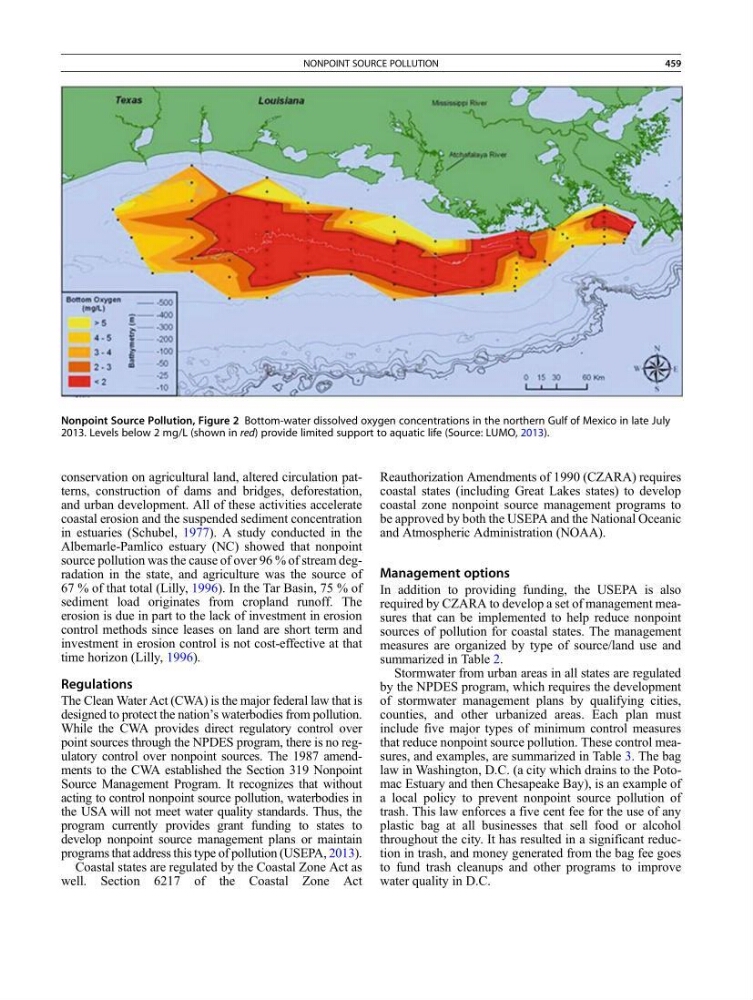
Nonpoint Source Pollution, Figure 2 Bottom-water dissolved oxygen concentrations in the northern Gulf of Mexico in late July
2013. Levels below 2 mg/L (shown in red) provide limited support to aquatic life (Source: LUMO, 2013).
NONPOINT SOURCE POLLUTION
459
and urban development. All of these activities accelerate
coastal erosion and the suspended sediment concentration
in estuaries (Schubel, 1977). A study conducted in the
Albemarle-Pamlico estuary (NC) showed that nonpoint
source pollution was the cause of over 96 % of stream degradation in the state, and agriculture was the source of
67 % of that total (Lilly, 1996). In the Tar Basin, 75 % of
sediment load originates from cropland runoff. The
erosion is due in part to the lack of investment in erosion
control methods since leases on land are short term and
investment in erosion control is not cost-effective at that
time horizon (Lilly, 1996).
Regulations
The Clean Water Act (CWA) is the major federal law that is
designed to protect the nation’s waterbodies from pollution.
While the CWA provides direct regulatory control over
point sources through the NPDES program, there is no regulatory control over nonpoint sources. The 1987 amendments to the CWA established the Section 319 Nonpoint
Source Management Program. It recognizes that without
acting to control nonpoint source pollution, waterbodies in
the USA will not meet water quality standards. Thus, the
program currently provides grant funding to states to
develop nonpoint source management plans or maintain
programs that address this type of pollution (USEPA, 2013).
Coastal states are regulated by the Coastal Zone Act as
well. Section 6217 of the Coastal Zone Act
Reauthorization Amendments of 1990 (CZARA) requires
coastal states (including Great Lakes states) to develop
coastal zone nonpoint source management programs to
be approved by both the USEPA and the National Oceanic
and Atmospheric Administration (NOAA).
Management options
In addition to providing funding, the USEPA is also
required by CZARA to develop a set of management measures that can be implemented to help reduce nonpoint
sources of pollution for coastal states. The management
measures are organized by type of source/land use and
summarized in Table 2.
Stormwater from urban areas in all states are regulated
by the NPDES program, which requires the development
of stormwater management plans by qualifying cities,
counties, and other urbanized areas. Each plan must
include five major types of minimum control measures
that reduce nonpoint source pollution. These control measures, and examples, are summarized in Table 3. The bag
law in Washington, D.C. (a city which drains to the Potomac Estuary and then Chesapeake Bay), is an example of
a local policy to prevent nonpoint source pollution of
trash. This law enforces a five cent fee for the use of any
plastic bag at all businesses that sell food or alcohol
throughout the city. It has resulted in a significant reduction in trash, and money generated from the bag fee goes
to fund trash cleanups and other programs to improve
water quality in D.C.
Nonpoint Source Pollution, Figure 2 Bottom-water dissolved oxygen concentrations in the northern Gulf of Mexico in late July
2013. Levels below 2 mg/L (shown in red) provide limited support to aquatic life (Source: LUMO, 2013).
NONPOINT SOURCE POLLUTION
459