

Summary
Nonpoint source pollution is a major issue preventing
thousands of US waterbodies, including most estuaries,
from meeting water quality standards. The impacts are
pervasive and harmful to humans, wildlife, and the
environment. The sources and pathways are diverse and
difficult to define, which makes identification and management complex. Federal regulations enforced by the
USEPA do not currently provide direct regulatory control
of nonpoint sources of pollution, but there is funding and
resources available to plan for and manage their impacts.
NOAA’s recent report on conditions in estuaries calls for
“coordinated and integrated action that balances
management action, efficient monitoring to assess the
effectiveness of the management, targeted research, and
a communications campaign aimed at engaging the
broader community” (Bricker et al., 2007). Thus a multipronged approach is needed in order to address this
challenging issue.
Bibliography
Bierman, V. J., Jr., Hinz, S. C., Justic, D., Scavia, D., Veil, J. A.,
Satterlee, K. III, Parker, M. E., and Wilson, S., 2008. Predicted
impacts from offshore produced-water discharges on Hypoxia
in the Gulf of Mexico. In Proceedings of the Society of
Petroleum Engineers Europec/EAGE Annual Conference and
Exhibition, 11–14 June 2007.
Bricker, S. B., Clement, C. G., Pirhalla, D. E., Orlando, S. P., and
Farrow, D. R. G., 1999. National Estuarine Eutrophication
Assessment: Effects of Nutrient Enrichment in the Nation’s Estuaries. Silver Spring: NOAA, National Ocean Service, Special
Projects Office and the National Centers for Coastal Ocean
Science.
Bricker, S., Longstaff, B., Dennison, W., Jones, A., Boicourt, K.,
Wicks, C., and Woerner, J., 2007. Effects of Nutrient Enrichment
in the Nation’s Estuaries: A Decade of Change, National Estuarine Eutrophication Assessment Update. Silver Spring: National
Centers for Coastal Ocean Science. NOAA Coastal Ocean
Program Decision Analysis Series No. 26.
Lilly, J. P., 1996. SoilFacts: agriculture and coastal water quality.
Publication AG-439-10 North Carolina Cooperative Extension
Service,
Raleigh.
http://www.soil.ncsu.edu/publications/
Soilfacts/AG-439-10/AG-439-10.pdf.
Louisiana Universities Marine Consortium (LUMO), 2013.
Hypoxia in the Northern Gulf of Mexico. N.N. Rabalais,
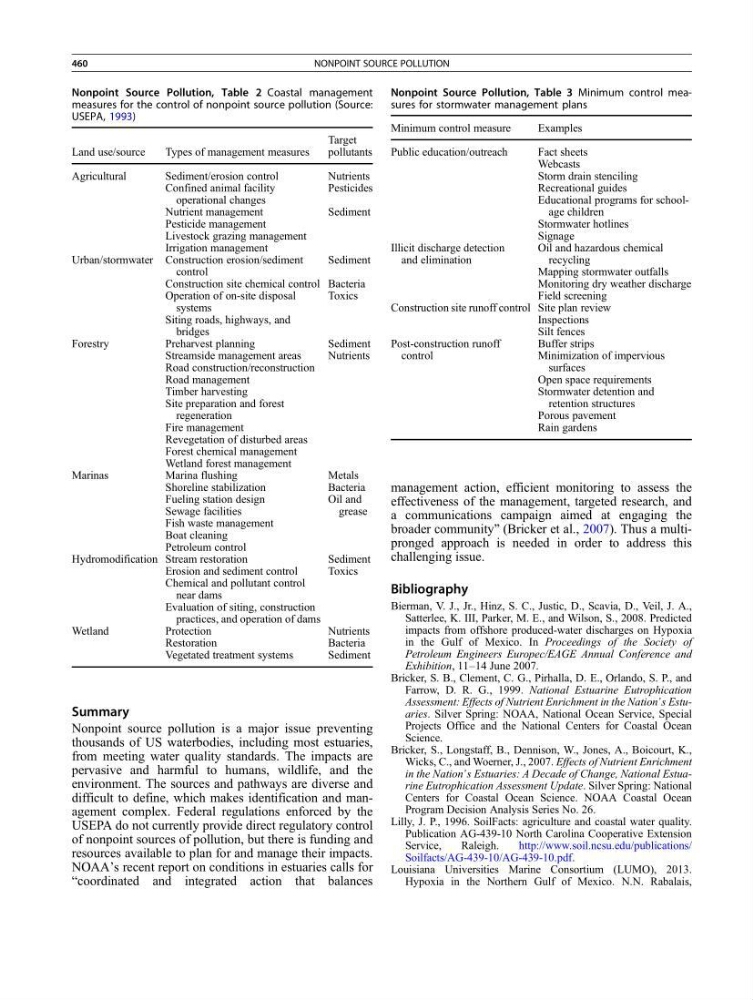
Nonpoint Source Pollution, Table 2 Coastal management
measures for the control of nonpoint source pollution (Source:
USEPA, 1993)
Land use/source
Types of management measures
Target
pollutants
Agricultural
Sediment/erosion control
Nutrients
Confined animal facility
operational changes
Pesticides
Nutrient management
Sediment
Pesticide management
Livestock grazing management
Irrigation management
Urban/stormwater Construction erosion/sediment
control
Sediment
Construction site chemical control Bacteria
Operation of on-site disposal
systems
Toxics
Siting roads, highways, and
bridges
Forestry
Preharvest planning
Sediment
Nutrients
Streamside management areas
Road construction/reconstruction
Road management
Timber harvesting
Site preparation and forest
regeneration
Fire management
Revegetation of disturbed areas
Forest chemical management
Wetland forest management
Marinas
Marina flushing
Metals
Shoreline stabilization
Bacteria
Fueling station design
Oil and
grease
Sewage facilities
Fish waste management
Boat cleaning
Petroleum control
Hydromodification Stream restoration
Sediment
Erosion and sediment control
Toxics
Chemical and pollutant control
near dams
Evaluation of siting, construction
practices, and operation of dams
Wetland
Protection
Nutrients
Restoration
Bacteria
Vegetated treatment systems
Sediment
Nonpoint Source Pollution, Table 3 Minimum control measures for stormwater management plans
Minimum control measure
Examples
Public education/outreach
Fact sheets
Webcasts
Storm drain stenciling
Recreational guides
Educational programs for schoolage children
Stormwater hotlines
Signage
Illicit discharge detection
and elimination
Oil and hazardous chemical
recycling
Mapping stormwater outfalls
Monitoring dry weather discharge
Field screening
Construction site runoff control Site plan review
Inspections
Silt fences
Post-construction runoff
control
Buffer strips
Minimization of impervious
surfaces
Open space requirements
Stormwater detention and
retention structures
Porous pavement
Rain gardens
460
NONPOINT SOURCE POLLUTION
Nonpoint source pollution is a major issue preventing
thousands of US waterbodies, including most estuaries,
from meeting water quality standards. The impacts are
pervasive and harmful to humans, wildlife, and the
environment. The sources and pathways are diverse and
difficult to define, which makes identification and management complex. Federal regulations enforced by the
USEPA do not currently provide direct regulatory control
of nonpoint sources of pollution, but there is funding and
resources available to plan for and manage their impacts.
NOAA’s recent report on conditions in estuaries calls for
“coordinated and integrated action that balances
management action, efficient monitoring to assess the
effectiveness of the management, targeted research, and
a communications campaign aimed at engaging the
broader community” (Bricker et al., 2007). Thus a multipronged approach is needed in order to address this
challenging issue.
Bibliography
Bierman, V. J., Jr., Hinz, S. C., Justic, D., Scavia, D., Veil, J. A.,
Satterlee, K. III, Parker, M. E., and Wilson, S., 2008. Predicted
impacts from offshore produced-water discharges on Hypoxia
in the Gulf of Mexico. In Proceedings of the Society of
Petroleum Engineers Europec/EAGE Annual Conference and
Exhibition, 11–14 June 2007.
Bricker, S. B., Clement, C. G., Pirhalla, D. E., Orlando, S. P., and
Farrow, D. R. G., 1999. National Estuarine Eutrophication
Assessment: Effects of Nutrient Enrichment in the Nation’s Estuaries. Silver Spring: NOAA, National Ocean Service, Special
Projects Office and the National Centers for Coastal Ocean
Science.
Bricker, S., Longstaff, B., Dennison, W., Jones, A., Boicourt, K.,
Wicks, C., and Woerner, J., 2007. Effects of Nutrient Enrichment
in the Nation’s Estuaries: A Decade of Change, National Estuarine Eutrophication Assessment Update. Silver Spring: National
Centers for Coastal Ocean Science. NOAA Coastal Ocean
Program Decision Analysis Series No. 26.
Lilly, J. P., 1996. SoilFacts: agriculture and coastal water quality.
Publication AG-439-10 North Carolina Cooperative Extension
Service,
Raleigh.
http://www.soil.ncsu.edu/publications/
Soilfacts/AG-439-10/AG-439-10.pdf.
Louisiana Universities Marine Consortium (LUMO), 2013.
Hypoxia in the Northern Gulf of Mexico. N.N. Rabalais,
Nonpoint Source Pollution, Table 2 Coastal management
measures for the control of nonpoint source pollution (Source:
USEPA, 1993)
Land use/source
Types of management measures
Target
pollutants
Agricultural
Sediment/erosion control
Nutrients
Confined animal facility
operational changes
Pesticides
Nutrient management
Sediment
Pesticide management
Livestock grazing management
Irrigation management
Urban/stormwater Construction erosion/sediment
control
Sediment
Construction site chemical control Bacteria
Operation of on-site disposal
systems
Toxics
Siting roads, highways, and
bridges
Forestry
Preharvest planning
Sediment
Nutrients
Streamside management areas
Road construction/reconstruction
Road management
Timber harvesting
Site preparation and forest
regeneration
Fire management
Revegetation of disturbed areas
Forest chemical management
Wetland forest management
Marinas
Marina flushing
Metals
Shoreline stabilization
Bacteria
Fueling station design
Oil and
grease
Sewage facilities
Fish waste management
Boat cleaning
Petroleum control
Hydromodification Stream restoration
Sediment
Erosion and sediment control
Toxics
Chemical and pollutant control
near dams
Evaluation of siting, construction
practices, and operation of dams
Wetland
Protection
Nutrients
Restoration
Bacteria
Vegetated treatment systems
Sediment
Nonpoint Source Pollution, Table 3 Minimum control measures for stormwater management plans
Minimum control measure
Examples
Public education/outreach
Fact sheets
Webcasts
Storm drain stenciling
Recreational guides
Educational programs for schoolage children
Stormwater hotlines
Signage
Illicit discharge detection
and elimination
Oil and hazardous chemical
recycling
Mapping stormwater outfalls
Monitoring dry weather discharge
Field screening
Construction site runoff control Site plan review
Inspections
Silt fences
Post-construction runoff
control
Buffer strips
Minimization of impervious
surfaces
Open space requirements
Stormwater detention and
retention structures
Porous pavement
Rain gardens
460
NONPOINT SOURCE POLLUTION