

and morphology, estuaries act as natural sinks for the
watershed that they drain. Their location on the coast
at the intersection of fresh- and saltwater provides a
low-gradient environment with slow-moving water that
gradually gathers runoff from the entire watershed. The
low water velocity in estuaries enables the heavier sediments, and the contaminants bound to them, to settle.
Some sediment is washed out to sea by tidal and current
forces, only to get forced back upstream with the change
in tides and winds. The wide, relatively flat morphology
of estuaries encourages vegetation growth such as algal
mats and eel grass beds that provide additional places for
contaminated sediments to deposit. Lastly, salty water
neutralizes the charge of particles suspended in the estuarine water column, and they are better able to clump
together and settle to the bottom (Oberrecht, 2002). In
addition to natural reasons of vulnerability, the coastal
areas of the USA that are home to estuaries are also the
most densely populated. In 2011, the population density
of US coastal counties was over four times that of the average nationwide density (U.S. Census, 2011). Increased
population places particular pressure on estuarine water
quality since population growth is linked to increased
human activities that create nonpoint source pollution
(Bricker et al., 1999).
Impacts to estuaries (and other waterbodies) from nonpoint source pollution are wide ranging and come from
every type of land use and many human activities
(Table 1). Examples of impacts from nonpoint source
pollution to estuaries include:
• Loss of species abundance
• Loss of species diversity
• Shellfish bed closures
• Swimming beach closures
• Decline in species health
• Fish kills
• Algae blooms (including toxic algae)
• Human disease outbreaks
• Flooding
• Low dissolved oxygen in water (NOAA, 2009)
A study on eutrophication in estuaries, which is due in
large part to nonpoint source pollution, reported that conditions in 65 % of the nation’s estuaries will decline in the
next decade (Bricker et al., 2007). A 1995 survey of shellfish waters in the USA found that 3.5 billion acres, or
nearly one in every seven acres of shellfish beds, were
unable to be harvested due to poor water quality. For over
half of the coastal states included, nonpoint sources were
responsible for more than 95 % of the areas closed to
shellfishing (NOAA, 1996).
Major water quality issues across the country are
caused by nonpoint source pollution in estuaries. Between
2004 and 2008, a hypoxic zone, characterized by dangerously low levels of dissolved oxygen in the northern Gulf
of Mexico estuary, was measured to be, on average,
17,000 km
2 (the size of Lake Ontario; Figure 2). The reason for this catastrophe is the seasonal drop of dissolved
oxygen levels in water to below 2 mg/L, where it is very
difficult for living organisms to survive, and the source
is the runoff from the Mississippi River Basin. Over time,
there has been an increased use of fertilizers on agricultural land and combustion of fossil fuels to produce electricity and drive cars (LUMO, 2013). Although there are
continued point sources of pollution that contribute to
the hypoxic zone, a significant portion of the impact can
be attributed to nonpoint source pollution, including some
of the sources listed above. The result is a drastic increase
in nitrogen and phosphorus that runs off into or is deposited through the atmosphere onto waterbodies and makes
its way into the northern Gulf (Bierman et al., 2008).
Sedimentation and increased turbidity is another very
common impact of nonpoint source pollution. Sedimentation rates in estuaries are naturally high, but human activities have significantly exacerbated the natural rates of
filling through a variety of practices including poor soil
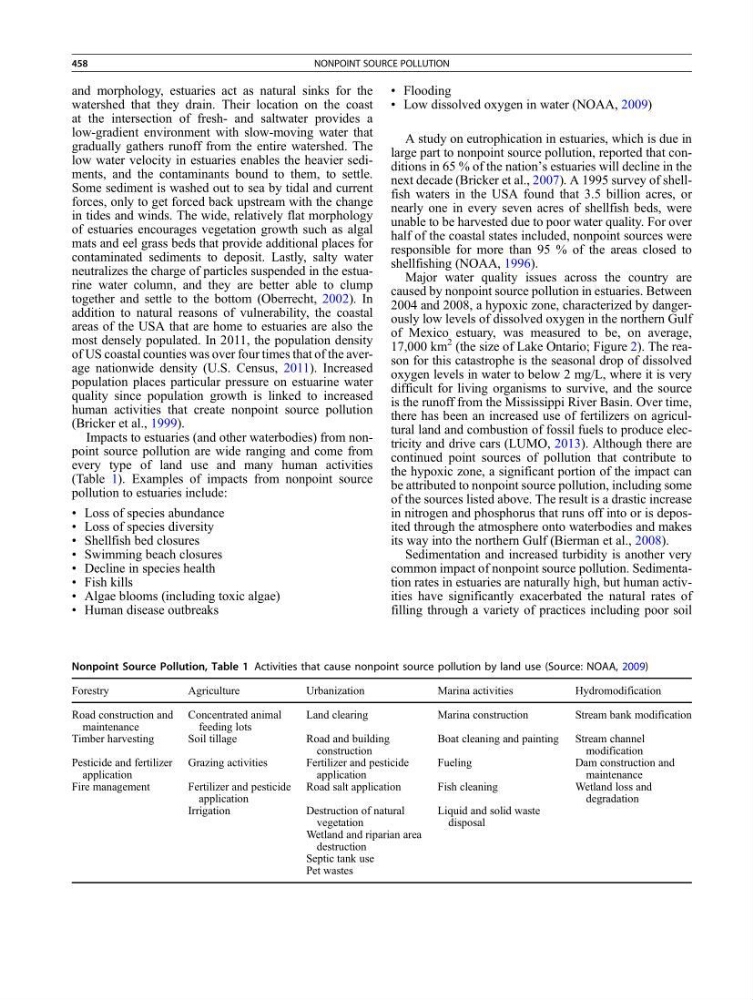
Nonpoint Source Pollution, Table 1 Activities that cause nonpoint source pollution by land use (Source: NOAA, 2009)
Forestry
Agriculture
Urbanization
Marina activities
Hydromodification
Road construction and
maintenance
Concentrated animal
feeding lots
Land clearing
Marina construction
Stream bank modification
Timber harvesting
Soil tillage
Road and building
construction
Boat cleaning and painting Stream channel
modification
Pesticide and fertilizer
application
Grazing activities
Fertilizer and pesticide
application
Fueling
Dam construction and
maintenance
Fire management
Fertilizer and pesticide
application
Road salt application
Fish cleaning
Wetland loss and
degradation
Irrigation
Destruction of natural
vegetation
Liquid and solid waste
disposal
Wetland and riparian area
destruction
Septic tank use
Pet wastes
458
NONPOINT SOURCE POLLUTION
watershed that they drain. Their location on the coast
at the intersection of fresh- and saltwater provides a
low-gradient environment with slow-moving water that
gradually gathers runoff from the entire watershed. The
low water velocity in estuaries enables the heavier sediments, and the contaminants bound to them, to settle.
Some sediment is washed out to sea by tidal and current
forces, only to get forced back upstream with the change
in tides and winds. The wide, relatively flat morphology
of estuaries encourages vegetation growth such as algal
mats and eel grass beds that provide additional places for
contaminated sediments to deposit. Lastly, salty water
neutralizes the charge of particles suspended in the estuarine water column, and they are better able to clump
together and settle to the bottom (Oberrecht, 2002). In
addition to natural reasons of vulnerability, the coastal
areas of the USA that are home to estuaries are also the
most densely populated. In 2011, the population density
of US coastal counties was over four times that of the average nationwide density (U.S. Census, 2011). Increased
population places particular pressure on estuarine water
quality since population growth is linked to increased
human activities that create nonpoint source pollution
(Bricker et al., 1999).
Impacts to estuaries (and other waterbodies) from nonpoint source pollution are wide ranging and come from
every type of land use and many human activities
(Table 1). Examples of impacts from nonpoint source
pollution to estuaries include:
• Loss of species abundance
• Loss of species diversity
• Shellfish bed closures
• Swimming beach closures
• Decline in species health
• Fish kills
• Algae blooms (including toxic algae)
• Human disease outbreaks
• Flooding
• Low dissolved oxygen in water (NOAA, 2009)
A study on eutrophication in estuaries, which is due in
large part to nonpoint source pollution, reported that conditions in 65 % of the nation’s estuaries will decline in the
next decade (Bricker et al., 2007). A 1995 survey of shellfish waters in the USA found that 3.5 billion acres, or
nearly one in every seven acres of shellfish beds, were
unable to be harvested due to poor water quality. For over
half of the coastal states included, nonpoint sources were
responsible for more than 95 % of the areas closed to
shellfishing (NOAA, 1996).
Major water quality issues across the country are
caused by nonpoint source pollution in estuaries. Between
2004 and 2008, a hypoxic zone, characterized by dangerously low levels of dissolved oxygen in the northern Gulf
of Mexico estuary, was measured to be, on average,
17,000 km
2 (the size of Lake Ontario; Figure 2). The reason for this catastrophe is the seasonal drop of dissolved
oxygen levels in water to below 2 mg/L, where it is very
difficult for living organisms to survive, and the source
is the runoff from the Mississippi River Basin. Over time,
there has been an increased use of fertilizers on agricultural land and combustion of fossil fuels to produce electricity and drive cars (LUMO, 2013). Although there are
continued point sources of pollution that contribute to
the hypoxic zone, a significant portion of the impact can
be attributed to nonpoint source pollution, including some
of the sources listed above. The result is a drastic increase
in nitrogen and phosphorus that runs off into or is deposited through the atmosphere onto waterbodies and makes
its way into the northern Gulf (Bierman et al., 2008).
Sedimentation and increased turbidity is another very
common impact of nonpoint source pollution. Sedimentation rates in estuaries are naturally high, but human activities have significantly exacerbated the natural rates of
filling through a variety of practices including poor soil
Nonpoint Source Pollution, Table 1 Activities that cause nonpoint source pollution by land use (Source: NOAA, 2009)
Forestry
Agriculture
Urbanization
Marina activities
Hydromodification
Road construction and
maintenance
Concentrated animal
feeding lots
Land clearing
Marina construction
Stream bank modification
Timber harvesting
Soil tillage
Road and building
construction
Boat cleaning and painting Stream channel
modification
Pesticide and fertilizer
application
Grazing activities
Fertilizer and pesticide
application
Fueling
Dam construction and
maintenance
Fire management
Fertilizer and pesticide
application
Road salt application
Fish cleaning
Wetland loss and
degradation
Irrigation
Destruction of natural
vegetation
Liquid and solid waste
disposal
Wetland and riparian area
destruction
Septic tank use
Pet wastes
458
NONPOINT SOURCE POLLUTION