

Definition
Diffuse source of pollution to receiving waterbodies,
most often in the form of runoff from adjacent land or
atmospheric deposition.
Introduction
Industrial discharge of chemicals, oil spills, raw sewage,
and illegal dumping are the images that come to mind
when most people think of the causes of water pollution.
However, the Clean Water Act and related implementation
of state and local regulations have been largely successful
in eliminating or minimizing this type of discharge to
waterbodies, and water quality improvements have been
significant. Yet, water quality standards are still not being
met in many waterbodies across the country. Today’s
largest threat to water quality in the USA comes from
sources that are much more diffuse and harder to define
or control. Pollution reaches waterbodies from a large
variety of sources, but they can generally be categorized
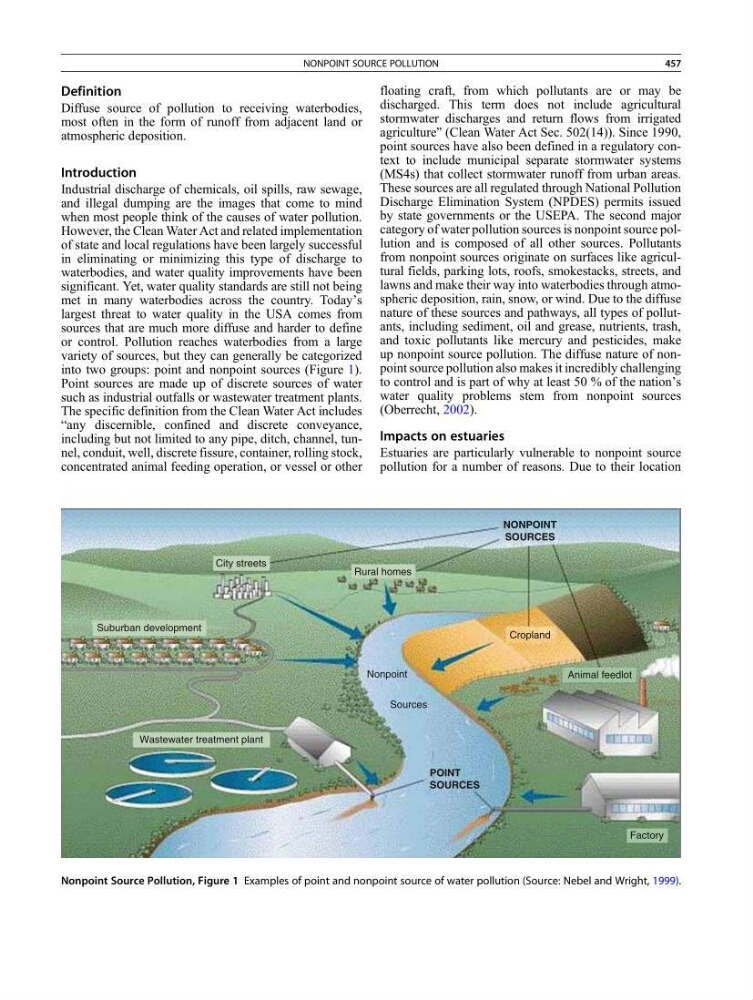
into two groups: point and nonpoint sources (Figure 1).
Point sources are made up of discrete sources of water
such as industrial outfalls or wastewater treatment plants.
The specific definition from the Clean Water Act includes
“any discernible, confined and discrete conveyance,
including but not limited to any pipe, ditch, channel, tunnel, conduit, well, discrete fissure, container, rolling stock,
concentrated animal feeding operation, or vessel or other
floating craft, from which pollutants are or may be
discharged. This term does not include agricultural
stormwater discharges and return flows from irrigated
agriculture” (Clean Water Act Sec. 502(14)). Since 1990,
point sources have also been defined in a regulatory context to include municipal separate stormwater systems
(MS4s) that collect stormwater runoff from urban areas.
These sources are all regulated through National Pollution
Discharge Elimination System (NPDES) permits issued
by state governments or the USEPA. The second major
category of water pollution sources is nonpoint source pollution and is composed of all other sources. Pollutants
from nonpoint sources originate on surfaces like agricultural fields, parking lots, roofs, smokestacks, streets, and
lawns and make their way into waterbodies through atmospheric deposition, rain, snow, or wind. Due to the diffuse
nature of these sources and pathways, all types of pollutants, including sediment, oil and grease, nutrients, trash,
and toxic pollutants like mercury and pesticides, make
up nonpoint source pollution. The diffuse nature of nonpoint source pollution also makes it incredibly challenging
to control and is part of why at least 50 % of the nation’s
water quality problems stem from nonpoint sources
(Oberrecht, 2002).
Impacts on estuaries
Estuaries are particularly vulnerable to nonpoint source
pollution for a number of reasons. Due to their location
Suburban development
City streets
Rural homes
Cropland
Nonpoint
Sources
Animal feedlot
Wastewater treatment plant
Factory
NONPOINT
SOURCES
POINT
SOURCES
Nonpoint Source Pollution, Figure 1 Examples of point and nonpoint source of water pollution (Source: Nebel and Wright, 1999).
NONPOINT SOURCE POLLUTION
457
Diffuse source of pollution to receiving waterbodies,
most often in the form of runoff from adjacent land or
atmospheric deposition.
Introduction
Industrial discharge of chemicals, oil spills, raw sewage,
and illegal dumping are the images that come to mind
when most people think of the causes of water pollution.
However, the Clean Water Act and related implementation
of state and local regulations have been largely successful
in eliminating or minimizing this type of discharge to
waterbodies, and water quality improvements have been
significant. Yet, water quality standards are still not being
met in many waterbodies across the country. Today’s
largest threat to water quality in the USA comes from
sources that are much more diffuse and harder to define
or control. Pollution reaches waterbodies from a large
variety of sources, but they can generally be categorized
into two groups: point and nonpoint sources (Figure 1).
Point sources are made up of discrete sources of water
such as industrial outfalls or wastewater treatment plants.
The specific definition from the Clean Water Act includes
“any discernible, confined and discrete conveyance,
including but not limited to any pipe, ditch, channel, tunnel, conduit, well, discrete fissure, container, rolling stock,
concentrated animal feeding operation, or vessel or other
floating craft, from which pollutants are or may be
discharged. This term does not include agricultural
stormwater discharges and return flows from irrigated
agriculture” (Clean Water Act Sec. 502(14)). Since 1990,
point sources have also been defined in a regulatory context to include municipal separate stormwater systems
(MS4s) that collect stormwater runoff from urban areas.
These sources are all regulated through National Pollution
Discharge Elimination System (NPDES) permits issued
by state governments or the USEPA. The second major
category of water pollution sources is nonpoint source pollution and is composed of all other sources. Pollutants
from nonpoint sources originate on surfaces like agricultural fields, parking lots, roofs, smokestacks, streets, and
lawns and make their way into waterbodies through atmospheric deposition, rain, snow, or wind. Due to the diffuse
nature of these sources and pathways, all types of pollutants, including sediment, oil and grease, nutrients, trash,
and toxic pollutants like mercury and pesticides, make
up nonpoint source pollution. The diffuse nature of nonpoint source pollution also makes it incredibly challenging
to control and is part of why at least 50 % of the nation’s
water quality problems stem from nonpoint sources
(Oberrecht, 2002).
Impacts on estuaries
Estuaries are particularly vulnerable to nonpoint source
pollution for a number of reasons. Due to their location
Suburban development
City streets
Rural homes
Cropland
Nonpoint
Sources
Animal feedlot
Wastewater treatment plant
Factory
NONPOINT
SOURCES
POINT
SOURCES
Nonpoint Source Pollution, Figure 1 Examples of point and nonpoint source of water pollution (Source: Nebel and Wright, 1999).
NONPOINT SOURCE POLLUTION
457