

The dry bulk density, by contrast, denotes the ratio
between the mass of the dry solids and the volume of the
water-saturated sediment sample. It is mathematically
expressed by the relation:
BD d ¼ M d =V t
ð7Þ
where BD d is the dry bulk density (in g cm
À3 or kg m
À3
),
M d the mass of the dry solids (g or kg), and V t as defined
above. In saline environments, a correction for the salt
content in the pore water has to be implemented
(cf. section on “Water content” above). Because the values
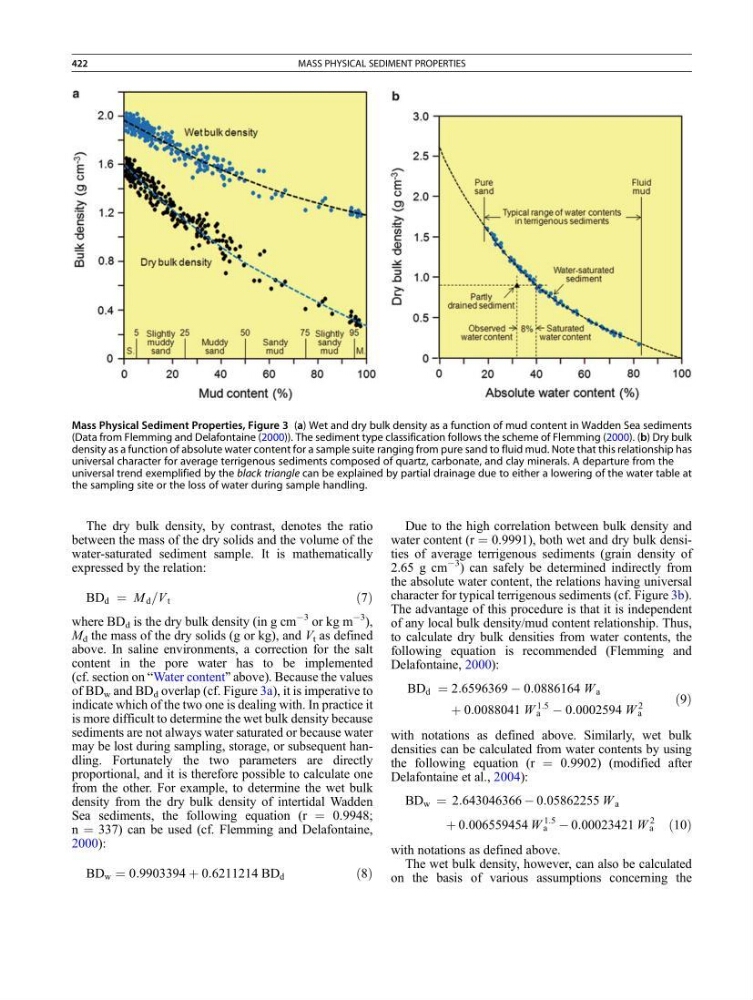
of BD w and BD d overlap (cf. Figure 3a), it is imperative to
indicate which of the two one is dealing with. In practice it
is more difficult to determine the wet bulk density because
sediments are not always water saturated or because water
may be lost during sampling, storage, or subsequent handling. Fortunately the two parameters are directly
proportional, and it is therefore possible to calculate one
from the other. For example, to determine the wet bulk
density from the dry bulk density of intertidal Wadden
Sea sediments, the following equation (r ¼ 0.9948;
n ¼ 337) can be used (cf. Flemming and Delafontaine,
2000):
BD w ¼ 0:9903394 þ 0:6211214 BD d
ð8Þ
Due to the high correlation between bulk density and
water content (r ¼ 0.9991), both wet and dry bulk densities of average terrigenous sediments (grain density of
2.65 g cm
À3
) can safely be determined indirectly from
the absolute water content, the relations having universal
character for typical terrigenous sediments (cf. Figure 3b).
The advantage of this procedure is that it is independent
of any local bulk density/mud content relationship. Thus,
to calculate dry bulk densities from water contents, the
following equation is recommended (Flemming and
Delafontaine, 2000):
BD d ¼ 2:6596369 À 0:0886164 W a
þ 0:0088041 W a
1:5
À 0:0002594 W a
2
ð9Þ
with notations as defined above. Similarly, wet bulk
densities can be calculated from water contents by using
the following equation (r ¼ 0.9902) (modified after
Delafontaine et al., 2004):
BD w ¼ 2:643046366 À 0:05862255 W a
þ 0:006559454 W a
1:5
À 0:00023421 W a
2
ð10Þ
with notations as defined above.
The wet bulk density, however, can also be calculated
on the basis of various assumptions concerning the
Mass Physical Sediment Properties, Figure 3 (a) Wet and dry bulk density as a function of mud content in Wadden Sea sediments
(Data from Flemming and Delafontaine (2000)). The sediment type classification follows the scheme of Flemming (2000). (b) Dry bulk
density as a function of absolute water content for a sample suite ranging from pure sand to fluid mud. Note that this relationship has
universal character for average terrigenous sediments composed of quartz, carbonate, and clay minerals. A departure from the
universal trend exemplified by the black triangle can be explained by partial drainage due to either a lowering of the water table at
the sampling site or the loss of water during sample handling.
422
MASS PHYSICAL SEDIMENT PROPERTIES
between the mass of the dry solids and the volume of the
water-saturated sediment sample. It is mathematically
expressed by the relation:
BD d ¼ M d =V t
ð7Þ
where BD d is the dry bulk density (in g cm
À3 or kg m
À3
),
M d the mass of the dry solids (g or kg), and V t as defined
above. In saline environments, a correction for the salt
content in the pore water has to be implemented
(cf. section on “Water content” above). Because the values
of BD w and BD d overlap (cf. Figure 3a), it is imperative to
indicate which of the two one is dealing with. In practice it
is more difficult to determine the wet bulk density because
sediments are not always water saturated or because water
may be lost during sampling, storage, or subsequent handling. Fortunately the two parameters are directly
proportional, and it is therefore possible to calculate one
from the other. For example, to determine the wet bulk
density from the dry bulk density of intertidal Wadden
Sea sediments, the following equation (r ¼ 0.9948;
n ¼ 337) can be used (cf. Flemming and Delafontaine,
2000):
BD w ¼ 0:9903394 þ 0:6211214 BD d
ð8Þ
Due to the high correlation between bulk density and
water content (r ¼ 0.9991), both wet and dry bulk densities of average terrigenous sediments (grain density of
2.65 g cm
À3
) can safely be determined indirectly from
the absolute water content, the relations having universal
character for typical terrigenous sediments (cf. Figure 3b).
The advantage of this procedure is that it is independent
of any local bulk density/mud content relationship. Thus,
to calculate dry bulk densities from water contents, the
following equation is recommended (Flemming and
Delafontaine, 2000):
BD d ¼ 2:6596369 À 0:0886164 W a
þ 0:0088041 W a
1:5
À 0:0002594 W a
2
ð9Þ
with notations as defined above. Similarly, wet bulk
densities can be calculated from water contents by using
the following equation (r ¼ 0.9902) (modified after
Delafontaine et al., 2004):
BD w ¼ 2:643046366 À 0:05862255 W a
þ 0:006559454 W a
1:5
À 0:00023421 W a
2
ð10Þ
with notations as defined above.
The wet bulk density, however, can also be calculated
on the basis of various assumptions concerning the
Mass Physical Sediment Properties, Figure 3 (a) Wet and dry bulk density as a function of mud content in Wadden Sea sediments
(Data from Flemming and Delafontaine (2000)). The sediment type classification follows the scheme of Flemming (2000). (b) Dry bulk
density as a function of absolute water content for a sample suite ranging from pure sand to fluid mud. Note that this relationship has
universal character for average terrigenous sediments composed of quartz, carbonate, and clay minerals. A departure from the
universal trend exemplified by the black triangle can be explained by partial drainage due to either a lowering of the water table at
the sampling site or the loss of water during sample handling.
422
MASS PHYSICAL SEDIMENT PROPERTIES