

physical nature of the sediment and the water. For this
purpose the following equation can be used:
BD w ¼ r s 1 À j
ð
Þþ r w j
ð
Þ
ð11Þ
where r s is the density of the dry solids, r w the density of
the water, and j the porosity. The procedure for calculating the density of the dry solids has already been introduced (Eq. 5). The porosity is calculated from Eq. (16)
(see below).
Bulk density is an important parameter used for
a variety of purposes, particularly in standing stock and
flux studies where the individual contributions of various
sediment components must be quantified. As will be
shown below, it is in this context that the content versus
concentration issue becomes particularly relevant.
Shear strength
The shear strength of sediment is a measure of the force
required to overcome the internal friction (in sands) or
cohesion between particles (in sand/silt/clay mixtures)
and is commonly measured with an appropriately
calibrated vane shear apparatus. In effect, the instrument
measures the resistance of the sediment to the rotational
force exerted by a calibrated, spring-supported vane
inserted into the sediment. For practical purposes, the
yield force (or yield pressure) can be related to other
parameters such as current shear along the surface of
a sediment body, vertical load forces exerted by objects
rolling, falling, or resting on its surface, or the expulsion
of rising liquids and gases. It can be expressed mathematically as
t ¼ c þ s À u
ð
Þtan f
ð12Þ
where t is the shear strength, measured either as a pressure
(e.g., in kPa) or as a force (e.g., in kg m
À2
), and c is
a measure of cohesion, s the total stress, u the pore water
pressure, and f the angle of internal friction or shearing
resistance.
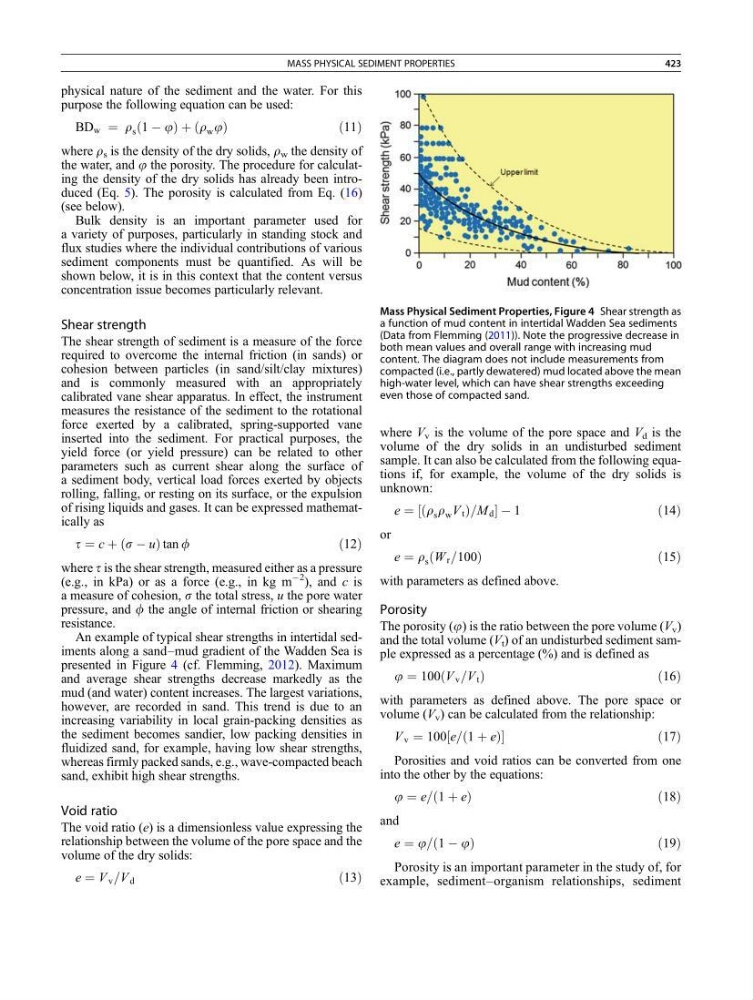
An example of typical shear strengths in intertidal sediments along a sand–mud gradient of the Wadden Sea is
presented in Figure 4 (cf. Flemming, 2012). Maximum
and average shear strengths decrease markedly as the
mud (and water) content increases. The largest variations,
however, are recorded in sand. This trend is due to an
increasing variability in local grain-packing densities as
the sediment becomes sandier, low packing densities in
fluidized sand, for example, having low shear strengths,
whereas firmly packed sands, e.g., wave-compacted beach
sand, exhibit high shear strengths.
Void ratio
The void ratio (e) is a dimensionless value expressing the
relationship between the volume of the pore space and the
volume of the dry solids:
e ¼ V v =V d
ð13Þ
where V v is the volume of the pore space and V d is the
volume of the dry solids in an undisturbed sediment
sample. It can also be calculated from the following equations if, for example, the volume of the dry solids is
unknown:
e ¼ r s r w V t
ð
Þ=M d
½
À 1
ð14Þ
or
e ¼ r s W r =100
ð
Þ
ð 15Þ
with parameters as defined above.
Porosity
The porosity (j) is the ratio between the pore volume (V v )
and the total volume (V t ) of an undisturbed sediment sample expressed as a percentage (%) and is defined as
j ¼ 100 V v =V t
ð
Þ
ð16Þ
with parameters as defined above. The pore space or
volume (V v ) can be calculated from the relationship:
V v ¼ 100 e= 1 þ e
ð
Þ
½
ð 17Þ
Porosities and void ratios can be converted from one
into the other by the equations:
j ¼ e= 1 þ e
ð
Þ
ð18Þ
and
e ¼ j= 1 À j
ð
Þ
ð19Þ
Porosity is an important parameter in the study of, for
example, sediment–organism relationships, sediment
Mass Physical Sediment Properties, Figure 4 Shear strength as
a function of mud content in intertidal Wadden Sea sediments
(Data from Flemming (2011)). Note the progressive decrease in
both mean values and overall range with increasing mud
content. The diagram does not include measurements from
compacted (i.e., partly dewatered) mud located above the mean
high-water level, which can have shear strengths exceeding
even those of compacted sand.
MASS PHYSICAL SEDIMENT PROPERTIES
423
purpose the following equation can be used:
BD w ¼ r s 1 À j
ð
Þþ r w j
ð
Þ
ð11Þ
where r s is the density of the dry solids, r w the density of
the water, and j the porosity. The procedure for calculating the density of the dry solids has already been introduced (Eq. 5). The porosity is calculated from Eq. (16)
(see below).
Bulk density is an important parameter used for
a variety of purposes, particularly in standing stock and
flux studies where the individual contributions of various
sediment components must be quantified. As will be
shown below, it is in this context that the content versus
concentration issue becomes particularly relevant.
Shear strength
The shear strength of sediment is a measure of the force
required to overcome the internal friction (in sands) or
cohesion between particles (in sand/silt/clay mixtures)
and is commonly measured with an appropriately
calibrated vane shear apparatus. In effect, the instrument
measures the resistance of the sediment to the rotational
force exerted by a calibrated, spring-supported vane
inserted into the sediment. For practical purposes, the
yield force (or yield pressure) can be related to other
parameters such as current shear along the surface of
a sediment body, vertical load forces exerted by objects
rolling, falling, or resting on its surface, or the expulsion
of rising liquids and gases. It can be expressed mathematically as
t ¼ c þ s À u
ð
Þtan f
ð12Þ
where t is the shear strength, measured either as a pressure
(e.g., in kPa) or as a force (e.g., in kg m
À2
), and c is
a measure of cohesion, s the total stress, u the pore water
pressure, and f the angle of internal friction or shearing
resistance.
An example of typical shear strengths in intertidal sediments along a sand–mud gradient of the Wadden Sea is
presented in Figure 4 (cf. Flemming, 2012). Maximum
and average shear strengths decrease markedly as the
mud (and water) content increases. The largest variations,
however, are recorded in sand. This trend is due to an
increasing variability in local grain-packing densities as
the sediment becomes sandier, low packing densities in
fluidized sand, for example, having low shear strengths,
whereas firmly packed sands, e.g., wave-compacted beach
sand, exhibit high shear strengths.
Void ratio
The void ratio (e) is a dimensionless value expressing the
relationship between the volume of the pore space and the
volume of the dry solids:
e ¼ V v =V d
ð13Þ
where V v is the volume of the pore space and V d is the
volume of the dry solids in an undisturbed sediment
sample. It can also be calculated from the following equations if, for example, the volume of the dry solids is
unknown:
e ¼ r s r w V t
ð
Þ=M d
½
À 1
ð14Þ
or
e ¼ r s W r =100
ð
Þ
ð 15Þ
with parameters as defined above.
Porosity
The porosity (j) is the ratio between the pore volume (V v )
and the total volume (V t ) of an undisturbed sediment sample expressed as a percentage (%) and is defined as
j ¼ 100 V v =V t
ð
Þ
ð16Þ
with parameters as defined above. The pore space or
volume (V v ) can be calculated from the relationship:
V v ¼ 100 e= 1 þ e
ð
Þ
½
ð 17Þ
Porosities and void ratios can be converted from one
into the other by the equations:
j ¼ e= 1 þ e
ð
Þ
ð18Þ
and
e ¼ j= 1 À j
ð
Þ
ð19Þ
Porosity is an important parameter in the study of, for
example, sediment–organism relationships, sediment
Mass Physical Sediment Properties, Figure 4 Shear strength as
a function of mud content in intertidal Wadden Sea sediments
(Data from Flemming (2011)). Note the progressive decrease in
both mean values and overall range with increasing mud
content. The diagram does not include measurements from
compacted (i.e., partly dewatered) mud located above the mean
high-water level, which can have shear strengths exceeding
even those of compacted sand.
MASS PHYSICAL SEDIMENT PROPERTIES
423