

It should be noted, however, that in other environments the
relations between bulk density and mud content may
depart from the illustrated example due to regional differences in the grain-size composition of the mud fraction
(silt/clay ratios) and/or changing water contents due to variable degrees of sediment compaction.
Estuarine sediments are commonly composed of terrigenous minerals such as quartz, carbonates, and clay which
all have similar densities (of ca. 2.65 g cm
À3
). Thus, if the
mineral composition is not known, the average grain density (r s ) of the dry solids can be calculated from the
relationship:
r s ¼ M d =V d
ð5Þ
where M d is the mass of the dry solids and V d is the volume
of the dry solids. This is a good cross-check by which
unusual mineral compositions, e.g., exceptionally high
heavy mineral content, can be detected.
The wet bulk density denotes the ratio between the total
mass of a water-saturated sample and the volume of the
water-saturated sediment, which is mathematically
expressed by the relation:
BD w ¼ M t =V t
ð6Þ
where BD w is the wet bulk density (in g cm
À3 or kg m
À3
),
M t the total mass of the water-saturated sediment sample
(g or kg), and V t the volume of the water-saturated
sediment.
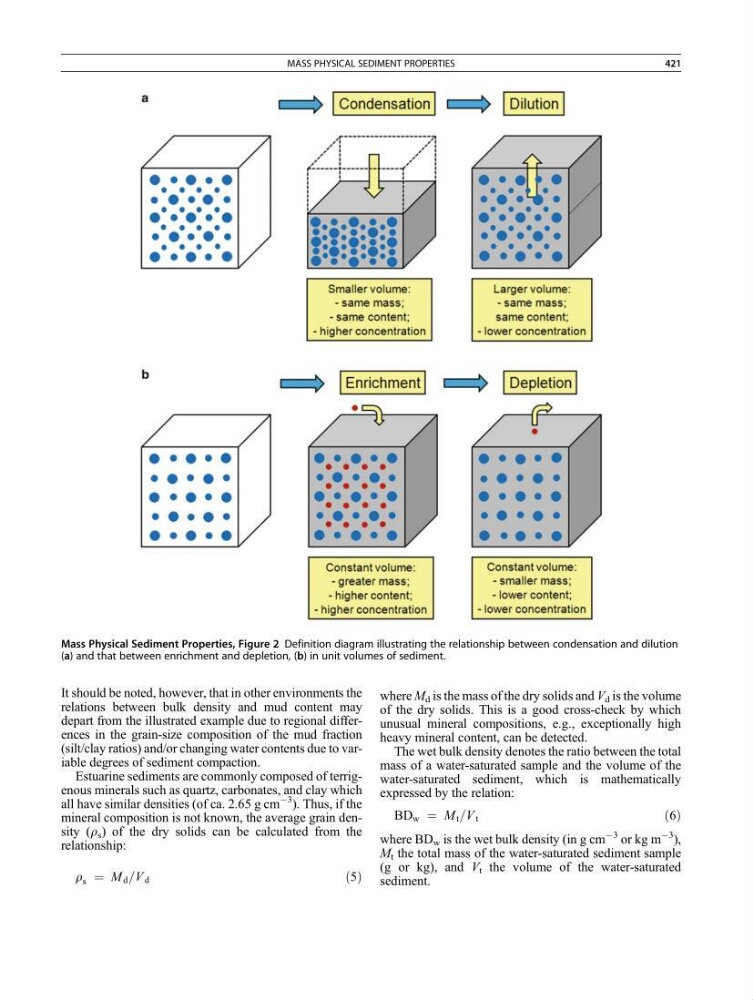
Mass Physical Sediment Properties, Figure 2 Definition diagram illustrating the relationship between condensation and dilution
(a) and that between enrichment and depletion, (b) in unit volumes of sediment.
MASS PHYSICAL SEDIMENT PROPERTIES
421
relations between bulk density and mud content may
depart from the illustrated example due to regional differences in the grain-size composition of the mud fraction
(silt/clay ratios) and/or changing water contents due to variable degrees of sediment compaction.
Estuarine sediments are commonly composed of terrigenous minerals such as quartz, carbonates, and clay which
all have similar densities (of ca. 2.65 g cm
À3
). Thus, if the
mineral composition is not known, the average grain density (r s ) of the dry solids can be calculated from the
relationship:
r s ¼ M d =V d
ð5Þ
where M d is the mass of the dry solids and V d is the volume
of the dry solids. This is a good cross-check by which
unusual mineral compositions, e.g., exceptionally high
heavy mineral content, can be detected.
The wet bulk density denotes the ratio between the total
mass of a water-saturated sample and the volume of the
water-saturated sediment, which is mathematically
expressed by the relation:
BD w ¼ M t =V t
ð6Þ
where BD w is the wet bulk density (in g cm
À3 or kg m
À3
),
M t the total mass of the water-saturated sediment sample
(g or kg), and V t the volume of the water-saturated
sediment.
Mass Physical Sediment Properties, Figure 2 Definition diagram illustrating the relationship between condensation and dilution
(a) and that between enrichment and depletion, (b) in unit volumes of sediment.
MASS PHYSICAL SEDIMENT PROPERTIES
421