

in volume (Figure 2a), the process being known as
condensation. The opposite process is known as dilution,
the concentration now decreasing, while the content again
remains unchanged. Thus, material contents will only
change if a solid substance is added to or removed from
the sediment, e.g., the precipitation or selective dissolution of carbonate from a quartz–carbonate mixture. These
mechanisms, respectively, are known as enrichment and
depletion of the sediment in a particular substance
(Figure 2b), the latter process being also known as impoverishment. Such changes in content are automatically
accompanied by changes in concentration. The important
message here is that condensation does not result in
enrichment and dilution not in depletion.
Parameter definitions
Water content
The water content refers to the amount of interstitial fluid
contained in a unit mass of water-saturated sediment. If the
sediment is not saturated with water (e.g., in drained or
partly drained intertidal sands), one would speak of the
moisture or residual water content. In the case of watersaturated sediments, two types of water content measures
have to be distinguished, i.e., the absolute water content
and the relative water content.
The absolute water content is defined as the mass of water
relative to the total mass of a water-saturated sample.
This ratio is generally expressed as a percentage value
(weight %), which is mathematically expressed as:
W a ¼ 100 M w =M t
ð
Þ
ð 1Þ
where W a is the absolute water content (weight %), M w the
mass of the pore water (mg, g, or kg), and M t the total mass
of the water-saturated sample (mg, g, or kg). In this
approach the percent water content is always <100 %.
The relative water content, by contrast, is defined as the
mass of water relative to the mass of the dry solids in the
sample. This ratio is commonly also expressed as a
percentage value (weight %) and is mathematically
expressed as:
W r ¼ 100 M w =M d
ð
Þ
ð 2Þ
where W r is the relative water content (weight %), M w the
mass of the pore water, and M d the mass of the dry solids in
the sample. In contrast to the absolute water content, the
relative water content can reach values >100 %, if the
mass of the pore water exceeds the mass of the dry solids,
as is commonly the case in soft mud. In fluid mud, for
example, the relative water content can be as high as
500 %. Because relative water contents <100 % can be
confused with absolute water contents, it is imperative to
always indicate the type of measurement.
In environments characterized by saline waters, as
is the case in most estuaries, the determination of water
content by weight loss after drying needs to be corrected
for the mass added by the precipitated salt. In the case of
absolute water content, the procedure is mathematically
expressed as:
W a ¼ 100 M t À M d
ð
Þ = M d À rM t
ð
Þ
½
ð 3Þ
where r is the mass of salt in the pore water of the unit
sediment volume, and other parameters as defined above.
In the case of relative water content, the corresponding
equation is:
W r ¼ 100 M t À M d
ð
Þ1 þ r
ð
Þ=M t
½
ð 4Þ
with parameters as defined above.
Bulk density
The bulk density of sediment (also known as “unit density”
in geotechnology) denotes the mass per unit volume of
sediment. It is an indication of the degree to which the sediment is permeated by voids (pore space) relative to the
volume of the solids. Bulk density is normally determined
by sampling a constant volume of sediment and relating it
to the measured mass of the solids. In aqueous environments, the bulk density can include the pore water, in
which case we speak of wet bulk density, or it can exclude
the pore water, in which case we speak of dry bulk density.
An example of the trends defined by both wet and dry bulk
density as a function of mud content for Wadden Sea sediments is illustrated in Figure 3a (modified after Flemming
and Delafontaine, 2000; Delafontaine et al., 2004).
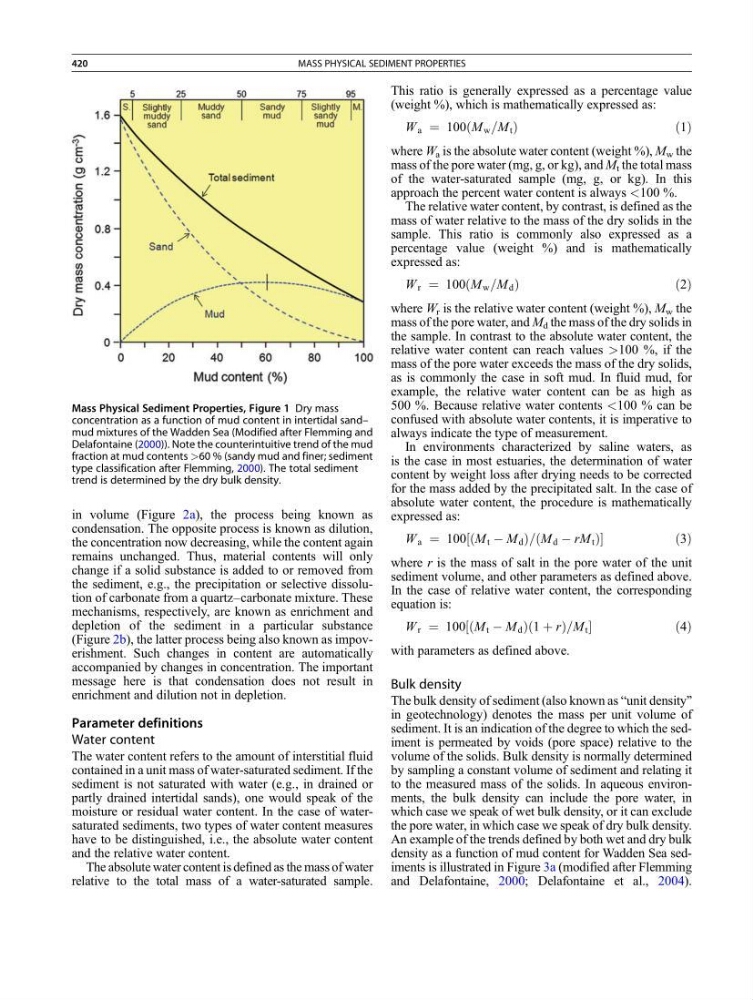
Mass Physical Sediment Properties, Figure 1 Dry mass
concentration as a function of mud content in intertidal sand–
mud mixtures of the Wadden Sea (Modified after Flemming and
Delafontaine (2000)). Note the counterintuitive trend of the mud
fraction at mud contents >60 % (sandy mud and finer; sediment
type classification after Flemming, 2000). The total sediment
trend is determined by the dry bulk density.
420
MASS PHYSICAL SEDIMENT PROPERTIES
condensation. The opposite process is known as dilution,
the concentration now decreasing, while the content again
remains unchanged. Thus, material contents will only
change if a solid substance is added to or removed from
the sediment, e.g., the precipitation or selective dissolution of carbonate from a quartz–carbonate mixture. These
mechanisms, respectively, are known as enrichment and
depletion of the sediment in a particular substance
(Figure 2b), the latter process being also known as impoverishment. Such changes in content are automatically
accompanied by changes in concentration. The important
message here is that condensation does not result in
enrichment and dilution not in depletion.
Parameter definitions
Water content
The water content refers to the amount of interstitial fluid
contained in a unit mass of water-saturated sediment. If the
sediment is not saturated with water (e.g., in drained or
partly drained intertidal sands), one would speak of the
moisture or residual water content. In the case of watersaturated sediments, two types of water content measures
have to be distinguished, i.e., the absolute water content
and the relative water content.
The absolute water content is defined as the mass of water
relative to the total mass of a water-saturated sample.
This ratio is generally expressed as a percentage value
(weight %), which is mathematically expressed as:
W a ¼ 100 M w =M t
ð
Þ
ð 1Þ
where W a is the absolute water content (weight %), M w the
mass of the pore water (mg, g, or kg), and M t the total mass
of the water-saturated sample (mg, g, or kg). In this
approach the percent water content is always <100 %.
The relative water content, by contrast, is defined as the
mass of water relative to the mass of the dry solids in the
sample. This ratio is commonly also expressed as a
percentage value (weight %) and is mathematically
expressed as:
W r ¼ 100 M w =M d
ð
Þ
ð 2Þ
where W r is the relative water content (weight %), M w the
mass of the pore water, and M d the mass of the dry solids in
the sample. In contrast to the absolute water content, the
relative water content can reach values >100 %, if the
mass of the pore water exceeds the mass of the dry solids,
as is commonly the case in soft mud. In fluid mud, for
example, the relative water content can be as high as
500 %. Because relative water contents <100 % can be
confused with absolute water contents, it is imperative to
always indicate the type of measurement.
In environments characterized by saline waters, as
is the case in most estuaries, the determination of water
content by weight loss after drying needs to be corrected
for the mass added by the precipitated salt. In the case of
absolute water content, the procedure is mathematically
expressed as:
W a ¼ 100 M t À M d
ð
Þ = M d À rM t
ð
Þ
½
ð 3Þ
where r is the mass of salt in the pore water of the unit
sediment volume, and other parameters as defined above.
In the case of relative water content, the corresponding
equation is:
W r ¼ 100 M t À M d
ð
Þ1 þ r
ð
Þ=M t
½
ð 4Þ
with parameters as defined above.
Bulk density
The bulk density of sediment (also known as “unit density”
in geotechnology) denotes the mass per unit volume of
sediment. It is an indication of the degree to which the sediment is permeated by voids (pore space) relative to the
volume of the solids. Bulk density is normally determined
by sampling a constant volume of sediment and relating it
to the measured mass of the solids. In aqueous environments, the bulk density can include the pore water, in
which case we speak of wet bulk density, or it can exclude
the pore water, in which case we speak of dry bulk density.
An example of the trends defined by both wet and dry bulk
density as a function of mud content for Wadden Sea sediments is illustrated in Figure 3a (modified after Flemming
and Delafontaine, 2000; Delafontaine et al., 2004).
Mass Physical Sediment Properties, Figure 1 Dry mass
concentration as a function of mud content in intertidal sand–
mud mixtures of the Wadden Sea (Modified after Flemming and
Delafontaine (2000)). Note the counterintuitive trend of the mud
fraction at mud contents >60 % (sandy mud and finer; sediment
type classification after Flemming, 2000). The total sediment
trend is determined by the dry bulk density.
420
MASS PHYSICAL SEDIMENT PROPERTIES