

Some of the hydrodynamic processes that result in
changes of elevation to the surface estuarine water
(specifically tidal propagation, river freshwater inflow,
and the Coriolis acceleration) are subsumed under the
term “barotropic pressure” (Feireisl, 2004). Barotropic
pressure gradients drive flow and hence mixing. Horizontal changes in density that can result in density-driven
flows are subsumed under the term “baroclinic pressure
gradient” (Li et al., 1998; Simons et al., 2010).
The mixing of the various water bodies in estuaries is
more easily viewed from the perspectives of major and
subsidiary or minor contributing processes. The major
processes involved in mixing the water types are tides,
river flow, and wind. Here, for tides and river flow, the
effectiveness of mixing is directly determined by the comparative magnitudes of tidal and river fluxes and their
interactions and of the duration and strength of river flow.
Daily tidal influx delivers marine water that commonly
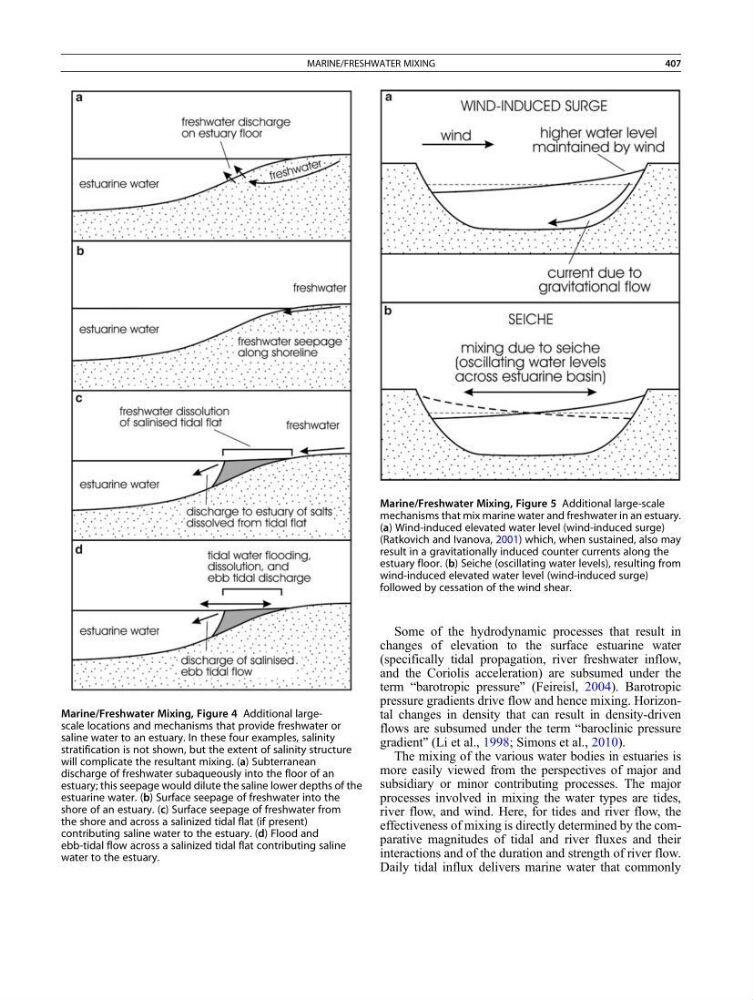
Marine/Freshwater Mixing, Figure 4 Additional largescale locations and mechanisms that provide freshwater or
saline water to an estuary. In these four examples, salinity
stratification is not shown, but the extent of salinity structure
will complicate the resultant mixing. (a) Subterranean
discharge of freshwater subaqueously into the floor of an
estuary; this seepage would dilute the saline lower depths of the
estuarine water. (b) Surface seepage of freshwater into the
shore of an estuary. (c) Surface seepage of freshwater from
the shore and across a salinized tidal flat (if present)
contributing saline water to the estuary. (d) Flood and
ebb-tidal flow across a salinized tidal flat contributing saline
water to the estuary.
Marine/Freshwater Mixing, Figure 5 Additional large-scale
mechanisms that mix marine water and freshwater in an estuary.
(a) Wind-induced elevated water level (wind-induced surge)
(Ratkovich and Ivanova, 2001) which, when sustained, also may
result in a gravitationally induced counter currents along the
estuary floor. (b) Seiche (oscillating water levels), resulting from
wind-induced elevated water level (wind-induced surge)
followed by cessation of the wind shear.
MARINE/FRESHWATER MIXING
407
changes of elevation to the surface estuarine water
(specifically tidal propagation, river freshwater inflow,
and the Coriolis acceleration) are subsumed under the
term “barotropic pressure” (Feireisl, 2004). Barotropic
pressure gradients drive flow and hence mixing. Horizontal changes in density that can result in density-driven
flows are subsumed under the term “baroclinic pressure
gradient” (Li et al., 1998; Simons et al., 2010).
The mixing of the various water bodies in estuaries is
more easily viewed from the perspectives of major and
subsidiary or minor contributing processes. The major
processes involved in mixing the water types are tides,
river flow, and wind. Here, for tides and river flow, the
effectiveness of mixing is directly determined by the comparative magnitudes of tidal and river fluxes and their
interactions and of the duration and strength of river flow.
Daily tidal influx delivers marine water that commonly
Marine/Freshwater Mixing, Figure 4 Additional largescale locations and mechanisms that provide freshwater or
saline water to an estuary. In these four examples, salinity
stratification is not shown, but the extent of salinity structure
will complicate the resultant mixing. (a) Subterranean
discharge of freshwater subaqueously into the floor of an
estuary; this seepage would dilute the saline lower depths of the
estuarine water. (b) Surface seepage of freshwater into the
shore of an estuary. (c) Surface seepage of freshwater from
the shore and across a salinized tidal flat (if present)
contributing saline water to the estuary. (d) Flood and
ebb-tidal flow across a salinized tidal flat contributing saline
water to the estuary.
Marine/Freshwater Mixing, Figure 5 Additional large-scale
mechanisms that mix marine water and freshwater in an estuary.
(a) Wind-induced elevated water level (wind-induced surge)
(Ratkovich and Ivanova, 2001) which, when sustained, also may
result in a gravitationally induced counter currents along the
estuary floor. (b) Seiche (oscillating water levels), resulting from
wind-induced elevated water level (wind-induced surge)
followed by cessation of the wind shear.
MARINE/FRESHWATER MIXING
407