

penetrates the estuary as a salt wedge under a freshwater
layer. Alternate flooding and ebbing of the tide, and penetration into and under the freshwater, causes the saltwater/
freshwater interface to alternate and change level resulting
in mixing of the two water bodies.
The next major process is river flow, and, depending on
the strength of the river, freshwater is injected into the
estuary to varying degrees. At one extreme it may be
injected as far as the seaward mouth of the estuary, rendering the entire estuary brackish or fresh. With strong river
flow, and tidal ranges of lower magnitudes, freshwater
flows over a deeper layer of more dense seawater.
The relationship of tidal magnitude and river flow and
the resulting estuarine mixing and estuarine salinity structure is treated descriptively and mathematically by Haas
(1977), Geyer and Farmer (1989), and MacCready (1999).
Wind is the third major process involved in mixing the
water types within an estuary. It is particularly important
where estuaries are microtidal and the tides are less effective in driving the mixing of water bodies. With adequate
fetch and strong winds, major horizontal circulation patterns may be established which can crosscut salinity
plumes and salinity gradients resulting in cross-estuary
mixing. Strong winds can also result in surges which, with
elevated water levels along a shore, result in gravitationally induced return-flow basal currents. If derived from
low-salinity near-surface water, these flows descend as
anomalous lower-salinity plumes into deeper water.
Wind-induced surges can also lead to seiching (Jackson,
1833; Ratkovich and Ivanova, 2001; Luettich et al.,
2002), which results in cross-estuary mixing. Depending
on the size and depth of the estuary, horizontal wind currents can induce Ekman flow and hence also vertical
mixing (Gross, 1972). Finally, wind can result in windinduced surface water cooling and gravitational sinking
of the cooler surface layer with a resulting vertical circulation/convection.
Other relatively more minor processes involved in
mixing of estuarine water include shoreline freshwater
seepage (where freshwater discharges from the uplands
along the shore) and sub-estuarine or subaqueous freshwater seepage into shallow water (where freshwater discharges from the uplands into aquifers which convey it
into the subaqueous environment). If the subaqueous
freshwater discharge from the estuary floor enters more
saline water, the buoyancy of the freshwater creates
a plume to the surface of the estuarine water body and
contributes to local mixing.
Where salinized water from tidal flats and tidal creeks
enters estuarine water of lower salinity, the local saline
water density-driven flows can result in local mixing.
Sources of local salinized water can arise in several ways.
Estuarine tidal flats can become salinized during exposure
during neap tides or low spring tides, and freshwater runoff from the uplands, crossing these salinized tidal flats,
becomes salinized and delivers salty water to the estuary.
Similarly, tidal flooding, dissolution, and ebb-tidal flow
of tidal waters across salinized tidal flats deliver saltenriched water to the estuary on the ebb tide. Tidal creeks
draining and ebbing from salinized tidal flats can deliver
salt-enriched water in plumes to the estuary.
Wind cooling of estuarine surface waters can result in
temperature-determined density-driven flows where surface waters, sufficiently cooled, gravitationally descend
to warmer parts of the estuarine water body resulting in
the mixing of water bodies. Mixing also is effected by
density-driven flows resulting where turbid freshwater,
laden with suspended mud, is delivered by a river to the
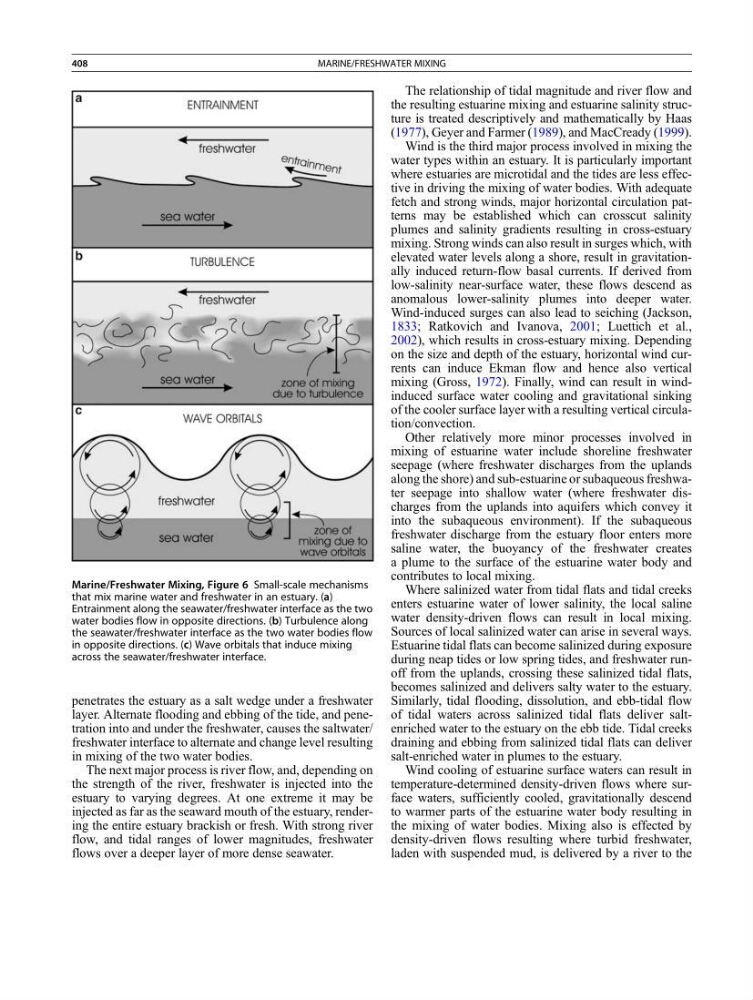
Marine/Freshwater Mixing, Figure 6 Small-scale mechanisms
that mix marine water and freshwater in an estuary. (a)
Entrainment along the seawater/freshwater interface as the two
water bodies flow in opposite directions. (b) Turbulence along
the seawater/freshwater interface as the two water bodies flow
in opposite directions. (c) Wave orbitals that induce mixing
across the seawater/freshwater interface.
408
MARINE/FRESHWATER MIXING
layer. Alternate flooding and ebbing of the tide, and penetration into and under the freshwater, causes the saltwater/
freshwater interface to alternate and change level resulting
in mixing of the two water bodies.
The next major process is river flow, and, depending on
the strength of the river, freshwater is injected into the
estuary to varying degrees. At one extreme it may be
injected as far as the seaward mouth of the estuary, rendering the entire estuary brackish or fresh. With strong river
flow, and tidal ranges of lower magnitudes, freshwater
flows over a deeper layer of more dense seawater.
The relationship of tidal magnitude and river flow and
the resulting estuarine mixing and estuarine salinity structure is treated descriptively and mathematically by Haas
(1977), Geyer and Farmer (1989), and MacCready (1999).
Wind is the third major process involved in mixing the
water types within an estuary. It is particularly important
where estuaries are microtidal and the tides are less effective in driving the mixing of water bodies. With adequate
fetch and strong winds, major horizontal circulation patterns may be established which can crosscut salinity
plumes and salinity gradients resulting in cross-estuary
mixing. Strong winds can also result in surges which, with
elevated water levels along a shore, result in gravitationally induced return-flow basal currents. If derived from
low-salinity near-surface water, these flows descend as
anomalous lower-salinity plumes into deeper water.
Wind-induced surges can also lead to seiching (Jackson,
1833; Ratkovich and Ivanova, 2001; Luettich et al.,
2002), which results in cross-estuary mixing. Depending
on the size and depth of the estuary, horizontal wind currents can induce Ekman flow and hence also vertical
mixing (Gross, 1972). Finally, wind can result in windinduced surface water cooling and gravitational sinking
of the cooler surface layer with a resulting vertical circulation/convection.
Other relatively more minor processes involved in
mixing of estuarine water include shoreline freshwater
seepage (where freshwater discharges from the uplands
along the shore) and sub-estuarine or subaqueous freshwater seepage into shallow water (where freshwater discharges from the uplands into aquifers which convey it
into the subaqueous environment). If the subaqueous
freshwater discharge from the estuary floor enters more
saline water, the buoyancy of the freshwater creates
a plume to the surface of the estuarine water body and
contributes to local mixing.
Where salinized water from tidal flats and tidal creeks
enters estuarine water of lower salinity, the local saline
water density-driven flows can result in local mixing.
Sources of local salinized water can arise in several ways.
Estuarine tidal flats can become salinized during exposure
during neap tides or low spring tides, and freshwater runoff from the uplands, crossing these salinized tidal flats,
becomes salinized and delivers salty water to the estuary.
Similarly, tidal flooding, dissolution, and ebb-tidal flow
of tidal waters across salinized tidal flats deliver saltenriched water to the estuary on the ebb tide. Tidal creeks
draining and ebbing from salinized tidal flats can deliver
salt-enriched water in plumes to the estuary.
Wind cooling of estuarine surface waters can result in
temperature-determined density-driven flows where surface waters, sufficiently cooled, gravitationally descend
to warmer parts of the estuarine water body resulting in
the mixing of water bodies. Mixing also is effected by
density-driven flows resulting where turbid freshwater,
laden with suspended mud, is delivered by a river to the
Marine/Freshwater Mixing, Figure 6 Small-scale mechanisms
that mix marine water and freshwater in an estuary. (a)
Entrainment along the seawater/freshwater interface as the two
water bodies flow in opposite directions. (b) Turbulence along
the seawater/freshwater interface as the two water bodies flow
in opposite directions. (c) Wave orbitals that induce mixing
across the seawater/freshwater interface.
408
MARINE/FRESHWATER MIXING