

18. Bathymetry-induced and plan-geometry-induced
eddying
19. Horizontal mixing driven by interaction of flood tidal
water and outflowing freshwater
20. Mixing by Coriolis force
At the finer scales, across the saltwater/freshwater interface, there is (1) entrainment, (2) turbulence, and (3) wavedriven (wave orbital) vertical mixing. Intermittent and
infrequent events such as storms and cyclones can also
induce mixing especially at the seaward portion of an
estuary.
Not all the processes that drive mixing are present in all
estuaries. The extent that a process is effective is dependent
on the size of the estuary (in that some of the mixing mechanisms operate best in large estuaries), bathymetry of the
estuary (in that complex bathymetry can result in complex
mixing and eddying), plan geometry of the estuary (in that
complex planar geometry results in complexity in mixing),
tidal range, rainfall in the catchment area of the contributing
river(s) (which will determine the volume and consistency
of freshwater delivery), the wind patterns and strengths
(which determine the importance of wind-driven circulation
and of intra-estuarine wave trains), and the climate (that
influences the amount of evaporation that will salinize the
estuary or its tidal flats).
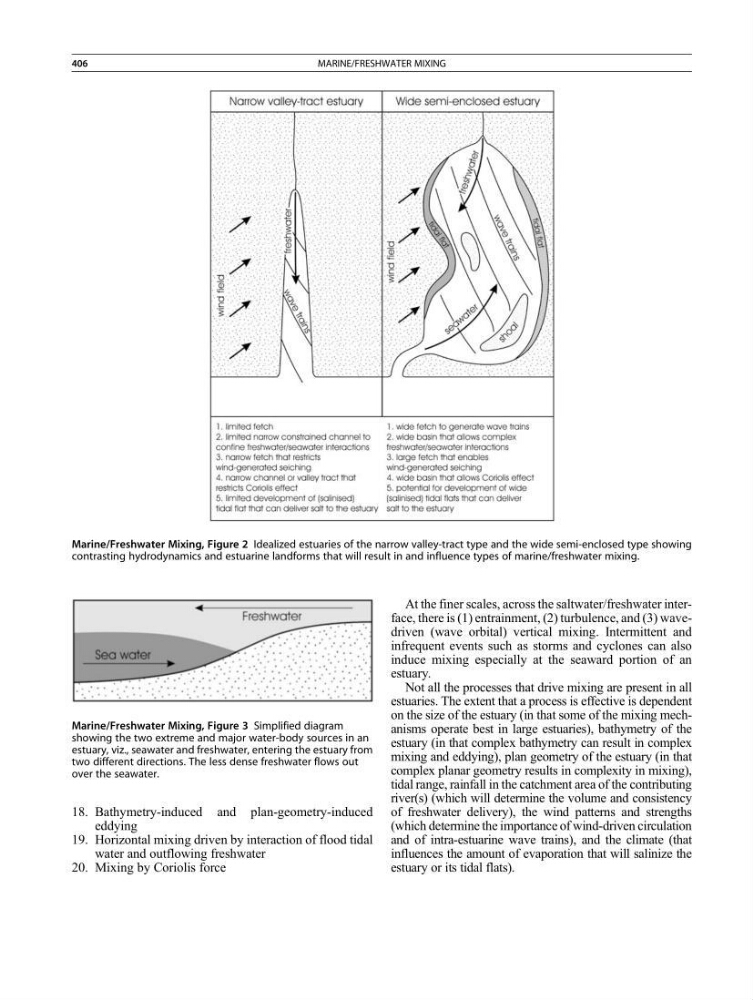
Marine/Freshwater Mixing, Figure 2 Idealized estuaries of the narrow valley-tract type and the wide semi-enclosed type showing
contrasting hydrodynamics and estuarine landforms that will result in and influence types of marine/freshwater mixing.
Marine/Freshwater Mixing, Figure 3 Simplified diagram
showing the two extreme and major water-body sources in an
estuary, viz., seawater and freshwater, entering the estuary from
two different directions. The less dense freshwater flows out
over the seawater.
406
MARINE/FRESHWATER MIXING
eddying
19. Horizontal mixing driven by interaction of flood tidal
water and outflowing freshwater
20. Mixing by Coriolis force
At the finer scales, across the saltwater/freshwater interface, there is (1) entrainment, (2) turbulence, and (3) wavedriven (wave orbital) vertical mixing. Intermittent and
infrequent events such as storms and cyclones can also
induce mixing especially at the seaward portion of an
estuary.
Not all the processes that drive mixing are present in all
estuaries. The extent that a process is effective is dependent
on the size of the estuary (in that some of the mixing mechanisms operate best in large estuaries), bathymetry of the
estuary (in that complex bathymetry can result in complex
mixing and eddying), plan geometry of the estuary (in that
complex planar geometry results in complexity in mixing),
tidal range, rainfall in the catchment area of the contributing
river(s) (which will determine the volume and consistency
of freshwater delivery), the wind patterns and strengths
(which determine the importance of wind-driven circulation
and of intra-estuarine wave trains), and the climate (that
influences the amount of evaporation that will salinize the
estuary or its tidal flats).
Marine/Freshwater Mixing, Figure 2 Idealized estuaries of the narrow valley-tract type and the wide semi-enclosed type showing
contrasting hydrodynamics and estuarine landforms that will result in and influence types of marine/freshwater mixing.
Marine/Freshwater Mixing, Figure 3 Simplified diagram
showing the two extreme and major water-body sources in an
estuary, viz., seawater and freshwater, entering the estuary from
two different directions. The less dense freshwater flows out
over the seawater.
406
MARINE/FRESHWATER MIXING