

The salinity of an estuary and the mixing within it are
also affected by processes and factors beyond just the
seesawing of seawater influx and riverine water outflow
and can involve hydrodynamics driven by wind, waves,
seiching, and evaporation, among others, and different
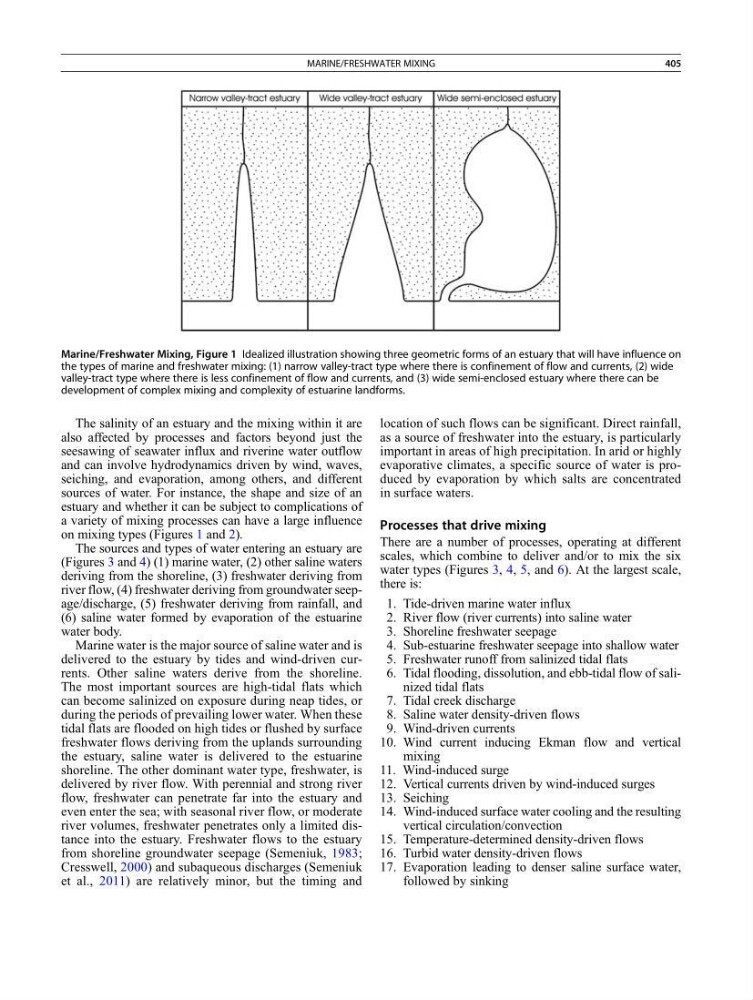
sources of water. For instance, the shape and size of an
estuary and whether it can be subject to complications of
a variety of mixing processes can have a large influence
on mixing types (Figures 1 and 2).
The sources and types of water entering an estuary are
(Figures 3 and 4) (1) marine water, (2) other saline waters
deriving from the shoreline, (3) freshwater deriving from
river flow, (4) freshwater deriving from groundwater seepage/discharge, (5) freshwater deriving from rainfall, and
(6) saline water formed by evaporation of the estuarine
water body.
Marine water is the major source of saline water and is
delivered to the estuary by tides and wind-driven currents. Other saline waters derive from the shoreline.
The most important sources are high-tidal flats which
can become salinized on exposure during neap tides, or
during the periods of prevailing lower water. When these
tidal flats are flooded on high tides or flushed by surface
freshwater flows deriving from the uplands surrounding
the estuary, saline water is delivered to the estuarine
shoreline. The other dominant water type, freshwater, is
delivered by river flow. With perennial and strong river
flow, freshwater can penetrate far into the estuary and
even enter the sea; with seasonal river flow, or moderate
river volumes, freshwater penetrates only a limited distance into the estuary. Freshwater flows to the estuary
from shoreline groundwater seepage (Semeniuk, 1983;
Cresswell, 2000) and subaqueous discharges (Semeniuk
et al., 2011) are relatively minor, but the timing and
location of such flows can be significant. Direct rainfall,
as a source of freshwater into the estuary, is particularly
important in areas of high precipitation. In arid or highly
evaporative climates, a specific source of water is produced by evaporation by which salts are concentrated
in surface waters.
Processes that drive mixing
There are a number of processes, operating at different
scales, which combine to deliver and/or to mix the six
water types (Figures 3, 4, 5, and 6). At the largest scale,
there is:
1. Tide-driven marine water influx
2. River flow (river currents) into saline water
3. Shoreline freshwater seepage
4. Sub-estuarine freshwater seepage into shallow water
5. Freshwater runoff from salinized tidal flats
6. Tidal flooding, dissolution, and ebb-tidal flow of salinized tidal flats
7. Tidal creek discharge
8. Saline water density-driven flows
9. Wind-driven currents
10. Wind current inducing Ekman flow and vertical
mixing
11. Wind-induced surge
12. Vertical currents driven by wind-induced surges
13. Seiching
14. Wind-induced surface water cooling and the resulting
vertical circulation/convection
15. Temperature-determined density-driven flows
16. Turbid water density-driven flows
17. Evaporation leading to denser saline surface water,
followed by sinking
Marine/Freshwater Mixing, Figure 1 Idealized illustration showing three geometric forms of an estuary that will have influence on
the types of marine and freshwater mixing: (1) narrow valley-tract type where there is confinement of flow and currents, (2) wide
valley-tract type where there is less confinement of flow and currents, and (3) wide semi-enclosed estuary where there can be
development of complex mixing and complexity of estuarine landforms.
MARINE/FRESHWATER MIXING
405
also affected by processes and factors beyond just the
seesawing of seawater influx and riverine water outflow
and can involve hydrodynamics driven by wind, waves,
seiching, and evaporation, among others, and different
sources of water. For instance, the shape and size of an
estuary and whether it can be subject to complications of
a variety of mixing processes can have a large influence
on mixing types (Figures 1 and 2).
The sources and types of water entering an estuary are
(Figures 3 and 4) (1) marine water, (2) other saline waters
deriving from the shoreline, (3) freshwater deriving from
river flow, (4) freshwater deriving from groundwater seepage/discharge, (5) freshwater deriving from rainfall, and
(6) saline water formed by evaporation of the estuarine
water body.
Marine water is the major source of saline water and is
delivered to the estuary by tides and wind-driven currents. Other saline waters derive from the shoreline.
The most important sources are high-tidal flats which
can become salinized on exposure during neap tides, or
during the periods of prevailing lower water. When these
tidal flats are flooded on high tides or flushed by surface
freshwater flows deriving from the uplands surrounding
the estuary, saline water is delivered to the estuarine
shoreline. The other dominant water type, freshwater, is
delivered by river flow. With perennial and strong river
flow, freshwater can penetrate far into the estuary and
even enter the sea; with seasonal river flow, or moderate
river volumes, freshwater penetrates only a limited distance into the estuary. Freshwater flows to the estuary
from shoreline groundwater seepage (Semeniuk, 1983;
Cresswell, 2000) and subaqueous discharges (Semeniuk
et al., 2011) are relatively minor, but the timing and
location of such flows can be significant. Direct rainfall,
as a source of freshwater into the estuary, is particularly
important in areas of high precipitation. In arid or highly
evaporative climates, a specific source of water is produced by evaporation by which salts are concentrated
in surface waters.
Processes that drive mixing
There are a number of processes, operating at different
scales, which combine to deliver and/or to mix the six
water types (Figures 3, 4, 5, and 6). At the largest scale,
there is:
1. Tide-driven marine water influx
2. River flow (river currents) into saline water
3. Shoreline freshwater seepage
4. Sub-estuarine freshwater seepage into shallow water
5. Freshwater runoff from salinized tidal flats
6. Tidal flooding, dissolution, and ebb-tidal flow of salinized tidal flats
7. Tidal creek discharge
8. Saline water density-driven flows
9. Wind-driven currents
10. Wind current inducing Ekman flow and vertical
mixing
11. Wind-induced surge
12. Vertical currents driven by wind-induced surges
13. Seiching
14. Wind-induced surface water cooling and the resulting
vertical circulation/convection
15. Temperature-determined density-driven flows
16. Turbid water density-driven flows
17. Evaporation leading to denser saline surface water,
followed by sinking
Marine/Freshwater Mixing, Figure 1 Idealized illustration showing three geometric forms of an estuary that will have influence on
the types of marine and freshwater mixing: (1) narrow valley-tract type where there is confinement of flow and currents, (2) wide
valley-tract type where there is less confinement of flow and currents, and (3) wide semi-enclosed estuary where there can be
development of complex mixing and complexity of estuarine landforms.
MARINE/FRESHWATER MIXING
405