

zone is also a preferential site of diagenesis (Back et al.,
1979), the lithological maturation of the rock (see below).
The influx of nutrients, both natural and artificial, from
coastal aquifers into estuaries has long been recognized
(Moore, 1999).
In the low latitudes, where limestone deposition is
ongoing, the carbonate rocks are necessarily young and
have been subjected to minimal diagenetic modification.
The earliest alteration is the inversion of primary depositional aragonite, a polymorph of CaCO 3 , to its more stable
form, calcite (also CaCO 3 ). This change in crystal structure, without a change in composition, releases trapped
cations, notably Sr
++
, which does not fit well into the calcite structure. Freshwater discharging from emergent very
young limestones into an estuary will contribute a high Sr
background compared to discharge at a later geologic time
when the aragonite to calcite inversion process has gone to
completion. Aragonite is also more soluble than calcite,
and karst processes therefore work very fast in young
limestones (Larson and Mylroie, 2013).
The young carbonate rocks in subaerial positions are
called eogenetic, when buried and undergoing major diagenesis, they are called mesogenetic, and when returned
by uplift to the earth’s surface as diagenetically mature
carbonate rocks, they are known as telogenetic
(Choquette and Pray, 1970). Mesogenetic carbonate
rocks, because of their deep burial position, are of no consequence to the discussion of estuaries. However, the difference between eogenetic and telogenetic carbonate
rocks located in estuaries is significant. Eogenetic rocks
retain most of their original depositional primary porosity,
commonly 30 %, and fluid flow is laminar diffuse flow
across the volume of the rock. Telogenetic carbonate rocks
retain minimal primary porosity and fluid flow is focused
along joints, fractures, and bedding planes (Mylroie and
Mylroie, 2013). Conduit flow is not restricted to
telogenetic rocks. Where groundwater discharges are
high, conduit flow can develop in eogenetic rocks
(Mylroie and Mylroie, 2007). The advective circulation
of seawater through conduits in eogenetic carbonate rocks
has been documented along the Caribbean coast of the
Yucatan Peninsula (Figure 7) and demonstrates a cavernous
zone which extends almost 10 km inland and expresses
a true subterranean estuary (Beddows et al., 2007).
Freshwater aquifer discharge into an estuary from carbonate rock will be very different depending on the diagenetic maturity of the rock. Eogenetic carbonate aquifers
will commonly provide relatively uniform diffuse flow
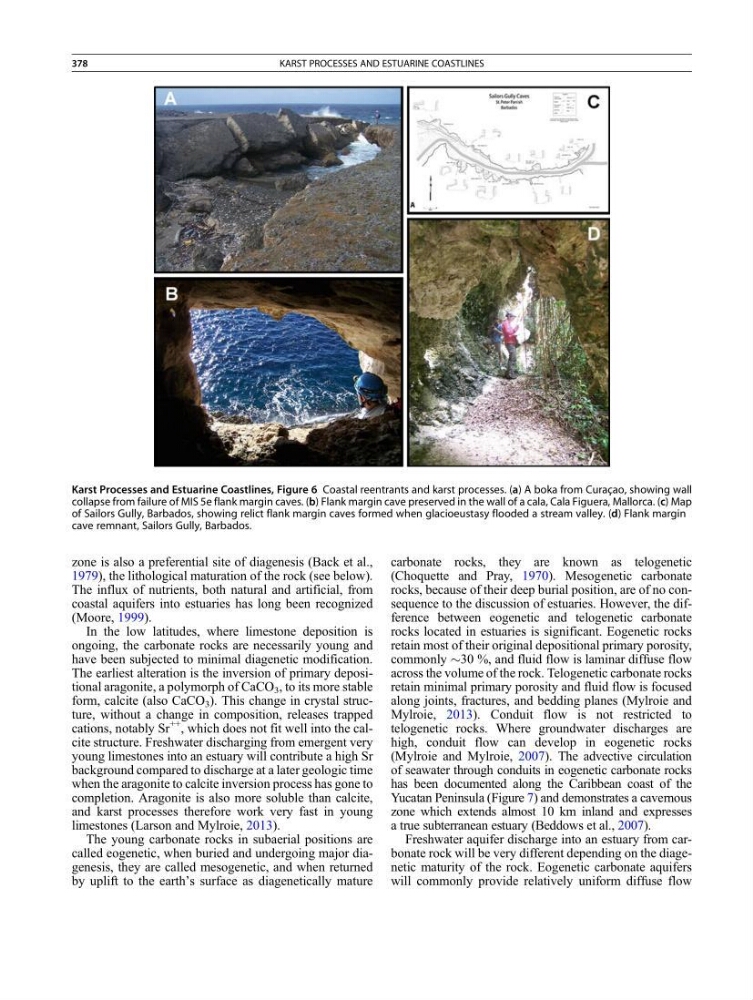
Karst Processes and Estuarine Coastlines, Figure 6 Coastal reentrants and karst processes. (a) A boka from Curac ¸ao, showing wall
collapse from failure of MIS 5e flank margin caves. (b) Flank margin cave preserved in the wall of a cala, Cala Figuera, Mallorca. (c) Map
of Sailors Gully, Barbados, showing relict flank margin caves formed when glacioeustasy flooded a stream valley. (d) Flank margin
cave remnant, Sailors Gully, Barbados.
378
KARST PROCESSES AND ESTUARINE COASTLINES
1979), the lithological maturation of the rock (see below).
The influx of nutrients, both natural and artificial, from
coastal aquifers into estuaries has long been recognized
(Moore, 1999).
In the low latitudes, where limestone deposition is
ongoing, the carbonate rocks are necessarily young and
have been subjected to minimal diagenetic modification.
The earliest alteration is the inversion of primary depositional aragonite, a polymorph of CaCO 3 , to its more stable
form, calcite (also CaCO 3 ). This change in crystal structure, without a change in composition, releases trapped
cations, notably Sr
++
, which does not fit well into the calcite structure. Freshwater discharging from emergent very
young limestones into an estuary will contribute a high Sr
background compared to discharge at a later geologic time
when the aragonite to calcite inversion process has gone to
completion. Aragonite is also more soluble than calcite,
and karst processes therefore work very fast in young
limestones (Larson and Mylroie, 2013).
The young carbonate rocks in subaerial positions are
called eogenetic, when buried and undergoing major diagenesis, they are called mesogenetic, and when returned
by uplift to the earth’s surface as diagenetically mature
carbonate rocks, they are known as telogenetic
(Choquette and Pray, 1970). Mesogenetic carbonate
rocks, because of their deep burial position, are of no consequence to the discussion of estuaries. However, the difference between eogenetic and telogenetic carbonate
rocks located in estuaries is significant. Eogenetic rocks
retain most of their original depositional primary porosity,
commonly 30 %, and fluid flow is laminar diffuse flow
across the volume of the rock. Telogenetic carbonate rocks
retain minimal primary porosity and fluid flow is focused
along joints, fractures, and bedding planes (Mylroie and
Mylroie, 2013). Conduit flow is not restricted to
telogenetic rocks. Where groundwater discharges are
high, conduit flow can develop in eogenetic rocks
(Mylroie and Mylroie, 2007). The advective circulation
of seawater through conduits in eogenetic carbonate rocks
has been documented along the Caribbean coast of the
Yucatan Peninsula (Figure 7) and demonstrates a cavernous
zone which extends almost 10 km inland and expresses
a true subterranean estuary (Beddows et al., 2007).
Freshwater aquifer discharge into an estuary from carbonate rock will be very different depending on the diagenetic maturity of the rock. Eogenetic carbonate aquifers
will commonly provide relatively uniform diffuse flow
Karst Processes and Estuarine Coastlines, Figure 6 Coastal reentrants and karst processes. (a) A boka from Curac ¸ao, showing wall
collapse from failure of MIS 5e flank margin caves. (b) Flank margin cave preserved in the wall of a cala, Cala Figuera, Mallorca. (c) Map
of Sailors Gully, Barbados, showing relict flank margin caves formed when glacioeustasy flooded a stream valley. (d) Flank margin
cave remnant, Sailors Gully, Barbados.
378
KARST PROCESSES AND ESTUARINE COASTLINES