

to the estuary margin (flank margin caves are mixing
chambers embedded within this fluid flow system and
have minimal impact on flow). Aquifer storage will be
large. Particulate matter will be substantially filtered out,
and slow flow velocities will give time for bioremediation
of contaminants. In contrast, the focus of flow to the planar
structures of telogenetic carbonate rocks (joints, fractures
and bedding planes) leads to the development of turbulent
flow pathways, which result in discharge to selected
points along the estuary perimeters, rapid flow with little
filtration, and minimal aquifer storage. Conduit systems
in eogenetic rocks, as in the Yucatan, create an interesting
duality, with large amounts of storage in the matrix, but
with well-established conduits containing turbulent flow
routes capable of rapid water transmission. The impact
on coastal ecosystems should be very different, with contaminant transport more of an issue in conduit-flow
systems. Anchialine cave systems and their biota are sensitive to the nature of the voids enclosing them in rocky
coastal environments, and large variations in species
diversity are expected (Mylroie and Mylroie, 2011; van
Hengstrum et al., 2011).
In terms of determining estuary water budgets and salinity gradients, the contribution of karst groundwater flow,
either as diffuse flow from eogenetic carbonates or as
focused flow from telogenetic carbonates, can be easily
missed. Karst watersheds are by definition cryptic, with
substantial surface flow diverted underground, while in
teleogenetic rocks the flow patterns do not differ much from
surficial stream channels in terms of discharge rates and volumes. Proper characterization of coastal estuary waters in
carbonate settings requires taking into account the unique
processes associated with karst. The investigator also needs
to recognize the diagenetic maturity of the carbonate rock.
Summary
Estuaries with part, or all, of their perimeter contained by
soluble rocks will display differences from those estuaries
developed in non-carbonate rock or sediments. Flank margin caves are the most notable difference and can create
coastline irregularities and specialty habitats. These caves
can also provide evidence of paleo-estuary conditions
when other evidence has been removed by erosion.
Freshwater input to the estuary may approach conditions
similar to typical diffuse groundwater flow if the soluble
rocks are eogenetic. If the soluble rocks are telogenetic,
then conduit-flow additions to the estuary can occur at
multiple discrete points along the estuary perimeter that
may not be obvious to casual observation. Accurate
assessment of an estuary developed in carbonate rocks
cannot be done without an awareness of how karst processes are participating in coastline development, habitat
placement, and freshwater flow.
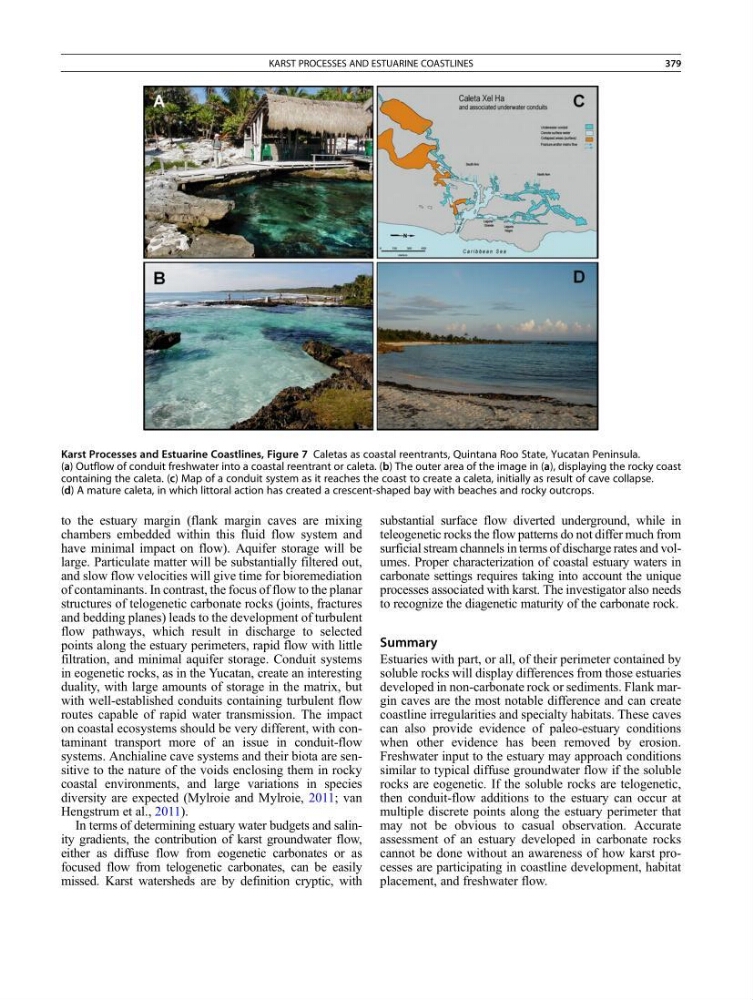
Karst Processes and Estuarine Coastlines, Figure 7 Caletas as coastal reentrants, Quintana Roo State, Yucatan Peninsula.
(a) Outflow of conduit freshwater into a coastal reentrant or caleta. (b) The outer area of the image in (a), displaying the rocky coast
containing the caleta. (c) Map of a conduit system as it reaches the coast to create a caleta, initially as result of cave collapse.
(d) A mature caleta, in which littoral action has created a crescent-shaped bay with beaches and rocky outcrops.
KARST PROCESSES AND ESTUARINE COASTLINES
379
chambers embedded within this fluid flow system and
have minimal impact on flow). Aquifer storage will be
large. Particulate matter will be substantially filtered out,
and slow flow velocities will give time for bioremediation
of contaminants. In contrast, the focus of flow to the planar
structures of telogenetic carbonate rocks (joints, fractures
and bedding planes) leads to the development of turbulent
flow pathways, which result in discharge to selected
points along the estuary perimeters, rapid flow with little
filtration, and minimal aquifer storage. Conduit systems
in eogenetic rocks, as in the Yucatan, create an interesting
duality, with large amounts of storage in the matrix, but
with well-established conduits containing turbulent flow
routes capable of rapid water transmission. The impact
on coastal ecosystems should be very different, with contaminant transport more of an issue in conduit-flow
systems. Anchialine cave systems and their biota are sensitive to the nature of the voids enclosing them in rocky
coastal environments, and large variations in species
diversity are expected (Mylroie and Mylroie, 2011; van
Hengstrum et al., 2011).
In terms of determining estuary water budgets and salinity gradients, the contribution of karst groundwater flow,
either as diffuse flow from eogenetic carbonates or as
focused flow from telogenetic carbonates, can be easily
missed. Karst watersheds are by definition cryptic, with
substantial surface flow diverted underground, while in
teleogenetic rocks the flow patterns do not differ much from
surficial stream channels in terms of discharge rates and volumes. Proper characterization of coastal estuary waters in
carbonate settings requires taking into account the unique
processes associated with karst. The investigator also needs
to recognize the diagenetic maturity of the carbonate rock.
Summary
Estuaries with part, or all, of their perimeter contained by
soluble rocks will display differences from those estuaries
developed in non-carbonate rock or sediments. Flank margin caves are the most notable difference and can create
coastline irregularities and specialty habitats. These caves
can also provide evidence of paleo-estuary conditions
when other evidence has been removed by erosion.
Freshwater input to the estuary may approach conditions
similar to typical diffuse groundwater flow if the soluble
rocks are eogenetic. If the soluble rocks are telogenetic,
then conduit-flow additions to the estuary can occur at
multiple discrete points along the estuary perimeter that
may not be obvious to casual observation. Accurate
assessment of an estuary developed in carbonate rocks
cannot be done without an awareness of how karst processes are participating in coastline development, habitat
placement, and freshwater flow.
Karst Processes and Estuarine Coastlines, Figure 7 Caletas as coastal reentrants, Quintana Roo State, Yucatan Peninsula.
(a) Outflow of conduit freshwater into a coastal reentrant or caleta. (b) The outer area of the image in (a), displaying the rocky coast
containing the caleta. (c) Map of a conduit system as it reaches the coast to create a caleta, initially as result of cave collapse.
(d) A mature caleta, in which littoral action has created a crescent-shaped bay with beaches and rocky outcrops.
KARST PROCESSES AND ESTUARINE COASTLINES
379