

over 3,000 m
2 of aerial footprint, developed during the last
interglacial sea-level highstand (MIS 5e, 124–115 ka)
(Labourdette et al., 2007). Because the caves form in the
discharging lens margin, they tend to have a limited vertical extent commensurate with a thin lens; however, the
caves have a broad aerial footprint that extends laterally
along the coast, but not deep into the interior, as cave genesis is restricted to the lens margin area (Figure 2c). The
flow within the caves is laminar, and the chambers are
irregular and maze-like (Figure 2), a pattern known as
ramiform (Palmer, 2007). The caves form without
humanly passable entrances, and they become accessible
only after surface erosion or collapse has exposed them.
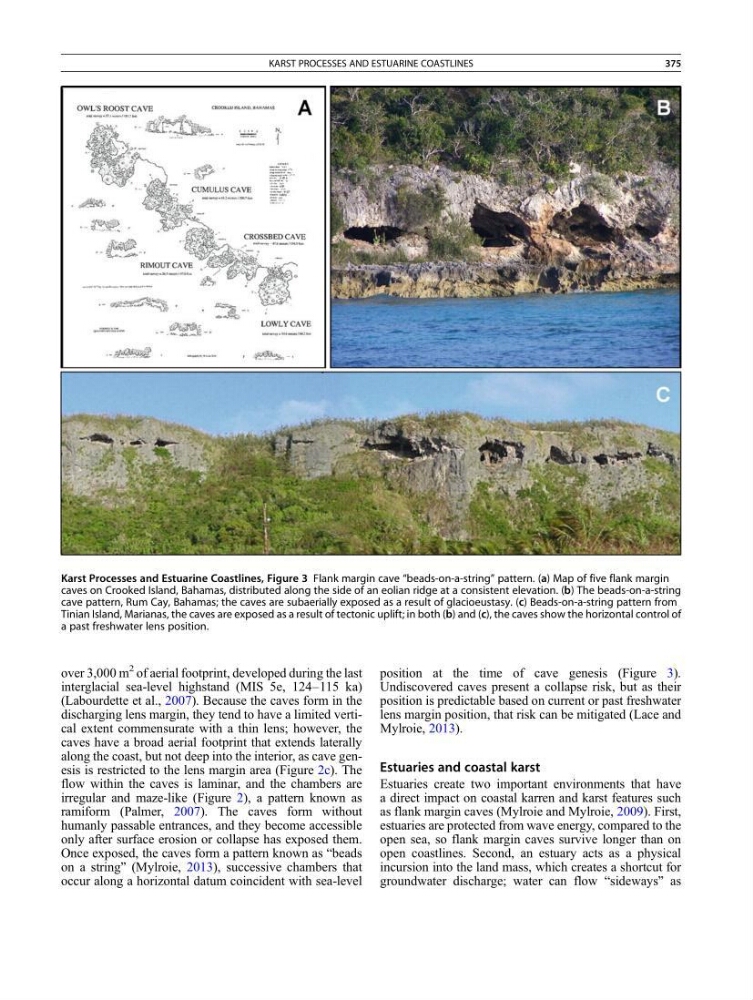
Once exposed, the caves form a pattern known as “beads
on a string” (Mylroie, 2013), successive chambers that
occur along a horizontal datum coincident with sea-level
position at the time of cave genesis (Figure 3).
Undiscovered caves present a collapse risk, but as their
position is predictable based on current or past freshwater
lens margin position, that risk can be mitigated (Lace and
Mylroie, 2013).
Estuaries and coastal karst
Estuaries create two important environments that have
a direct impact on coastal karren and karst features such
as flank margin caves (Mylroie and Mylroie, 2009). First,
estuaries are protected from wave energy, compared to the
open sea, so flank margin caves survive longer than on
open coastlines. Second, an estuary acts as a physical
incursion into the land mass, which creates a shortcut for
groundwater discharge; water can flow “sideways” as
Karst Processes and Estuarine Coastlines, Figure 3 Flank margin cave “beads-on-a-string” pattern. (a) Map of five flank margin
caves on Crooked Island, Bahamas, distributed along the side of an eolian ridge at a consistent elevation. (b) The beads-on-a-string
cave pattern, Rum Cay, Bahamas; the caves are subaerially exposed as a result of glacioeustasy. (c) Beads-on-a-string pattern from
Tinian Island, Marianas, the caves are exposed as a result of tectonic uplift; in both (b) and (c), the caves show the horizontal control of
a past freshwater lens position.
KARST PROCESSES AND ESTUARINE COASTLINES
375
2 of aerial footprint, developed during the last
interglacial sea-level highstand (MIS 5e, 124–115 ka)
(Labourdette et al., 2007). Because the caves form in the
discharging lens margin, they tend to have a limited vertical extent commensurate with a thin lens; however, the
caves have a broad aerial footprint that extends laterally
along the coast, but not deep into the interior, as cave genesis is restricted to the lens margin area (Figure 2c). The
flow within the caves is laminar, and the chambers are
irregular and maze-like (Figure 2), a pattern known as
ramiform (Palmer, 2007). The caves form without
humanly passable entrances, and they become accessible
only after surface erosion or collapse has exposed them.
Once exposed, the caves form a pattern known as “beads
on a string” (Mylroie, 2013), successive chambers that
occur along a horizontal datum coincident with sea-level
position at the time of cave genesis (Figure 3).
Undiscovered caves present a collapse risk, but as their
position is predictable based on current or past freshwater
lens margin position, that risk can be mitigated (Lace and
Mylroie, 2013).
Estuaries and coastal karst
Estuaries create two important environments that have
a direct impact on coastal karren and karst features such
as flank margin caves (Mylroie and Mylroie, 2009). First,
estuaries are protected from wave energy, compared to the
open sea, so flank margin caves survive longer than on
open coastlines. Second, an estuary acts as a physical
incursion into the land mass, which creates a shortcut for
groundwater discharge; water can flow “sideways” as
Karst Processes and Estuarine Coastlines, Figure 3 Flank margin cave “beads-on-a-string” pattern. (a) Map of five flank margin
caves on Crooked Island, Bahamas, distributed along the side of an eolian ridge at a consistent elevation. (b) The beads-on-a-string
cave pattern, Rum Cay, Bahamas; the caves are subaerially exposed as a result of glacioeustasy. (c) Beads-on-a-string pattern from
Tinian Island, Marianas, the caves are exposed as a result of tectonic uplift; in both (b) and (c), the caves show the horizontal control of
a past freshwater lens position.
KARST PROCESSES AND ESTUARINE COASTLINES
375