

they are edible, people can be encouraged to eat them to
minimize potential problems. An “Invasive Species
Cookbook” is available (“if you can’t beat, ‘em eat
‘em”), and the idea of the cookbook is to increase interest
in the issue of invasive species and to reduce their
populations by harvesting them as food sources and finding interesting ways to eat seaweeds, crabs, clams, mussels, fish, and snails.
Asian shore crab: Hemigrapsus sanguineus
This small species was first observed in New Jersey in
1988, probably having arrived in ballast water, and it has
since extended its range from Maine to North Carolina,
becoming very abundant in intertidal and shallow water
habitats where rock cover is available (McDermott, 1998).
They have a wide diet and a long breeding season and reproduce readily in a wide range of environmental conditions.
They are found in very high densities and actually seem to
have displaced green crabs from some areas. Control of this
species by predators seems unlikely as there is little evidence that they have major predators, supporting the
“enemy release hypothesis” of invasion biology.
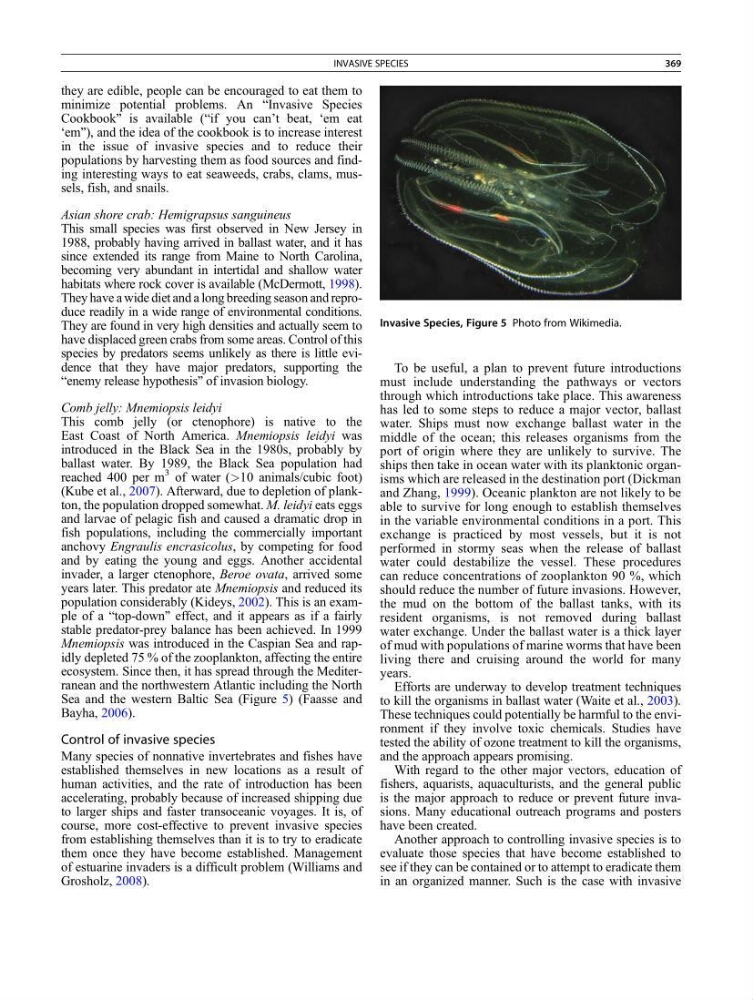
Comb jelly: Mnemiopsis leidyi
This comb jelly (or ctenophore) is native to the
East Coast of North America. Mnemiopsis leidyi was
introduced in the Black Sea in the 1980s, probably by
ballast water. By 1989, the Black Sea population had
reached 400 per m
3 of water (>10 animals/cubic foot)
(Kube et al., 2007). Afterward, due to depletion of plankton, the population dropped somewhat. M. leidyi eats eggs
and larvae of pelagic fish and caused a dramatic drop in
fish populations, including the commercially important
anchovy Engraulis encrasicolus, by competing for food
and by eating the young and eggs. Another accidental
invader, a larger ctenophore, Beroe ovata, arrived some
years later. This predator ate Mnemiopsis and reduced its
population considerably (Kideys, 2002). This is an example of a “top-down” effect, and it appears as if a fairly
stable predator-prey balance has been achieved. In 1999
Mnemiopsis was introduced in the Caspian Sea and rapidly depleted 75 % of the zooplankton, affecting the entire
ecosystem. Since then, it has spread through the Mediterranean and the northwestern Atlantic including the North
Sea and the western Baltic Sea (Figure 5) (Faasse and
Bayha, 2006).
Control of invasive species
Many species of nonnative invertebrates and fishes have
established themselves in new locations as a result of
human activities, and the rate of introduction has been
accelerating, probably because of increased shipping due
to larger ships and faster transoceanic voyages. It is, of
course, more cost-effective to prevent invasive species
from establishing themselves than it is to try to eradicate
them once they have become established. Management
of estuarine invaders is a difficult problem (Williams and
Grosholz, 2008).
To be useful, a plan to prevent future introductions
must include understanding the pathways or vectors
through which introductions take place. This awareness
has led to some steps to reduce a major vector, ballast
water. Ships must now exchange ballast water in the
middle of the ocean; this releases organisms from the
port of origin where they are unlikely to survive. The
ships then take in ocean water with its planktonic organisms which are released in the destination port (Dickman
and Zhang, 1999). Oceanic plankton are not likely to be
able to survive for long enough to establish themselves
in the variable environmental conditions in a port. This
exchange is practiced by most vessels, but it is not
performed in stormy seas when the release of ballast
water could destabilize the vessel. These procedures
can reduce concentrations of zooplankton 90 %, which
should reduce the number of future invasions. However,
the mud on the bottom of the ballast tanks, with its
resident organisms, is not removed during ballast
water exchange. Under the ballast water is a thick layer
of mud with populations of marine worms that have been
living there and cruising around the world for many
years.
Efforts are underway to develop treatment techniques
to kill the organisms in ballast water (Waite et al., 2003).
These techniques could potentially be harmful to the environment if they involve toxic chemicals. Studies have
tested the ability of ozone treatment to kill the organisms,
and the approach appears promising.
With regard to the other major vectors, education of
fishers, aquarists, aquaculturists, and the general public
is the major approach to reduce or prevent future invasions. Many educational outreach programs and posters
have been created.
Another approach to controlling invasive species is to
evaluate those species that have become established to
see if they can be contained or to attempt to eradicate them
in an organized manner. Such is the case with invasive
Invasive Species, Figure 5 Photo from Wikimedia.
INVASIVE SPECIES
369
minimize potential problems. An “Invasive Species
Cookbook” is available (“if you can’t beat, ‘em eat
‘em”), and the idea of the cookbook is to increase interest
in the issue of invasive species and to reduce their
populations by harvesting them as food sources and finding interesting ways to eat seaweeds, crabs, clams, mussels, fish, and snails.
Asian shore crab: Hemigrapsus sanguineus
This small species was first observed in New Jersey in
1988, probably having arrived in ballast water, and it has
since extended its range from Maine to North Carolina,
becoming very abundant in intertidal and shallow water
habitats where rock cover is available (McDermott, 1998).
They have a wide diet and a long breeding season and reproduce readily in a wide range of environmental conditions.
They are found in very high densities and actually seem to
have displaced green crabs from some areas. Control of this
species by predators seems unlikely as there is little evidence that they have major predators, supporting the
“enemy release hypothesis” of invasion biology.
Comb jelly: Mnemiopsis leidyi
This comb jelly (or ctenophore) is native to the
East Coast of North America. Mnemiopsis leidyi was
introduced in the Black Sea in the 1980s, probably by
ballast water. By 1989, the Black Sea population had
reached 400 per m
3 of water (>10 animals/cubic foot)
(Kube et al., 2007). Afterward, due to depletion of plankton, the population dropped somewhat. M. leidyi eats eggs
and larvae of pelagic fish and caused a dramatic drop in
fish populations, including the commercially important
anchovy Engraulis encrasicolus, by competing for food
and by eating the young and eggs. Another accidental
invader, a larger ctenophore, Beroe ovata, arrived some
years later. This predator ate Mnemiopsis and reduced its
population considerably (Kideys, 2002). This is an example of a “top-down” effect, and it appears as if a fairly
stable predator-prey balance has been achieved. In 1999
Mnemiopsis was introduced in the Caspian Sea and rapidly depleted 75 % of the zooplankton, affecting the entire
ecosystem. Since then, it has spread through the Mediterranean and the northwestern Atlantic including the North
Sea and the western Baltic Sea (Figure 5) (Faasse and
Bayha, 2006).
Control of invasive species
Many species of nonnative invertebrates and fishes have
established themselves in new locations as a result of
human activities, and the rate of introduction has been
accelerating, probably because of increased shipping due
to larger ships and faster transoceanic voyages. It is, of
course, more cost-effective to prevent invasive species
from establishing themselves than it is to try to eradicate
them once they have become established. Management
of estuarine invaders is a difficult problem (Williams and
Grosholz, 2008).
To be useful, a plan to prevent future introductions
must include understanding the pathways or vectors
through which introductions take place. This awareness
has led to some steps to reduce a major vector, ballast
water. Ships must now exchange ballast water in the
middle of the ocean; this releases organisms from the
port of origin where they are unlikely to survive. The
ships then take in ocean water with its planktonic organisms which are released in the destination port (Dickman
and Zhang, 1999). Oceanic plankton are not likely to be
able to survive for long enough to establish themselves
in the variable environmental conditions in a port. This
exchange is practiced by most vessels, but it is not
performed in stormy seas when the release of ballast
water could destabilize the vessel. These procedures
can reduce concentrations of zooplankton 90 %, which
should reduce the number of future invasions. However,
the mud on the bottom of the ballast tanks, with its
resident organisms, is not removed during ballast
water exchange. Under the ballast water is a thick layer
of mud with populations of marine worms that have been
living there and cruising around the world for many
years.
Efforts are underway to develop treatment techniques
to kill the organisms in ballast water (Waite et al., 2003).
These techniques could potentially be harmful to the environment if they involve toxic chemicals. Studies have
tested the ability of ozone treatment to kill the organisms,
and the approach appears promising.
With regard to the other major vectors, education of
fishers, aquarists, aquaculturists, and the general public
is the major approach to reduce or prevent future invasions. Many educational outreach programs and posters
have been created.
Another approach to controlling invasive species is to
evaluate those species that have become established to
see if they can be contained or to attempt to eradicate them
in an organized manner. Such is the case with invasive
Invasive Species, Figure 5 Photo from Wikimedia.
INVASIVE SPECIES
369