

worms, and small crustaceans. It also appears to learn and
remember better than native blue crabs (Roudez et al.,
2007).
It threatens Dungeness crab, oyster, and clam fisheries
and aquaculture in the Pacific Northwest as it moves up
the West Coast (Jamieson et al., 1998). On the East Coast,
the snails and mussels that have been living with it for over
a century have developed thicker shells as a defense, making it harder to crush than shellfish that have not been
exposed to green crabs (Leonard et al., 1999). The green
crabs in North America have fewer parasites (Torchin
et al., 2002) and grow considerably larger than they do
back home in their native European waters, traits that
may be contributing to their success.
Chinese mitten crabs: Eriocheir sinensis
The Chinese mitten crab is a burrowing crab native to the
Yellow Sea in Korea and China. It has dense patches of
hairs on its claws, hence the name mitten crab. In Asia, it
is a delicacy and it has been imported illegally into seafood stores in California for the Asian market, suggesting
that it may have been introduced by the release of leftover
crabs. It could also have been accidentally released in ballast water, which seems to be what happened in the early
1900s in Germany, with the result that in the 1920s and
1930s, the crabs expanded into many northern European
rivers and estuaries. Recently, the Thames River in
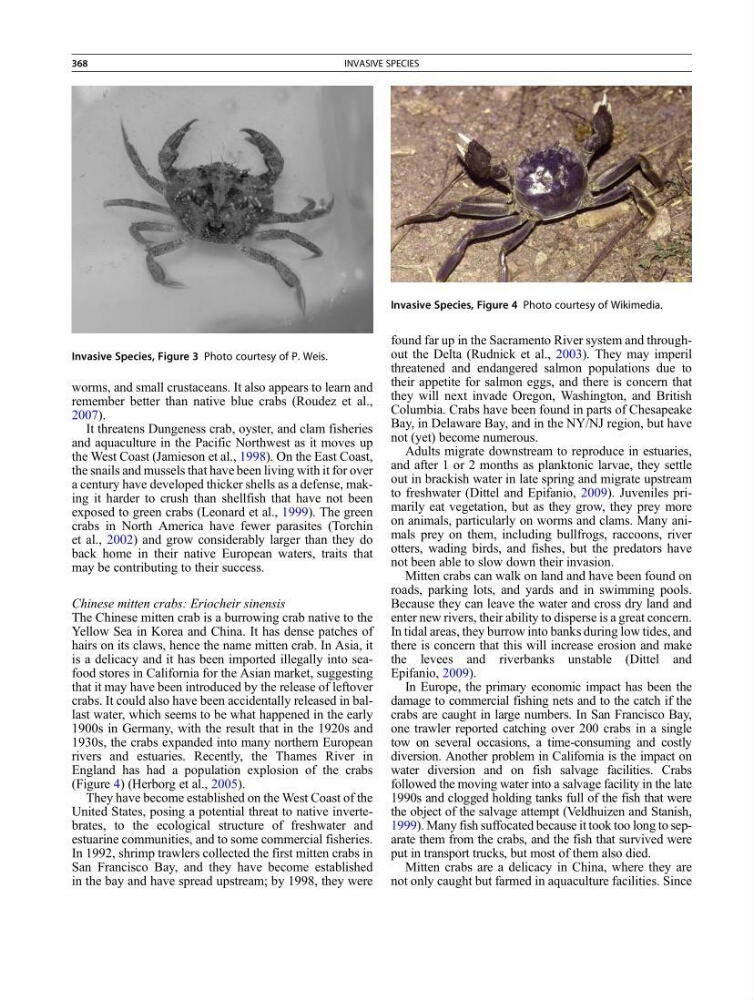
England has had a population explosion of the crabs
(Figure 4) (Herborg et al., 2005).
They have become established on the West Coast of the
United States, posing a potential threat to native invertebrates, to the ecological structure of freshwater and
estuarine communities, and to some commercial fisheries.
In 1992, shrimp trawlers collected the first mitten crabs in
San Francisco Bay, and they have become established
in the bay and have spread upstream; by 1998, they were
found far up in the Sacramento River system and throughout the Delta (Rudnick et al., 2003). They may imperil
threatened and endangered salmon populations due to
their appetite for salmon eggs, and there is concern that
they will next invade Oregon, Washington, and British
Columbia. Crabs have been found in parts of Chesapeake
Bay, in Delaware Bay, and in the NY/NJ region, but have
not (yet) become numerous.
Adults migrate downstream to reproduce in estuaries,
and after 1 or 2 months as planktonic larvae, they settle
out in brackish water in late spring and migrate upstream
to freshwater (Dittel and Epifanio, 2009). Juveniles primarily eat vegetation, but as they grow, they prey more
on animals, particularly on worms and clams. Many animals prey on them, including bullfrogs, raccoons, river
otters, wading birds, and fishes, but the predators have
not been able to slow down their invasion.
Mitten crabs can walk on land and have been found on
roads, parking lots, and yards and in swimming pools.
Because they can leave the water and cross dry land and
enter new rivers, their ability to disperse is a great concern.
In tidal areas, they burrow into banks during low tides, and
there is concern that this will increase erosion and make
the levees and riverbanks unstable (Dittel and
Epifanio, 2009).
In Europe, the primary economic impact has been the
damage to commercial fishing nets and to the catch if the
crabs are caught in large numbers. In San Francisco Bay,
one trawler reported catching over 200 crabs in a single
tow on several occasions, a time-consuming and costly
diversion. Another problem in California is the impact on
water diversion and on fish salvage facilities. Crabs
followed the moving water into a salvage facility in the late
1990s and clogged holding tanks full of the fish that were
the object of the salvage attempt (Veldhuizen and Stanish,
1999). Many fish suffocated because it took too long to separate them from the crabs, and the fish that survived were
put in transport trucks, but most of them also died.
Mitten crabs are a delicacy in China, where they are
not only caught but farmed in aquaculture facilities. Since
Invasive Species, Figure 4 Photo courtesy of Wikimedia.
Invasive Species, Figure 3 Photo courtesy of P. Weis.
368
INVASIVE SPECIES
remember better than native blue crabs (Roudez et al.,
2007).
It threatens Dungeness crab, oyster, and clam fisheries
and aquaculture in the Pacific Northwest as it moves up
the West Coast (Jamieson et al., 1998). On the East Coast,
the snails and mussels that have been living with it for over
a century have developed thicker shells as a defense, making it harder to crush than shellfish that have not been
exposed to green crabs (Leonard et al., 1999). The green
crabs in North America have fewer parasites (Torchin
et al., 2002) and grow considerably larger than they do
back home in their native European waters, traits that
may be contributing to their success.
Chinese mitten crabs: Eriocheir sinensis
The Chinese mitten crab is a burrowing crab native to the
Yellow Sea in Korea and China. It has dense patches of
hairs on its claws, hence the name mitten crab. In Asia, it
is a delicacy and it has been imported illegally into seafood stores in California for the Asian market, suggesting
that it may have been introduced by the release of leftover
crabs. It could also have been accidentally released in ballast water, which seems to be what happened in the early
1900s in Germany, with the result that in the 1920s and
1930s, the crabs expanded into many northern European
rivers and estuaries. Recently, the Thames River in
England has had a population explosion of the crabs
(Figure 4) (Herborg et al., 2005).
They have become established on the West Coast of the
United States, posing a potential threat to native invertebrates, to the ecological structure of freshwater and
estuarine communities, and to some commercial fisheries.
In 1992, shrimp trawlers collected the first mitten crabs in
San Francisco Bay, and they have become established
in the bay and have spread upstream; by 1998, they were
found far up in the Sacramento River system and throughout the Delta (Rudnick et al., 2003). They may imperil
threatened and endangered salmon populations due to
their appetite for salmon eggs, and there is concern that
they will next invade Oregon, Washington, and British
Columbia. Crabs have been found in parts of Chesapeake
Bay, in Delaware Bay, and in the NY/NJ region, but have
not (yet) become numerous.
Adults migrate downstream to reproduce in estuaries,
and after 1 or 2 months as planktonic larvae, they settle
out in brackish water in late spring and migrate upstream
to freshwater (Dittel and Epifanio, 2009). Juveniles primarily eat vegetation, but as they grow, they prey more
on animals, particularly on worms and clams. Many animals prey on them, including bullfrogs, raccoons, river
otters, wading birds, and fishes, but the predators have
not been able to slow down their invasion.
Mitten crabs can walk on land and have been found on
roads, parking lots, and yards and in swimming pools.
Because they can leave the water and cross dry land and
enter new rivers, their ability to disperse is a great concern.
In tidal areas, they burrow into banks during low tides, and
there is concern that this will increase erosion and make
the levees and riverbanks unstable (Dittel and
Epifanio, 2009).
In Europe, the primary economic impact has been the
damage to commercial fishing nets and to the catch if the
crabs are caught in large numbers. In San Francisco Bay,
one trawler reported catching over 200 crabs in a single
tow on several occasions, a time-consuming and costly
diversion. Another problem in California is the impact on
water diversion and on fish salvage facilities. Crabs
followed the moving water into a salvage facility in the late
1990s and clogged holding tanks full of the fish that were
the object of the salvage attempt (Veldhuizen and Stanish,
1999). Many fish suffocated because it took too long to separate them from the crabs, and the fish that survived were
put in transport trucks, but most of them also died.
Mitten crabs are a delicacy in China, where they are
not only caught but farmed in aquaculture facilities. Since
Invasive Species, Figure 4 Photo courtesy of Wikimedia.
Invasive Species, Figure 3 Photo courtesy of P. Weis.
368
INVASIVE SPECIES