

bay will become more indented or will recede in the
curved portion. Should the supply cease altogether, the
waterline will erode back to a limiting shape which is
termed static equilibrium. For coasts with predominate
wave climates, this limiting shape is predictable using
Static Equilibrium Model (SEB) formula. Varying wave
conditions and sand supply are the norm in Chesapeake
Bay, as in most estuaries, and must be accounted for in
the design process.
Since the first Chesapeake Bay headland breakwater
installation in 1985, creating shore protection using
pocket beaches while reducing the amount of rock (i.e.,
breakwater length) per length of shoreline has been
researched. There are numerous headland breakwater
projects built in different coastal settings for shore protection and public beach stability (Hardaway and Gunn,
2002). Stability of the bay beach is critical so that future
nourishment is minimized. However, rock costs for
breakwater units also are significant, and it is a balance
of these and project goals that make each site different.
The beach is the primary component of any given headland breakwater system and the source of material will
dictate costs and ultimately the design. Sand that can be
obtained directly from an adjacent sandy bank will cost
significantly less than sand that has to be trucked to
the site.
Beach berms occur on “natural” Chesapeake
Bay beaches and typically reside about 0.3–0.6 m above
MHW. The larger the fetch at the site, the higher the beach
berm is relative to MHW due, in part, to increased wave
runup. Since a stable pocket beach is the goal of the headland breakwater projects, it makes sense to build the beach
berm into the project. Empirical evidence can be found
on existing beaches whether natural, man-induced
(i.e., jetties) or man-made (i.e., groins or breakwaters).
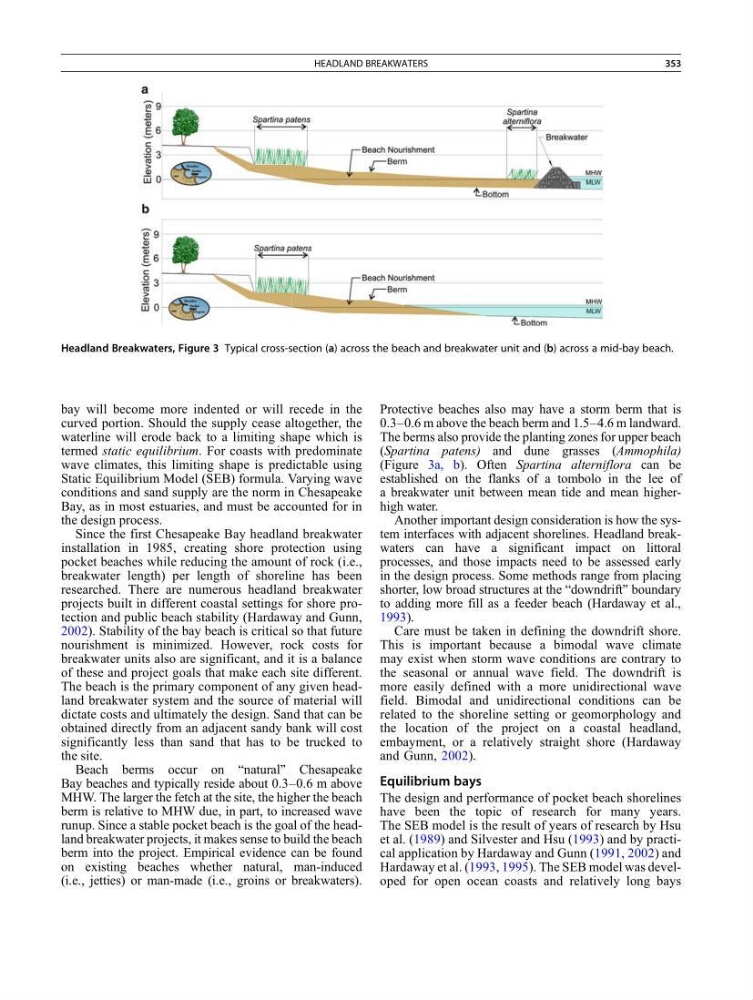
Protective beaches also may have a storm berm that is
0.3–0.6 m above the beach berm and 1.5–4.6 m landward.
The berms also provide the planting zones for upper beach
(Spartina patens) and dune grasses (Ammophila)
(Figure 3a, b). Often Spartina alterniflora can be
established on the flanks of a tombolo in the lee of
a breakwater unit between mean tide and mean higherhigh water.
Another important design consideration is how the system interfaces with adjacent shorelines. Headland breakwaters can have a significant impact on littoral
processes, and those impacts need to be assessed early
in the design process. Some methods range from placing
shorter, low broad structures at the “downdrift” boundary
to adding more fill as a feeder beach (Hardaway et al.,
1993).
Care must be taken in defining the downdrift shore.
This is important because a bimodal wave climate
may exist when storm wave conditions are contrary to
the seasonal or annual wave field. The downdrift is
more easily defined with a more unidirectional wave
field. Bimodal and unidirectional conditions can be
related to the shoreline setting or geomorphology and
the location of the project on a coastal headland,
embayment, or a relatively straight shore (Hardaway
and Gunn, 2002).
Equilibrium bays
The design and performance of pocket beach shorelines
have been the topic of research for many years.
The SEB model is the result of years of research by Hsu
et al. (1989) and Silvester and Hsu (1993) and by practical application by Hardaway and Gunn (1991, 2002) and
Hardaway et al. (1993, 1995). The SEB model was developed for open ocean coasts and relatively long bays
Headland Breakwaters, Figure 3 Typical cross-section (a) across the beach and breakwater unit and (b) across a mid-bay beach.
HEADLAND BREAKWATERS
353
curved portion. Should the supply cease altogether, the
waterline will erode back to a limiting shape which is
termed static equilibrium. For coasts with predominate
wave climates, this limiting shape is predictable using
Static Equilibrium Model (SEB) formula. Varying wave
conditions and sand supply are the norm in Chesapeake
Bay, as in most estuaries, and must be accounted for in
the design process.
Since the first Chesapeake Bay headland breakwater
installation in 1985, creating shore protection using
pocket beaches while reducing the amount of rock (i.e.,
breakwater length) per length of shoreline has been
researched. There are numerous headland breakwater
projects built in different coastal settings for shore protection and public beach stability (Hardaway and Gunn,
2002). Stability of the bay beach is critical so that future
nourishment is minimized. However, rock costs for
breakwater units also are significant, and it is a balance
of these and project goals that make each site different.
The beach is the primary component of any given headland breakwater system and the source of material will
dictate costs and ultimately the design. Sand that can be
obtained directly from an adjacent sandy bank will cost
significantly less than sand that has to be trucked to
the site.
Beach berms occur on “natural” Chesapeake
Bay beaches and typically reside about 0.3–0.6 m above
MHW. The larger the fetch at the site, the higher the beach
berm is relative to MHW due, in part, to increased wave
runup. Since a stable pocket beach is the goal of the headland breakwater projects, it makes sense to build the beach
berm into the project. Empirical evidence can be found
on existing beaches whether natural, man-induced
(i.e., jetties) or man-made (i.e., groins or breakwaters).
Protective beaches also may have a storm berm that is
0.3–0.6 m above the beach berm and 1.5–4.6 m landward.
The berms also provide the planting zones for upper beach
(Spartina patens) and dune grasses (Ammophila)
(Figure 3a, b). Often Spartina alterniflora can be
established on the flanks of a tombolo in the lee of
a breakwater unit between mean tide and mean higherhigh water.
Another important design consideration is how the system interfaces with adjacent shorelines. Headland breakwaters can have a significant impact on littoral
processes, and those impacts need to be assessed early
in the design process. Some methods range from placing
shorter, low broad structures at the “downdrift” boundary
to adding more fill as a feeder beach (Hardaway et al.,
1993).
Care must be taken in defining the downdrift shore.
This is important because a bimodal wave climate
may exist when storm wave conditions are contrary to
the seasonal or annual wave field. The downdrift is
more easily defined with a more unidirectional wave
field. Bimodal and unidirectional conditions can be
related to the shoreline setting or geomorphology and
the location of the project on a coastal headland,
embayment, or a relatively straight shore (Hardaway
and Gunn, 2002).
Equilibrium bays
The design and performance of pocket beach shorelines
have been the topic of research for many years.
The SEB model is the result of years of research by Hsu
et al. (1989) and Silvester and Hsu (1993) and by practical application by Hardaway and Gunn (1991, 2002) and
Hardaway et al. (1993, 1995). The SEB model was developed for open ocean coasts and relatively long bays
Headland Breakwaters, Figure 3 Typical cross-section (a) across the beach and breakwater unit and (b) across a mid-bay beach.
HEADLAND BREAKWATERS
353