

form of consumption by and assimilation into tissues of
other organisms, be they metazoans or microbes. The
structure, dynamics, and spatial relationships of the trophic networks derived from this basic observation are certain to affect the distribution and abundance of organisms
in very fundamental ways.” The dynamics of food webs
are now viewed from multiple perspectives. Paine
(1980) effectively articulated three synthetic characterizations of both the structure and dynamics of food web links
affecting community structure, from (1) static, topological
connectedness to (2) energy flow and (3) the strength of
functional interactions among the connected species
(Figure 3). With revelations of contaminant biomagnification (Suedel et al., 1994), the role of the “microbial
loop” (Azam et al., 1983), emergence of intrinsic patterns
(Pimm, 1982), and the use of elaborate ecological models
(e.g., Ecopath, Ecosim and Ecospace; Pauly et al., 2000)
and geochemical biomarkers such as natural stable isotopes and fatty acids (e.g., Hanson et al., 2010) have
greatly expanded our delineation and application of
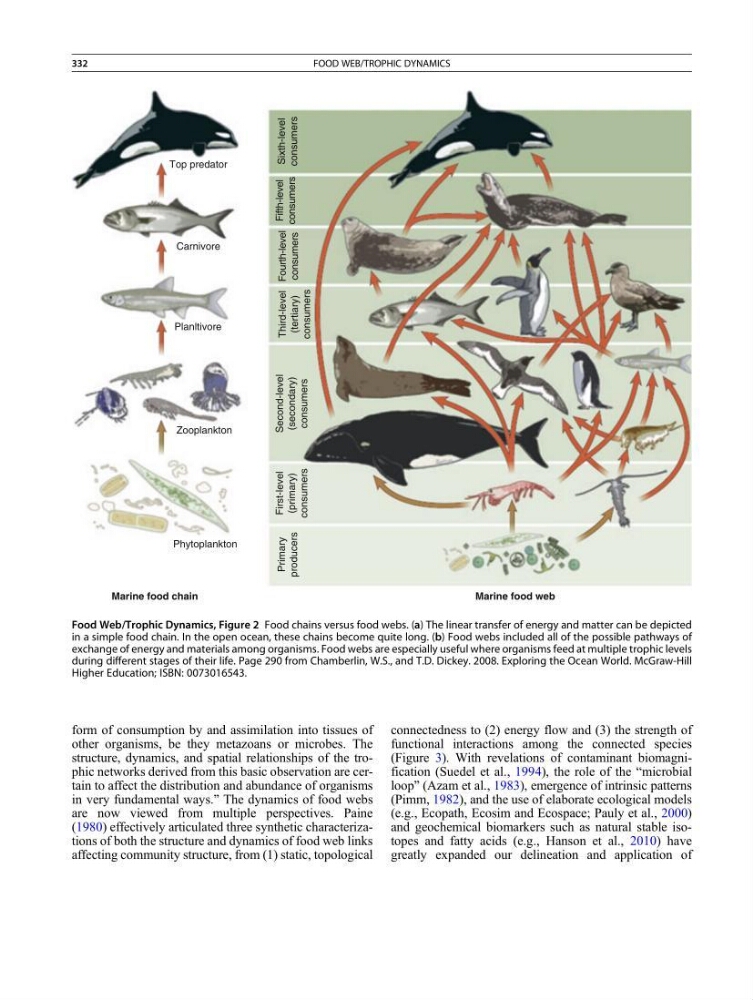
Top predator
Carnivore
Planltivore
Zooplankton
Phytoplankton
Primary
producers
First-level
(primary)
consumers
Second-level
(secondary)
consumers
Third-level
(tertiary)
consumers
Fourth-level
consumers
Fifth-level
consumers
Sixth-level
consumers
Marine food chain
Marine food web
Food Web/Trophic Dynamics, Figure 2 Food chains versus food webs. (a) The linear transfer of energy and matter can be depicted
in a simple food chain. In the open ocean, these chains become quite long. (b) Food webs included all of the possible pathways of
exchange of energy and materials among organisms. Food webs are especially useful where organisms feed at multiple trophic levels
during different stages of their life. Page 290 from Chamberlin, W.S., and T.D. Dickey. 2008. Exploring the Ocean World. McGraw-Hill
Higher Education; ISBN: 0073016543.
332
FOOD WEB/TROPHIC DYNAMICS
other organisms, be they metazoans or microbes. The
structure, dynamics, and spatial relationships of the trophic networks derived from this basic observation are certain to affect the distribution and abundance of organisms
in very fundamental ways.” The dynamics of food webs
are now viewed from multiple perspectives. Paine
(1980) effectively articulated three synthetic characterizations of both the structure and dynamics of food web links
affecting community structure, from (1) static, topological
connectedness to (2) energy flow and (3) the strength of
functional interactions among the connected species
(Figure 3). With revelations of contaminant biomagnification (Suedel et al., 1994), the role of the “microbial
loop” (Azam et al., 1983), emergence of intrinsic patterns
(Pimm, 1982), and the use of elaborate ecological models
(e.g., Ecopath, Ecosim and Ecospace; Pauly et al., 2000)
and geochemical biomarkers such as natural stable isotopes and fatty acids (e.g., Hanson et al., 2010) have
greatly expanded our delineation and application of
Top predator
Carnivore
Planltivore
Zooplankton
Phytoplankton
Primary
producers
First-level
(primary)
consumers
Second-level
(secondary)
consumers
Third-level
(tertiary)
consumers
Fourth-level
consumers
Fifth-level
consumers
Sixth-level
consumers
Marine food chain
Marine food web
Food Web/Trophic Dynamics, Figure 2 Food chains versus food webs. (a) The linear transfer of energy and matter can be depicted
in a simple food chain. In the open ocean, these chains become quite long. (b) Food webs included all of the possible pathways of
exchange of energy and materials among organisms. Food webs are especially useful where organisms feed at multiple trophic levels
during different stages of their life. Page 290 from Chamberlin, W.S., and T.D. Dickey. 2008. Exploring the Ocean World. McGraw-Hill
Higher Education; ISBN: 0073016543.
332
FOOD WEB/TROPHIC DYNAMICS