

Schoener, T. W., 1989. Food webs from the small to the large.
Ecology, 70, 1559–1589.
Spencer, M., and Warren, P. H., 1996. The effects of habitat size and
productivity on food web structure in small aquatic microcosms.
Oikos, 75, 419–430.
Sterner, R. W., et al., 1997. The enigma of food chain length:
absence of theoretical evidence for dynamic constraints.
Ecology, 78, 2258–2262.
Cross-references
Detritus Food Webs
Food Web/Trophic Dynamics
FOOD WEB/TROPHIC DYNAMICS
Charles A. Simenstad
School of Aquatic and Fishery Sciences, University of
Washington, Seattle, WA, USA
Synonyms
Food cycle; Food nexe; Trophic network
Definition
The network of interconnected food chains in an ecosystem, wherein organisms that eat each other form
a sequence of interconnecting links from the initial producers of organic matter through the various consumers.
Description
Believed to have been initially depicted by the Muslim
scientist al-Jāḥiẓ (nickname, meaning “google-eyed” for
Abu ‘Uthman’ Amr ibn Bahr) in the ninth century
(Egerton, 2002), food chains communicate the procession
of energy from the origin of fixation by primary producers
through herbivores and successive levels of higher level
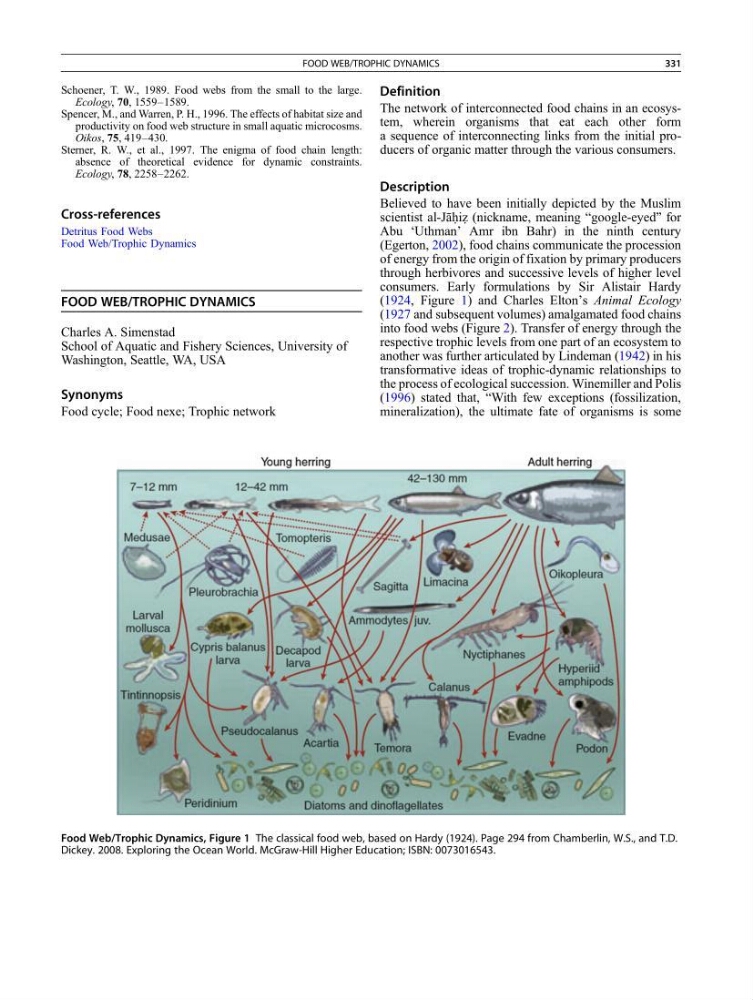
consumers. Early formulations by Sir Alistair Hardy
(1924, Figure 1) and Charles Elton’s Animal Ecology
(1927 and subsequent volumes) amalgamated food chains
into food webs (Figure 2). Transfer of energy through the
respective trophic levels from one part of an ecosystem to
another was further articulated by Lindeman (1942) in his
transformative ideas of trophic-dynamic relationships to
the process of ecological succession. Winemiller and Polis
(1996) stated that, “With few exceptions (fossilization,
mineralization), the ultimate fate of organisms is some
Food Web/Trophic Dynamics, Figure 1 The classical food web, based on Hardy (1924). Page 294 from Chamberlin, W.S., and T.D.
Dickey. 2008. Exploring the Ocean World. McGraw-Hill Higher Education; ISBN: 0073016543.
FOOD WEB/TROPHIC DYNAMICS
331
Ecology, 70, 1559–1589.
Spencer, M., and Warren, P. H., 1996. The effects of habitat size and
productivity on food web structure in small aquatic microcosms.
Oikos, 75, 419–430.
Sterner, R. W., et al., 1997. The enigma of food chain length:
absence of theoretical evidence for dynamic constraints.
Ecology, 78, 2258–2262.
Cross-references
Detritus Food Webs
Food Web/Trophic Dynamics
FOOD WEB/TROPHIC DYNAMICS
Charles A. Simenstad
School of Aquatic and Fishery Sciences, University of
Washington, Seattle, WA, USA
Synonyms
Food cycle; Food nexe; Trophic network
Definition
The network of interconnected food chains in an ecosystem, wherein organisms that eat each other form
a sequence of interconnecting links from the initial producers of organic matter through the various consumers.
Description
Believed to have been initially depicted by the Muslim
scientist al-Jāḥiẓ (nickname, meaning “google-eyed” for
Abu ‘Uthman’ Amr ibn Bahr) in the ninth century
(Egerton, 2002), food chains communicate the procession
of energy from the origin of fixation by primary producers
through herbivores and successive levels of higher level
consumers. Early formulations by Sir Alistair Hardy
(1924, Figure 1) and Charles Elton’s Animal Ecology
(1927 and subsequent volumes) amalgamated food chains
into food webs (Figure 2). Transfer of energy through the
respective trophic levels from one part of an ecosystem to
another was further articulated by Lindeman (1942) in his
transformative ideas of trophic-dynamic relationships to
the process of ecological succession. Winemiller and Polis
(1996) stated that, “With few exceptions (fossilization,
mineralization), the ultimate fate of organisms is some
Food Web/Trophic Dynamics, Figure 1 The classical food web, based on Hardy (1924). Page 294 from Chamberlin, W.S., and T.D.
Dickey. 2008. Exploring the Ocean World. McGraw-Hill Higher Education; ISBN: 0073016543.
FOOD WEB/TROPHIC DYNAMICS
331