

and are characterized by wide variability of environmental
conditions (Barletta et al., 2010). These systems also support human activities, such as fishing and environment
use. Fisheries are an integral part of human societies in
the coastal zone and are directly related and dependent
on estuarine productivity (Blaber, 2000; Barletta et al.,
2010). They can be divided into four main sectors: (1) subsistence (fishers consume their catch or give it away but do
not sell it); (2) artisanal (fishers sell part of their catch but
also retain part for their own consumption); (3) commercial (all catch is sold); and (4) recreational (fishing is carried out as a sport or leisure pastime and not primarily
for producing food or income) (Blaber et al., 2000). Traditional fisheries have a long history and form part of the
human culture in estuarine communities. They may also
have a long-standing and complex interrelationship with
the environment and in the tropics and subtropics are
increasingly regarded as part of the overall ecology
(Blaber et al., 2000). Implementing conservation strategies is essential in order to protect natural resources,
including fishes and their habitats.
Monitoring and knowledge of the effects of small-scale
and large-scale patterns in abiotic and biotic conditions, as
well as fisheries activities, are necessary for a more complete understanding of fish and fisheries dynamics and,
therefore, their effective management (Blaber et al.,
2000; Barletta et al., 2010). Moreover, understanding the
variations of fish assemblages in estuarine ecosystems at
different spatial and temporal scales can provide valuable
insights for fisheries management and nature conservation. The high spatial heterogeneity and the different fish
fauna assemblages need a habitat-based classification of
estuarine landscape features employing readily obtainable
quantitative data for geophysical and oceanographic characteristics (Barletta et al., 2010). This categorization could
provide data that correlate fish assemblages, or key species, to specific estuaries or coastal sectors. This would
offer the necessary aid to regional fisheries management
systems and provide a framework for research, monitoring, and conservation of the estuarine ecosystem.
Barletta et al. (2010) indicated that seasonal and annual
variability in the southwest Atlantic coastal system
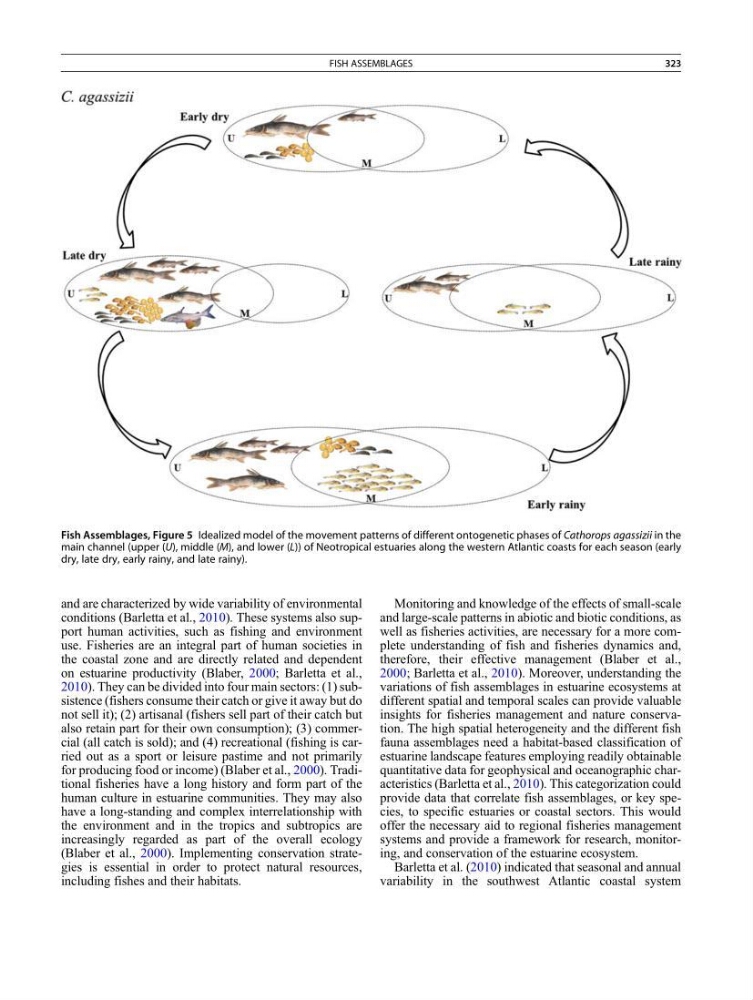
Fish Assemblages, Figure 5 Idealized model of the movement patterns of different ontogenetic phases of Cathorops agassizii in the
main channel (upper (U), middle (M), and lower (L)) of Neotropical estuaries along the western Atlantic coasts for each season (early
dry, late dry, early rainy, and late rainy).
FISH ASSEMBLAGES
323
conditions (Barletta et al., 2010). These systems also support human activities, such as fishing and environment
use. Fisheries are an integral part of human societies in
the coastal zone and are directly related and dependent
on estuarine productivity (Blaber, 2000; Barletta et al.,
2010). They can be divided into four main sectors: (1) subsistence (fishers consume their catch or give it away but do
not sell it); (2) artisanal (fishers sell part of their catch but
also retain part for their own consumption); (3) commercial (all catch is sold); and (4) recreational (fishing is carried out as a sport or leisure pastime and not primarily
for producing food or income) (Blaber et al., 2000). Traditional fisheries have a long history and form part of the
human culture in estuarine communities. They may also
have a long-standing and complex interrelationship with
the environment and in the tropics and subtropics are
increasingly regarded as part of the overall ecology
(Blaber et al., 2000). Implementing conservation strategies is essential in order to protect natural resources,
including fishes and their habitats.
Monitoring and knowledge of the effects of small-scale
and large-scale patterns in abiotic and biotic conditions, as
well as fisheries activities, are necessary for a more complete understanding of fish and fisheries dynamics and,
therefore, their effective management (Blaber et al.,
2000; Barletta et al., 2010). Moreover, understanding the
variations of fish assemblages in estuarine ecosystems at
different spatial and temporal scales can provide valuable
insights for fisheries management and nature conservation. The high spatial heterogeneity and the different fish
fauna assemblages need a habitat-based classification of
estuarine landscape features employing readily obtainable
quantitative data for geophysical and oceanographic characteristics (Barletta et al., 2010). This categorization could
provide data that correlate fish assemblages, or key species, to specific estuaries or coastal sectors. This would
offer the necessary aid to regional fisheries management
systems and provide a framework for research, monitoring, and conservation of the estuarine ecosystem.
Barletta et al. (2010) indicated that seasonal and annual
variability in the southwest Atlantic coastal system
Fish Assemblages, Figure 5 Idealized model of the movement patterns of different ontogenetic phases of Cathorops agassizii in the
main channel (upper (U), middle (M), and lower (L)) of Neotropical estuaries along the western Atlantic coasts for each season (early
dry, late dry, early rainy, and late rainy).
FISH ASSEMBLAGES
323