

influences various fish biological behaviors (migration,
spawning, mating, and bottom fidelity), as well as the seasonal and interannual coastal habitat use, that determine
fish catchability and susceptibility. On a large spatial
scale, the strong physical environmental gradient along
the southwest Atlantic coastal system creates a gradual
change in the fish composition from fresh and shallow
to marine and deeper waters that define the riverine,
estuarine, and coastal shelf fish assemblages (Anganuzzi,
1983; Jaureguizar et al., 2004; Lorenzo Pereiro, 2007).
The riverine fish assemblages occupy the inner part
of the La Plata River characterized by freshwater
(salinity 0.08 Æ 0.02) and shallow depths (7.88 Æ
1.53 m). Its ichthyofauna forms part of the Paranoplatense
fish community and shows a high affinity for the Paraná
and Uruguay River basins (Cousseau, 1985). It is mainly
dominated by freshwater and anadromous species. The
anadromous species, during spring and early summer,
extends up the La Plata River and its basin to spawn.
The estuarine fish assemblage occupies the mixohaline
waters of the La Plata Estuary, and its ichthyofauna is
dominated by euryhaline species of marine origin. The
species composition shows a gradient to the mouth where
estuarine resident species predominate and, to a lesser
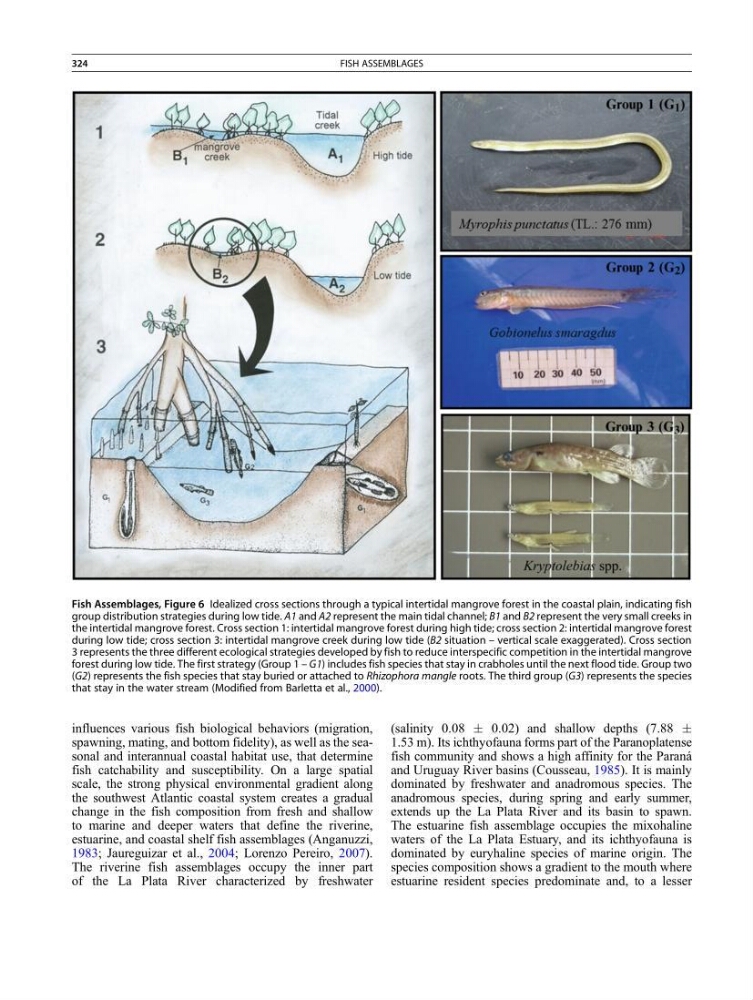
Fish Assemblages, Figure 6 Idealized cross sections through a typical intertidal mangrove forest in the coastal plain, indicating fish
group distribution strategies during low tide. A1 and A2 represent the main tidal channel; B1 and B2 represent the very small creeks in
the intertidal mangrove forest. Cross section 1: intertidal mangrove forest during high tide; cross section 2: intertidal mangrove forest
during low tide; cross section 3: intertidal mangrove creek during low tide (B2 situation – vertical scale exaggerated). Cross section
3 represents the three different ecological strategies developed by fish to reduce interspecific competition in the intertidal mangrove
forest during low tide. The first strategy (Group 1 – G1) includes fish species that stay in crabholes until the next flood tide. Group two
(G2) represents the fish species that stay buried or attached to Rhizophora mangle roots. The third group (G3) represents the species
that stay in the water stream (Modified from Barletta et al., 2000).
324
FISH ASSEMBLAGES
spawning, mating, and bottom fidelity), as well as the seasonal and interannual coastal habitat use, that determine
fish catchability and susceptibility. On a large spatial
scale, the strong physical environmental gradient along
the southwest Atlantic coastal system creates a gradual
change in the fish composition from fresh and shallow
to marine and deeper waters that define the riverine,
estuarine, and coastal shelf fish assemblages (Anganuzzi,
1983; Jaureguizar et al., 2004; Lorenzo Pereiro, 2007).
The riverine fish assemblages occupy the inner part
of the La Plata River characterized by freshwater
(salinity 0.08 Æ 0.02) and shallow depths (7.88 Æ
1.53 m). Its ichthyofauna forms part of the Paranoplatense
fish community and shows a high affinity for the Paraná
and Uruguay River basins (Cousseau, 1985). It is mainly
dominated by freshwater and anadromous species. The
anadromous species, during spring and early summer,
extends up the La Plata River and its basin to spawn.
The estuarine fish assemblage occupies the mixohaline
waters of the La Plata Estuary, and its ichthyofauna is
dominated by euryhaline species of marine origin. The
species composition shows a gradient to the mouth where
estuarine resident species predominate and, to a lesser
Fish Assemblages, Figure 6 Idealized cross sections through a typical intertidal mangrove forest in the coastal plain, indicating fish
group distribution strategies during low tide. A1 and A2 represent the main tidal channel; B1 and B2 represent the very small creeks in
the intertidal mangrove forest. Cross section 1: intertidal mangrove forest during high tide; cross section 2: intertidal mangrove forest
during low tide; cross section 3: intertidal mangrove creek during low tide (B2 situation – vertical scale exaggerated). Cross section
3 represents the three different ecological strategies developed by fish to reduce interspecific competition in the intertidal mangrove
forest during low tide. The first strategy (Group 1 – G1) includes fish species that stay in crabholes until the next flood tide. Group two
(G2) represents the fish species that stay buried or attached to Rhizophora mangle roots. The third group (G3) represents the species
that stay in the water stream (Modified from Barletta et al., 2000).
324
FISH ASSEMBLAGES