

freshwater environments (Barletta-Bergan et al., 2002a).
Juvenile fish use the different estuarine habitats as feeding
grounds and refuge (Krumme et al., 2005; Dantas et al.,
2013). The structure and seasonal dynamics of the fish larvae and juvenile fish assemblages clearly reflect the importance of the main channel (Barletta-Bergan et al., 2002a;
Barletta et al., 2005) and mangrove forest (Barletta-Bergan
et al., 2002b; Barletta et al., 2003) of the estuary as fish nursery habitats (Barletta and Blaber, 2007).
Estuarine connectivity
Estuaries are transitional zones between marine and
freshwater systems, and the connection of these
systems enables the transference of organisms, organic
matter, and nutrients to nearshore coastal waters
(Blaber, 2000; Barletta-Bergan et al., 2002a; BarlettaBergan et al., 2002b; Barletta et al., 2003, 2005). Studies
of estuarine fish assemblages show that they undergo large
seasonal fluctuations in biomass and density, and
estuarine-dependent species are ordered along a largescale spatial gradient, when relatively stable hydrological
conditions create a well-defined salinity gradient in the
estuary (McLusky and Elliott, 2004; Barletta et al., 2005,
2008; Vilar et al., 2013). Understanding connectivity
among estuarine habitats and populations of freshwater,
estuarine, and marine fish is vital for studying population
dynamics, managing fish stocks, designing marine
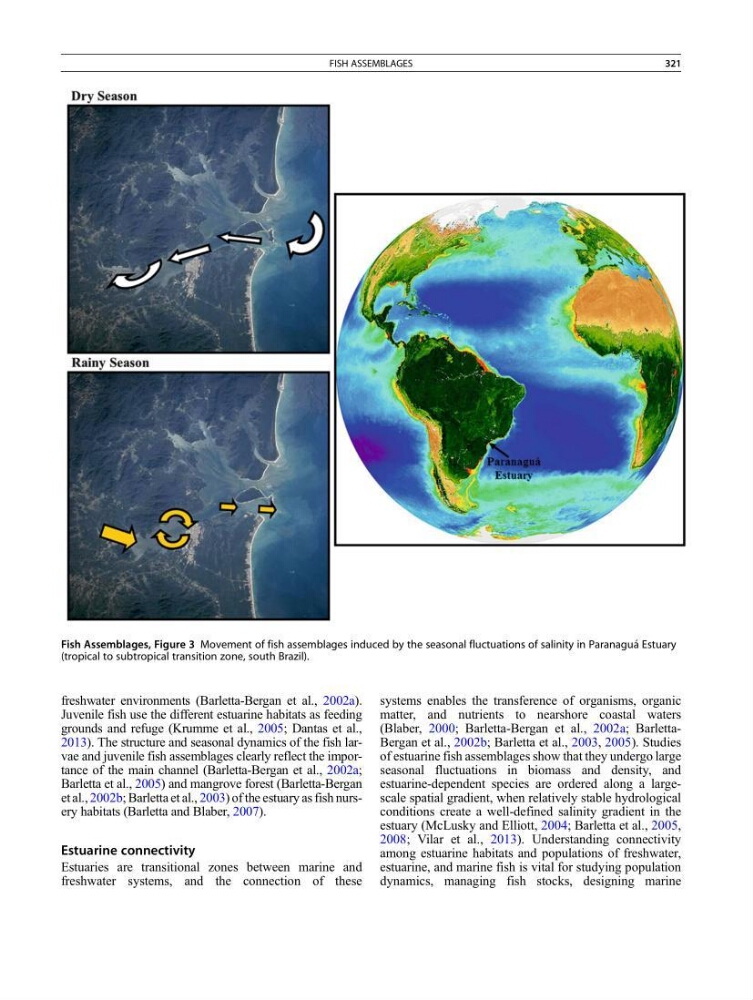
Fish Assemblages, Figure 3 Movement of fish assemblages induced by the seasonal fluctuations of salinity in Paranagua ´ Estuary
(tropical to subtropical transition zone, south Brazil).
FISH ASSEMBLAGES
321
Juvenile fish use the different estuarine habitats as feeding
grounds and refuge (Krumme et al., 2005; Dantas et al.,
2013). The structure and seasonal dynamics of the fish larvae and juvenile fish assemblages clearly reflect the importance of the main channel (Barletta-Bergan et al., 2002a;
Barletta et al., 2005) and mangrove forest (Barletta-Bergan
et al., 2002b; Barletta et al., 2003) of the estuary as fish nursery habitats (Barletta and Blaber, 2007).
Estuarine connectivity
Estuaries are transitional zones between marine and
freshwater systems, and the connection of these
systems enables the transference of organisms, organic
matter, and nutrients to nearshore coastal waters
(Blaber, 2000; Barletta-Bergan et al., 2002a; BarlettaBergan et al., 2002b; Barletta et al., 2003, 2005). Studies
of estuarine fish assemblages show that they undergo large
seasonal fluctuations in biomass and density, and
estuarine-dependent species are ordered along a largescale spatial gradient, when relatively stable hydrological
conditions create a well-defined salinity gradient in the
estuary (McLusky and Elliott, 2004; Barletta et al., 2005,
2008; Vilar et al., 2013). Understanding connectivity
among estuarine habitats and populations of freshwater,
estuarine, and marine fish is vital for studying population
dynamics, managing fish stocks, designing marine
Fish Assemblages, Figure 3 Movement of fish assemblages induced by the seasonal fluctuations of salinity in Paranagua ´ Estuary
(tropical to subtropical transition zone, south Brazil).
FISH ASSEMBLAGES
321