

Estuarine habitat roles
Estuaries in the tropical (Blaber, 2000; Barletta et al.,
2005; Dantas et al., 2012), subtropical (Jaureguizar et al.,
2004), and temperate regions (Thiel et al., 1995) act as
breeding, mating, nursery, and feeding grounds for many
fish species. Estuarine habitat use depends on
a combination of the seasonal variation of abiotic factors
(e.g., salinity, turbidity, temperature) and biotic factors
(e.g., competition for food and space) (Blaber, 2000).
For example, mangrove intertidal creeks (Barletta et al.,
2000, 2003), main channels (Barletta et al., 2005, 2008;
Dantas et al., 2012), and seagrass beds (Dorenbosch
et al., 2006) provide different habitat for each fish species
in a fish assemblage, depending on the ontogenetic phase
of the species and the environmental conditions of specific
sites during different times scales. In mangrove estuaries,
the controlling marine influence is the tide, and
up-estuary is the seasonal fluctuation of freshwater river
flow (Barletta et al., 2010). Fish assemblages can be
described by their biomass, density, and number of species, and these variables change in the estuary main
channel, mudflats, and intertidal mangrove forest, at both
high and low tides. The mangrove forest along the northern coast of South America is not flooded during low tide
(tidal range, 5–7 m). Nevertheless, many fish species
remain in the mangrove forest during this time. Tidal
behavior strategies are described for fish species that linger in mangrove forests during low tide, using this habitat
for protection from predation and for food resources
(Barletta et al., 2000).
Estuaries support resident fish assemblages that are
functionally important as an intermediate trophic level
for many consumers. The production and seasonal occurrence of fishes vary with salinity, hydrology, and nutrient
status in the estuary, and many species are adapted to these
salinity fluctuations and are resident within estuarine habitats. Other species remain in estuaries only during certain
periods of their life cycles and when the conditions are
favorable (Blaber, 2000; Barletta et al., 2010).
Estuaries are frequently referred to as nursery areas for
fishes (Beck et al., 2001). Ichthyoplankton can originate
either from within the estuary or from adjacent marine and
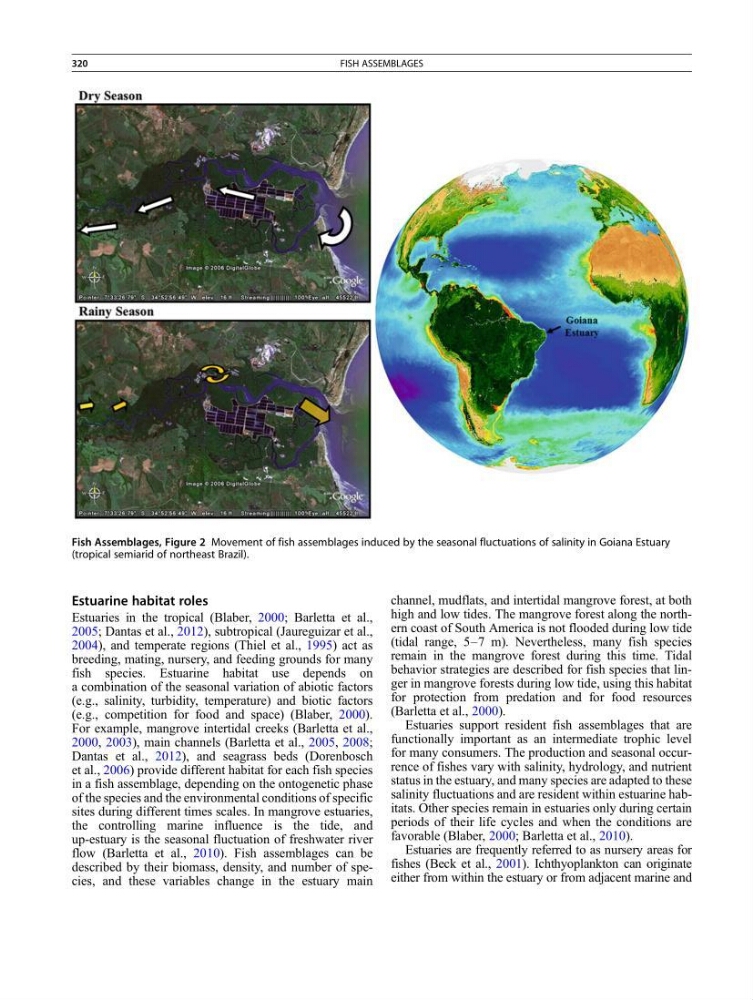
Fish Assemblages, Figure 2 Movement of fish assemblages induced by the seasonal fluctuations of salinity in Goiana Estuary
(tropical semiarid of northeast Brazil).
320
FISH ASSEMBLAGES
Estuaries in the tropical (Blaber, 2000; Barletta et al.,
2005; Dantas et al., 2012), subtropical (Jaureguizar et al.,
2004), and temperate regions (Thiel et al., 1995) act as
breeding, mating, nursery, and feeding grounds for many
fish species. Estuarine habitat use depends on
a combination of the seasonal variation of abiotic factors
(e.g., salinity, turbidity, temperature) and biotic factors
(e.g., competition for food and space) (Blaber, 2000).
For example, mangrove intertidal creeks (Barletta et al.,
2000, 2003), main channels (Barletta et al., 2005, 2008;
Dantas et al., 2012), and seagrass beds (Dorenbosch
et al., 2006) provide different habitat for each fish species
in a fish assemblage, depending on the ontogenetic phase
of the species and the environmental conditions of specific
sites during different times scales. In mangrove estuaries,
the controlling marine influence is the tide, and
up-estuary is the seasonal fluctuation of freshwater river
flow (Barletta et al., 2010). Fish assemblages can be
described by their biomass, density, and number of species, and these variables change in the estuary main
channel, mudflats, and intertidal mangrove forest, at both
high and low tides. The mangrove forest along the northern coast of South America is not flooded during low tide
(tidal range, 5–7 m). Nevertheless, many fish species
remain in the mangrove forest during this time. Tidal
behavior strategies are described for fish species that linger in mangrove forests during low tide, using this habitat
for protection from predation and for food resources
(Barletta et al., 2000).
Estuaries support resident fish assemblages that are
functionally important as an intermediate trophic level
for many consumers. The production and seasonal occurrence of fishes vary with salinity, hydrology, and nutrient
status in the estuary, and many species are adapted to these
salinity fluctuations and are resident within estuarine habitats. Other species remain in estuaries only during certain
periods of their life cycles and when the conditions are
favorable (Blaber, 2000; Barletta et al., 2010).
Estuaries are frequently referred to as nursery areas for
fishes (Beck et al., 2001). Ichthyoplankton can originate
either from within the estuary or from adjacent marine and
Fish Assemblages, Figure 2 Movement of fish assemblages induced by the seasonal fluctuations of salinity in Goiana Estuary
(tropical semiarid of northeast Brazil).
320
FISH ASSEMBLAGES