

freshwater and shallow depths. The estuarine fish assemblage occupies the mixohaline waters of the La Plata Estuary, and its ichthyofauna is dominated by euryhaline
species of marine origin. The species composition shows
a gradient to the mouth, where estuarine resident species
predominate and, to a lesser degree, occasional freshwater
species, marine species, either stragglers or migrants, and
estuarine migrants (Barletta et al., 2010).
In the intertidal mangrove creek habitats of an estuarine
ecosystem in the northern Brazilian coast, fishes utilize the
intertidal areas in different ways (Barletta et al., 2000,
2003; Barletta-Bergan et al., 2002b). Some fishes remain
in the intertidal area at low tide, while others avoid this
area during the low tide, using the habitat only when it is
submerged. Two distinct fish assemblage patterns can be
observed in the intertidal mangrove creeks in this region.
Estuarine residents, marine seasonal migrants, and marine
juvenile migrants represent the first fish assemblage, and
marine juvenile migrants and marine adventitious visitors
form the second fish assemblage. This pattern is strongly
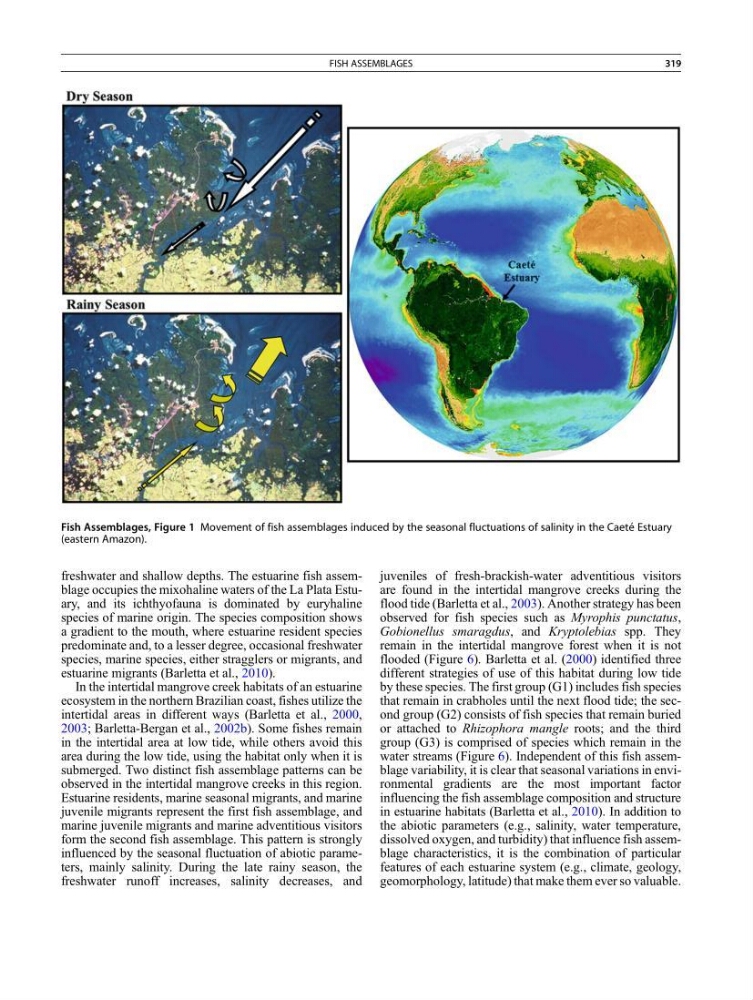
influenced by the seasonal fluctuation of abiotic parameters, mainly salinity. During the late rainy season, the
freshwater runoff increases, salinity decreases, and
juveniles of fresh-brackish-water adventitious visitors
are found in the intertidal mangrove creeks during the
flood tide (Barletta et al., 2003). Another strategy has been
observed for fish species such as Myrophis punctatus,
Gobionellus smaragdus, and Kryptolebias spp. They
remain in the intertidal mangrove forest when it is not
flooded (Figure 6). Barletta et al. (2000) identified three
different strategies of use of this habitat during low tide
by these species. The first group (G1) includes fish species
that remain in crabholes until the next flood tide; the second group (G2) consists of fish species that remain buried
or attached to Rhizophora mangle roots; and the third
group (G3) is comprised of species which remain in the
water streams (Figure 6). Independent of this fish assemblage variability, it is clear that seasonal variations in environmental gradients are the most important factor
influencing the fish assemblage composition and structure
in estuarine habitats (Barletta et al., 2010). In addition to
the abiotic parameters (e.g., salinity, water temperature,
dissolved oxygen, and turbidity) that influence fish assemblage characteristics, it is the combination of particular
features of each estuarine system (e.g., climate, geology,
geomorphology, latitude) that make them ever so valuable.
Fish Assemblages, Figure 1 Movement of fish assemblages induced by the seasonal fluctuations of salinity in the Caete ´ Estuary
(eastern Amazon).
FISH ASSEMBLAGES
319
species of marine origin. The species composition shows
a gradient to the mouth, where estuarine resident species
predominate and, to a lesser degree, occasional freshwater
species, marine species, either stragglers or migrants, and
estuarine migrants (Barletta et al., 2010).
In the intertidal mangrove creek habitats of an estuarine
ecosystem in the northern Brazilian coast, fishes utilize the
intertidal areas in different ways (Barletta et al., 2000,
2003; Barletta-Bergan et al., 2002b). Some fishes remain
in the intertidal area at low tide, while others avoid this
area during the low tide, using the habitat only when it is
submerged. Two distinct fish assemblage patterns can be
observed in the intertidal mangrove creeks in this region.
Estuarine residents, marine seasonal migrants, and marine
juvenile migrants represent the first fish assemblage, and
marine juvenile migrants and marine adventitious visitors
form the second fish assemblage. This pattern is strongly
influenced by the seasonal fluctuation of abiotic parameters, mainly salinity. During the late rainy season, the
freshwater runoff increases, salinity decreases, and
juveniles of fresh-brackish-water adventitious visitors
are found in the intertidal mangrove creeks during the
flood tide (Barletta et al., 2003). Another strategy has been
observed for fish species such as Myrophis punctatus,
Gobionellus smaragdus, and Kryptolebias spp. They
remain in the intertidal mangrove forest when it is not
flooded (Figure 6). Barletta et al. (2000) identified three
different strategies of use of this habitat during low tide
by these species. The first group (G1) includes fish species
that remain in crabholes until the next flood tide; the second group (G2) consists of fish species that remain buried
or attached to Rhizophora mangle roots; and the third
group (G3) is comprised of species which remain in the
water streams (Figure 6). Independent of this fish assemblage variability, it is clear that seasonal variations in environmental gradients are the most important factor
influencing the fish assemblage composition and structure
in estuarine habitats (Barletta et al., 2010). In addition to
the abiotic parameters (e.g., salinity, water temperature,
dissolved oxygen, and turbidity) that influence fish assemblage characteristics, it is the combination of particular
features of each estuarine system (e.g., climate, geology,
geomorphology, latitude) that make them ever so valuable.
Fish Assemblages, Figure 1 Movement of fish assemblages induced by the seasonal fluctuations of salinity in the Caete ´ Estuary
(eastern Amazon).
FISH ASSEMBLAGES
319