

hydrologic recharge mechanisms (viz., rain-recharged,
tide-recharged marine/brackish water, tidally driven freshwater, seasonally rising and falling water table above
freshwater lenses, and seasonally rising and falling water
table above saline water lenses, the latter varying seasonally). Deltas set in the various possible tidal ranges and
climate types provide further variation on the dynamics
of hydrology and hydrochemistry.
In the midst of standard salinity gradients and intraannual variations resulting from seasonal inflows and the
size of the estuary, there are important localized interactions occurring between water bodies. While surrounded
by open estuarine waters (into which the delta has been
prograding) and distributary channel systems that can vary
from marine to brackish to freshwater seasonally, the core
of a delta may contain a freshwater lens (similar to the
freshwater lens under an oceanic island) that interacts
hydrologically on its margins with the estuarine water
body or the channels. As such, the contact of the freshwater lens has a saline/freshwater contact similar to the
Ghyben-Herzberg saline and freshwater relation (Todd,
1959). Local areas on the subaerial delta plain, comprising
contrasting mud-floored lagoons/ponds or sandy cheniers,
or abandoned channels, are affected by river inflow, or
rain, or evaporation and develop salinities and
hydrochemically specific surface and near-surface water
bodies and groundwater bodies, respectively, that
perturbate the salinity/hydrochemistry of the main body
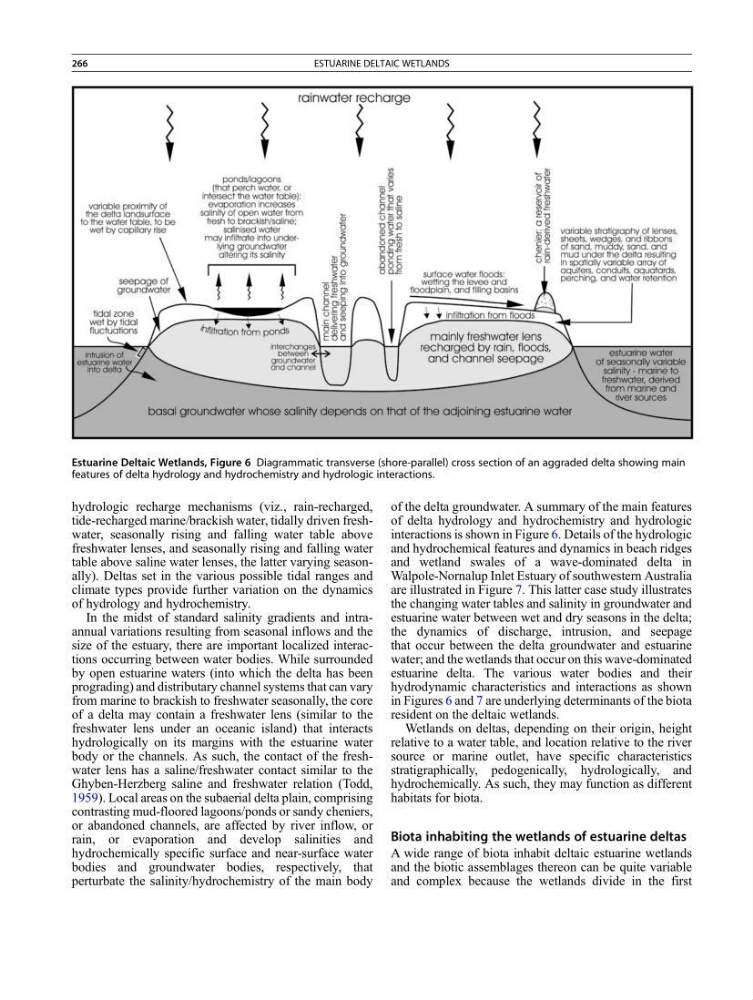
of the delta groundwater. A summary of the main features
of delta hydrology and hydrochemistry and hydrologic
interactions is shown in Figure 6. Details of the hydrologic
and hydrochemical features and dynamics in beach ridges
and wetland swales of a wave-dominated delta in
Walpole-Nornalup Inlet Estuary of southwestern Australia
are illustrated in Figure 7. This latter case study illustrates
the changing water tables and salinity in groundwater and
estuarine water between wet and dry seasons in the delta;
the dynamics of discharge, intrusion, and seepage
that occur between the delta groundwater and estuarine
water; and the wetlands that occur on this wave-dominated
estuarine delta. The various water bodies and their
hydrodynamic characteristics and interactions as shown
in Figures 6 and 7 are underlying determinants of the biota
resident on the deltaic wetlands.
Wetlands on deltas, depending on their origin, height
relative to a water table, and location relative to the river
source or marine outlet, have specific characteristics
stratigraphically, pedogenically, hydrologically, and
hydrochemically. As such, they may function as different
habitats for biota.
Biota inhabiting the wetlands of estuarine deltas
A wide range of biota inhabit deltaic estuarine wetlands
and the biotic assemblages thereon can be quite variable
and complex because the wetlands divide in the first
Estuarine Deltaic Wetlands, Figure 6 Diagrammatic transverse (shore-parallel) cross section of an aggraded delta showing main
features of delta hydrology and hydrochemistry and hydrologic interactions.
266
ESTUARINE DELTAIC WETLANDS
tide-recharged marine/brackish water, tidally driven freshwater, seasonally rising and falling water table above
freshwater lenses, and seasonally rising and falling water
table above saline water lenses, the latter varying seasonally). Deltas set in the various possible tidal ranges and
climate types provide further variation on the dynamics
of hydrology and hydrochemistry.
In the midst of standard salinity gradients and intraannual variations resulting from seasonal inflows and the
size of the estuary, there are important localized interactions occurring between water bodies. While surrounded
by open estuarine waters (into which the delta has been
prograding) and distributary channel systems that can vary
from marine to brackish to freshwater seasonally, the core
of a delta may contain a freshwater lens (similar to the
freshwater lens under an oceanic island) that interacts
hydrologically on its margins with the estuarine water
body or the channels. As such, the contact of the freshwater lens has a saline/freshwater contact similar to the
Ghyben-Herzberg saline and freshwater relation (Todd,
1959). Local areas on the subaerial delta plain, comprising
contrasting mud-floored lagoons/ponds or sandy cheniers,
or abandoned channels, are affected by river inflow, or
rain, or evaporation and develop salinities and
hydrochemically specific surface and near-surface water
bodies and groundwater bodies, respectively, that
perturbate the salinity/hydrochemistry of the main body
of the delta groundwater. A summary of the main features
of delta hydrology and hydrochemistry and hydrologic
interactions is shown in Figure 6. Details of the hydrologic
and hydrochemical features and dynamics in beach ridges
and wetland swales of a wave-dominated delta in
Walpole-Nornalup Inlet Estuary of southwestern Australia
are illustrated in Figure 7. This latter case study illustrates
the changing water tables and salinity in groundwater and
estuarine water between wet and dry seasons in the delta;
the dynamics of discharge, intrusion, and seepage
that occur between the delta groundwater and estuarine
water; and the wetlands that occur on this wave-dominated
estuarine delta. The various water bodies and their
hydrodynamic characteristics and interactions as shown
in Figures 6 and 7 are underlying determinants of the biota
resident on the deltaic wetlands.
Wetlands on deltas, depending on their origin, height
relative to a water table, and location relative to the river
source or marine outlet, have specific characteristics
stratigraphically, pedogenically, hydrologically, and
hydrochemically. As such, they may function as different
habitats for biota.
Biota inhabiting the wetlands of estuarine deltas
A wide range of biota inhabit deltaic estuarine wetlands
and the biotic assemblages thereon can be quite variable
and complex because the wetlands divide in the first
Estuarine Deltaic Wetlands, Figure 6 Diagrammatic transverse (shore-parallel) cross section of an aggraded delta showing main
features of delta hydrology and hydrochemistry and hydrologic interactions.
266
ESTUARINE DELTAIC WETLANDS