

instance into terrestrial (fluvial) types and coastal (marine/
estuarine) types and in the second instance the type of
biota that inhabits these environments is determined by
a number of factors: biogeography and climate, substrates,
salinity and hydrochemistry, hydroperiod (frequency of
flooding, inundation, or wetting), height of the wetland
above MSL, and tidal range. For instance, in tropical climates mangroves colonize the mid- to high-tidal zones
(habitats) of deltas, while in temperate climates there is
salt marsh in this zone. On low-tidal flats, there is often
an invertebrate benthos of varying biodiversity related to
biogeography and climate. Low-tidal flats comprising
sand in tropical climates support a range and diversity of
invertebrates that include molluscs, crustaceans, echinoderms, polychaetes, and anemones, while those in temperate climates support a lower diversity of molluscs,
crustaceans, and polychaetes. Low muddy tidal flats in
tropical climates support a more diverse range of molluscs, crustaceans, and polychaetes, than those in temperate climates. A description of some of the typical biota that
inhabits estuarine deltaic wetlands in Australia as related
to climate, hydrography/oceanography, tidal range, tidal
level, wetland type (habitat), substrate, hydroperiod, and
salinity is provided in Table 3.
Examples of some of the biotic assemblages on deltaic
wetlands in the Lawley River Estuary, Leschenault Inlet
Estuary, and Swan-Canning Estuary are shown in Figure 8.
The muddy tide-dominated macrotidal delta of the Lawley
River Estuary supports mangroves on mid- to high-tidal
flats, salt marsh on the high-tidal alluvial fans, and
high-diversity molluscs, crustaceans, and polychaetes in
the low-tidal flats. The sand-and-mud tide-dominated
microtidal Preston River Delta of the Leschenault
Inlet Estuary supports mangroves and salt marsh in the
mid- to high-tidal flats and molluscs, crustaceans, and
polychaetes in the low-tidal flats. The sand-and-mud
tide-dominated microtidal delta of the Swan-Canning
River Estuary supports salt marsh and forests/heath in
the mid- to high-tidal flats and molluscs, crustaceans,
and polychaetes in the low-tidal flats. For the Canning
Delta of the Swan-Canning River Estuary, the vegetation
manifests a plethora of floristic units within the salt marsh,
compared to the salt marsh of the Lawley River Delta and
the Preston River Delta, and so it presented in more detail
to illustrate the complexity of floristic units that can occur
on such estuarine deltas.
Discussion and summary
The landforms that comprise the deltas are the foundation to
wetlands and the habitats for biota. The landform types and
hence the wetland types vary according to whether the delta
is fluvially dominated, wave dominated, or tide dominated.
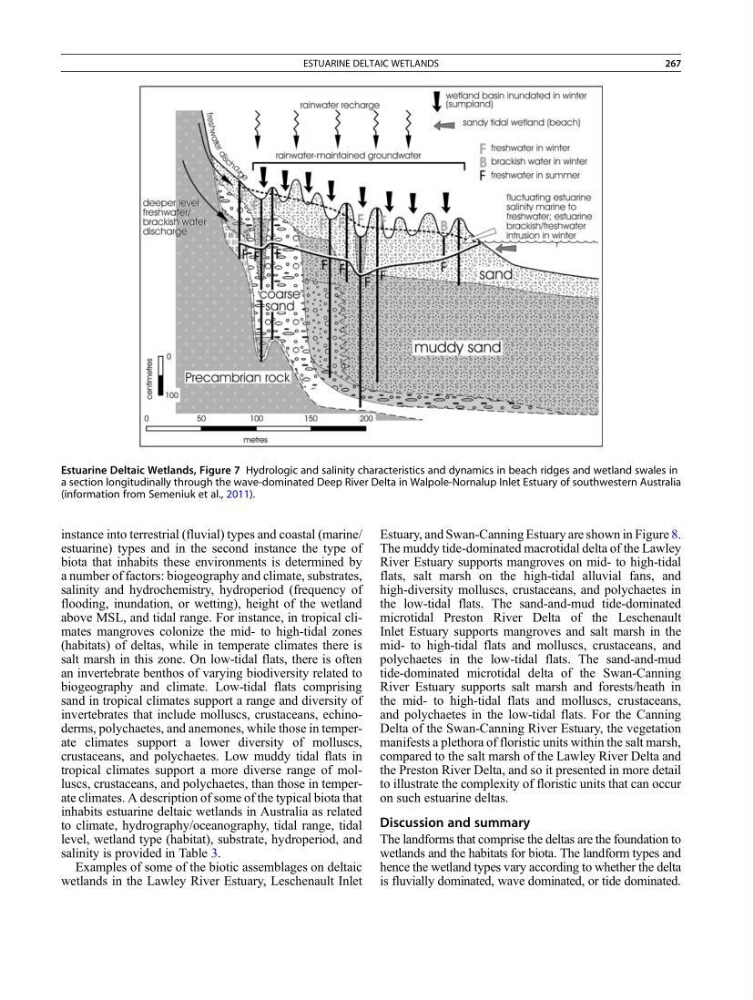
Estuarine Deltaic Wetlands, Figure 7 Hydrologic and salinity characteristics and dynamics in beach ridges and wetland swales in
a section longitudinally through the wave-dominated Deep River Delta in Walpole-Nornalup Inlet Estuary of southwestern Australia
(information from Semeniuk et al., 2011).
ESTUARINE DELTAIC WETLANDS
267
estuarine) types and in the second instance the type of
biota that inhabits these environments is determined by
a number of factors: biogeography and climate, substrates,
salinity and hydrochemistry, hydroperiod (frequency of
flooding, inundation, or wetting), height of the wetland
above MSL, and tidal range. For instance, in tropical climates mangroves colonize the mid- to high-tidal zones
(habitats) of deltas, while in temperate climates there is
salt marsh in this zone. On low-tidal flats, there is often
an invertebrate benthos of varying biodiversity related to
biogeography and climate. Low-tidal flats comprising
sand in tropical climates support a range and diversity of
invertebrates that include molluscs, crustaceans, echinoderms, polychaetes, and anemones, while those in temperate climates support a lower diversity of molluscs,
crustaceans, and polychaetes. Low muddy tidal flats in
tropical climates support a more diverse range of molluscs, crustaceans, and polychaetes, than those in temperate climates. A description of some of the typical biota that
inhabits estuarine deltaic wetlands in Australia as related
to climate, hydrography/oceanography, tidal range, tidal
level, wetland type (habitat), substrate, hydroperiod, and
salinity is provided in Table 3.
Examples of some of the biotic assemblages on deltaic
wetlands in the Lawley River Estuary, Leschenault Inlet
Estuary, and Swan-Canning Estuary are shown in Figure 8.
The muddy tide-dominated macrotidal delta of the Lawley
River Estuary supports mangroves on mid- to high-tidal
flats, salt marsh on the high-tidal alluvial fans, and
high-diversity molluscs, crustaceans, and polychaetes in
the low-tidal flats. The sand-and-mud tide-dominated
microtidal Preston River Delta of the Leschenault
Inlet Estuary supports mangroves and salt marsh in the
mid- to high-tidal flats and molluscs, crustaceans, and
polychaetes in the low-tidal flats. The sand-and-mud
tide-dominated microtidal delta of the Swan-Canning
River Estuary supports salt marsh and forests/heath in
the mid- to high-tidal flats and molluscs, crustaceans,
and polychaetes in the low-tidal flats. For the Canning
Delta of the Swan-Canning River Estuary, the vegetation
manifests a plethora of floristic units within the salt marsh,
compared to the salt marsh of the Lawley River Delta and
the Preston River Delta, and so it presented in more detail
to illustrate the complexity of floristic units that can occur
on such estuarine deltas.
Discussion and summary
The landforms that comprise the deltas are the foundation to
wetlands and the habitats for biota. The landform types and
hence the wetland types vary according to whether the delta
is fluvially dominated, wave dominated, or tide dominated.
Estuarine Deltaic Wetlands, Figure 7 Hydrologic and salinity characteristics and dynamics in beach ridges and wetland swales in
a section longitudinally through the wave-dominated Deep River Delta in Walpole-Nornalup Inlet Estuary of southwestern Australia
(information from Semeniuk et al., 2011).
ESTUARINE DELTAIC WETLANDS
267