

waves, will have a wave-dominated form. Alternatively,
where tide and wave energy are relatively low, the delta
will have a fluvially dominated form.
Landforms of deltas that can form wetlands
The landforms that comprise deltas form the foundation
to wetlands and the habitats for wetland biota. Landforms
vary across the different types of deltas and across
a single delta type. In fluvially dominated deltas, the
landforms comprise tidal flats, beaches, tidal creeks,
beaches, floodplains, local cheniers, distributary channels, levee banks, water-filled abandoned channels, and
sediment-filled abandoned channels. In wave-dominated
deltas, the landforms comprise bars, beaches, sandy tidal
flats, beach ridges, swales, narrow to circular lagoons
leeward of bars and beach ridges, tidal flats, distributary
channels, rarer tidal creeks, levee banks, water-filled
abandoned channels, sediment-filled abandoned channels, and floodplains. In tide-dominated deltas, the
landforms comprise muddy and sandy tidal flats, tidal
shoals, tidal creeks, floodplains, local cheniers, distributary channels, levee banks, water-filled abandoned channels, and sediment-filled abandoned channels. In broad
terms, the delta can be separated into a subaerial portion
that has aggraded above tidal levels and largely encompasses fluvial landforms and processes, and into a tidal
portion that encompasses marine/estuarine landforms and
processes.
What is a wetland on a deltaic plain?
In a delta, a wetland essentially is either the terrestrial or
the tidally inundated part of the delta that is wet by natural
processes such that there is a permanent physical,
chemical, or biological imprint on the wetland sediment
or soil reflecting the hydric or hydrochemical condition,
or a biological response in terms of growth of hydrophilic
vegetation or accumulation of shell (Figure 3). For terrestrial wetlands on the subaerial parts of deltas (i.e., those
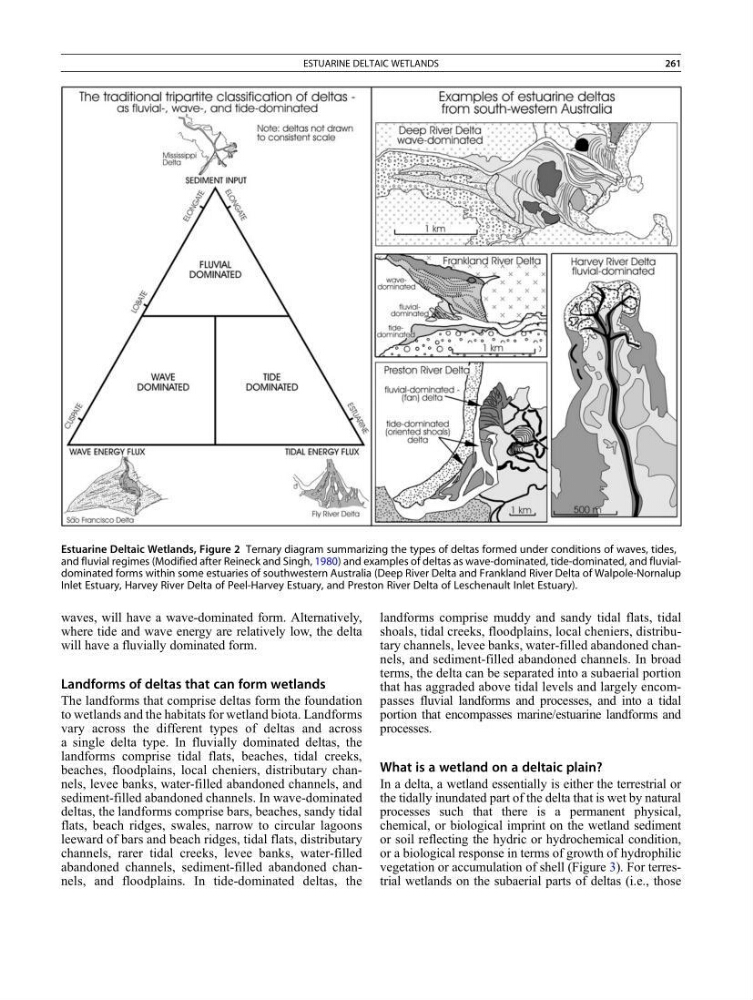
Estuarine Deltaic Wetlands, Figure 2 Ternary diagram summarizing the types of deltas formed under conditions of waves, tides,
and fluvial regimes (Modified after Reineck and Singh, 1980) and examples of deltas as wave-dominated, tide-dominated, and fluvialdominated forms within some estuaries of southwestern Australia (Deep River Delta and Frankland River Delta of Walpole-Nornalup
Inlet Estuary, Harvey River Delta of Peel-Harvey Estuary, and Preston River Delta of Leschenault Inlet Estuary).
ESTUARINE DELTAIC WETLANDS
261
where tide and wave energy are relatively low, the delta
will have a fluvially dominated form.
Landforms of deltas that can form wetlands
The landforms that comprise deltas form the foundation
to wetlands and the habitats for wetland biota. Landforms
vary across the different types of deltas and across
a single delta type. In fluvially dominated deltas, the
landforms comprise tidal flats, beaches, tidal creeks,
beaches, floodplains, local cheniers, distributary channels, levee banks, water-filled abandoned channels, and
sediment-filled abandoned channels. In wave-dominated
deltas, the landforms comprise bars, beaches, sandy tidal
flats, beach ridges, swales, narrow to circular lagoons
leeward of bars and beach ridges, tidal flats, distributary
channels, rarer tidal creeks, levee banks, water-filled
abandoned channels, sediment-filled abandoned channels, and floodplains. In tide-dominated deltas, the
landforms comprise muddy and sandy tidal flats, tidal
shoals, tidal creeks, floodplains, local cheniers, distributary channels, levee banks, water-filled abandoned channels, and sediment-filled abandoned channels. In broad
terms, the delta can be separated into a subaerial portion
that has aggraded above tidal levels and largely encompasses fluvial landforms and processes, and into a tidal
portion that encompasses marine/estuarine landforms and
processes.
What is a wetland on a deltaic plain?
In a delta, a wetland essentially is either the terrestrial or
the tidally inundated part of the delta that is wet by natural
processes such that there is a permanent physical,
chemical, or biological imprint on the wetland sediment
or soil reflecting the hydric or hydrochemical condition,
or a biological response in terms of growth of hydrophilic
vegetation or accumulation of shell (Figure 3). For terrestrial wetlands on the subaerial parts of deltas (i.e., those
Estuarine Deltaic Wetlands, Figure 2 Ternary diagram summarizing the types of deltas formed under conditions of waves, tides,
and fluvial regimes (Modified after Reineck and Singh, 1980) and examples of deltas as wave-dominated, tide-dominated, and fluvialdominated forms within some estuaries of southwestern Australia (Deep River Delta and Frankland River Delta of Walpole-Nornalup
Inlet Estuary, Harvey River Delta of Peel-Harvey Estuary, and Preston River Delta of Leschenault Inlet Estuary).
ESTUARINE DELTAIC WETLANDS
261