

Cross-references
Climate Change
Coastal Lagoons
Coastal Wetlands
Dissolved Oxygen
Estuarine Circulation
Food Web/Trophic Dynamics
Forested Wetland Habitat
Mangroves
Saltmarshes
Sea-Level Change and Coastal Wetlands
Sediment Transport
Tidal Ranges
Wetlands
ESTUARINE DELTAIC WETLANDS
Vic Semeniuk and Christine Semeniuk
V & C Semeniuk Research Group, Warwick,
WA, Australia
Definition
Wetlands developed on a delta within an estuary.
An estuary and the formation of a delta
An estuary is a river-to-marine transitional environment
where marine salinity is measurably diluted by (riverine)
freshwater in a valley tract, an inlet, a coastal lagoon, or
an embayment, producing a salinity gradient from the
river to the sea, from freshwater to marine. This is
a positive estuary. In some climates, where river contribution is seasonal or is markedly less than the evaporation
from the coastal water body, the inner parts of the estuary
are subject to evaporation, and the head of the estuary may
become seasonally hypersaline or at least attain salinity
higher than seawater. This is a negative or inverse estuary.
In either case, freshwater influx usually is via a river.
In the most common context where the freshwater
delivery system to the estuary is riverine, the river also
delivers fluvial sediment as traction load of sand and
gravel or in suspension as silt and clay. Such sedimentary
material commonly is deposited at the mouth of the river
where it enters the more open water system of the estuary
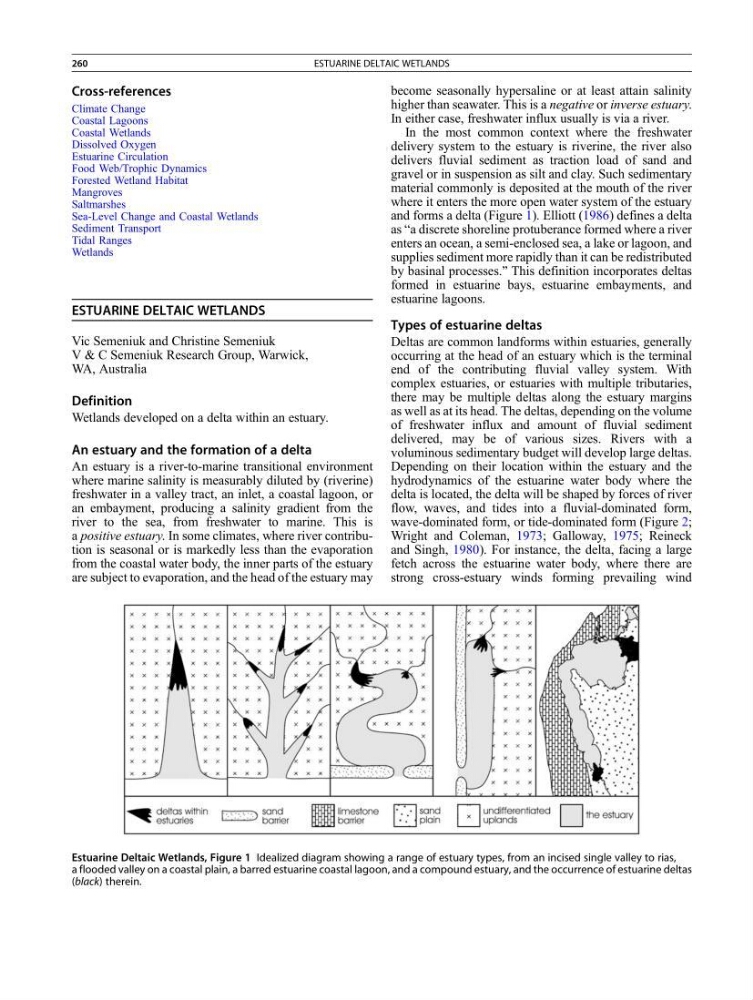
and forms a delta (Figure 1). Elliott (1986) defines a delta
as “a discrete shoreline protuberance formed where a river
enters an ocean, a semi-enclosed sea, a lake or lagoon, and
supplies sediment more rapidly than it can be redistributed
by basinal processes.” This definition incorporates deltas
formed in estuarine bays, estuarine embayments, and
estuarine lagoons.
Types of estuarine deltas
Deltas are common landforms within estuaries, generally
occurring at the head of an estuary which is the terminal
end of the contributing fluvial valley system. With
complex estuaries, or estuaries with multiple tributaries,
there may be multiple deltas along the estuary margins
as well as at its head. The deltas, depending on the volume
of freshwater influx and amount of fluvial sediment
delivered, may be of various sizes. Rivers with a
voluminous sedimentary budget will develop large deltas.
Depending on their location within the estuary and the
hydrodynamics of the estuarine water body where the
delta is located, the delta will be shaped by forces of river
flow, waves, and tides into a fluvial-dominated form,
wave-dominated form, or tide-dominated form (Figure 2;
Wright and Coleman, 1973; Galloway, 1975; Reineck
and Singh, 1980). For instance, the delta, facing a large
fetch across the estuarine water body, where there are
strong cross-estuary winds forming prevailing wind
Estuarine Deltaic Wetlands, Figure 1 Idealized diagram showing a range of estuary types, from an incised single valley to rias,
a flooded valley on a coastal plain, a barred estuarine coastal lagoon, and a compound estuary, and the occurrence of estuarine deltas
(black) therein.
260
ESTUARINE DELTAIC WETLANDS
Climate Change
Coastal Lagoons
Coastal Wetlands
Dissolved Oxygen
Estuarine Circulation
Food Web/Trophic Dynamics
Forested Wetland Habitat
Mangroves
Saltmarshes
Sea-Level Change and Coastal Wetlands
Sediment Transport
Tidal Ranges
Wetlands
ESTUARINE DELTAIC WETLANDS
Vic Semeniuk and Christine Semeniuk
V & C Semeniuk Research Group, Warwick,
WA, Australia
Definition
Wetlands developed on a delta within an estuary.
An estuary and the formation of a delta
An estuary is a river-to-marine transitional environment
where marine salinity is measurably diluted by (riverine)
freshwater in a valley tract, an inlet, a coastal lagoon, or
an embayment, producing a salinity gradient from the
river to the sea, from freshwater to marine. This is
a positive estuary. In some climates, where river contribution is seasonal or is markedly less than the evaporation
from the coastal water body, the inner parts of the estuary
are subject to evaporation, and the head of the estuary may
become seasonally hypersaline or at least attain salinity
higher than seawater. This is a negative or inverse estuary.
In either case, freshwater influx usually is via a river.
In the most common context where the freshwater
delivery system to the estuary is riverine, the river also
delivers fluvial sediment as traction load of sand and
gravel or in suspension as silt and clay. Such sedimentary
material commonly is deposited at the mouth of the river
where it enters the more open water system of the estuary
and forms a delta (Figure 1). Elliott (1986) defines a delta
as “a discrete shoreline protuberance formed where a river
enters an ocean, a semi-enclosed sea, a lake or lagoon, and
supplies sediment more rapidly than it can be redistributed
by basinal processes.” This definition incorporates deltas
formed in estuarine bays, estuarine embayments, and
estuarine lagoons.
Types of estuarine deltas
Deltas are common landforms within estuaries, generally
occurring at the head of an estuary which is the terminal
end of the contributing fluvial valley system. With
complex estuaries, or estuaries with multiple tributaries,
there may be multiple deltas along the estuary margins
as well as at its head. The deltas, depending on the volume
of freshwater influx and amount of fluvial sediment
delivered, may be of various sizes. Rivers with a
voluminous sedimentary budget will develop large deltas.
Depending on their location within the estuary and the
hydrodynamics of the estuarine water body where the
delta is located, the delta will be shaped by forces of river
flow, waves, and tides into a fluvial-dominated form,
wave-dominated form, or tide-dominated form (Figure 2;
Wright and Coleman, 1973; Galloway, 1975; Reineck
and Singh, 1980). For instance, the delta, facing a large
fetch across the estuarine water body, where there are
strong cross-estuary winds forming prevailing wind
Estuarine Deltaic Wetlands, Figure 1 Idealized diagram showing a range of estuary types, from an incised single valley to rias,
a flooded valley on a coastal plain, a barred estuarine coastal lagoon, and a compound estuary, and the occurrence of estuarine deltas
(black) therein.
260
ESTUARINE DELTAIC WETLANDS