

resulting in an environmentally stochastic stress zone
(Attrill and Rundle, 2002). They have been well studied
in terrestrial systems and at terrestrial/aquatic interfaces,
including the interface between rivers and estuaries.
Ecoclines have been only recently defined as gradient
zones containing relatively heterogeneous faunal communities, which are environmentally more stable than those
of ecotones (Attrill and Rundle, 2002). Ecoclines represent a boundary of more gradual and progressive change
between two systems, resulting from a response to stepwise differences of a major environmental driver that controls the transition process and is followed or modified by
other forcings.
The environmental gradients occurring in estuaries can
be either classified as ecotones, represented by the transition community between the freshwater and marine species, or ecoclines comprised of a series of assemblages
along the estuarine salinity gradient (Attrill and Rundle,
2002). Other potential environmental influences on
estuarine ecoclines would be the seasonal changes in
freshwater flow (long-term process) or daily rhythm of
the tides (short-term process) that have a strong influence
on the estuarine community.
Consequences of man-driven changes
in environmental gradients
Estuaries have been historically impacted by anthropogenic activities, such as land reclamation, functioning of
ports and maritime terminals, harboring of industrial
estates, and dredging of waterways, all of which are part
of a non-sustainable economic model which has failed to
take into consideration any ecological limits of the estuarine environment (Barletta et al., 2010). The effects of frequent and intense dredging activities in estuaries, for
example, can drastically alter the physical-chemical conditions of the system and change the patterns of their environmental gradients. For example, comparisons of
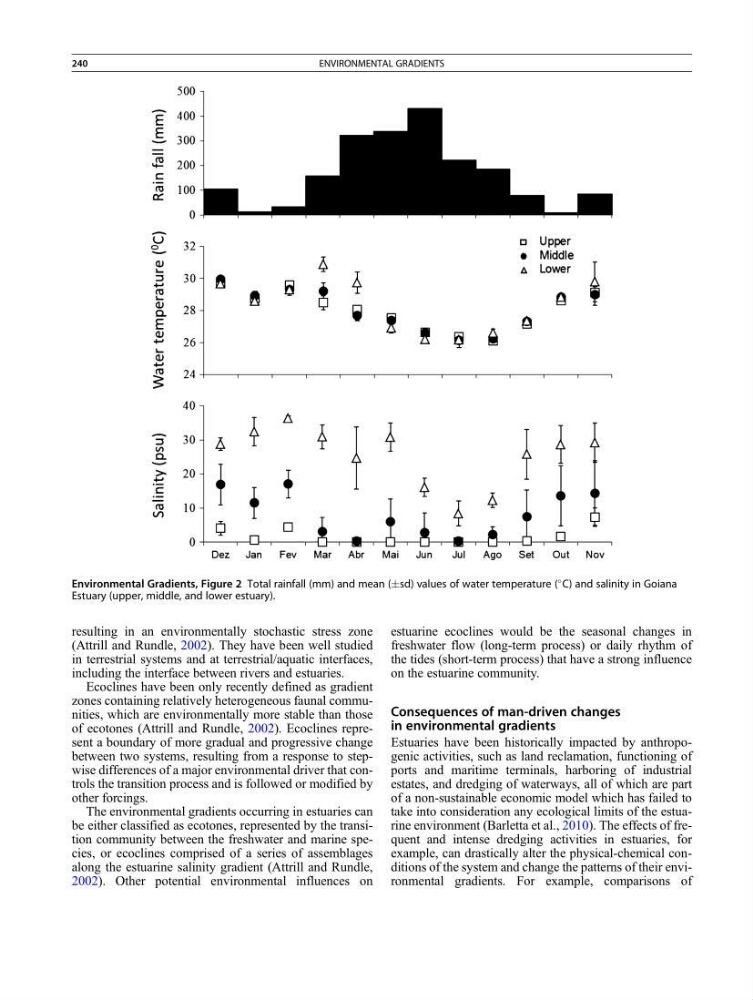
Environmental Gradients, Figure 2 Total rainfall (mm) and mean (Æsd) values of water temperature (
C) and salinity in Goiana
Estuary (upper, middle, and lower estuary).
240
ENVIRONMENTAL GRADIENTS
(Attrill and Rundle, 2002). They have been well studied
in terrestrial systems and at terrestrial/aquatic interfaces,
including the interface between rivers and estuaries.
Ecoclines have been only recently defined as gradient
zones containing relatively heterogeneous faunal communities, which are environmentally more stable than those
of ecotones (Attrill and Rundle, 2002). Ecoclines represent a boundary of more gradual and progressive change
between two systems, resulting from a response to stepwise differences of a major environmental driver that controls the transition process and is followed or modified by
other forcings.
The environmental gradients occurring in estuaries can
be either classified as ecotones, represented by the transition community between the freshwater and marine species, or ecoclines comprised of a series of assemblages
along the estuarine salinity gradient (Attrill and Rundle,
2002). Other potential environmental influences on
estuarine ecoclines would be the seasonal changes in
freshwater flow (long-term process) or daily rhythm of
the tides (short-term process) that have a strong influence
on the estuarine community.
Consequences of man-driven changes
in environmental gradients
Estuaries have been historically impacted by anthropogenic activities, such as land reclamation, functioning of
ports and maritime terminals, harboring of industrial
estates, and dredging of waterways, all of which are part
of a non-sustainable economic model which has failed to
take into consideration any ecological limits of the estuarine environment (Barletta et al., 2010). The effects of frequent and intense dredging activities in estuaries, for
example, can drastically alter the physical-chemical conditions of the system and change the patterns of their environmental gradients. For example, comparisons of
Environmental Gradients, Figure 2 Total rainfall (mm) and mean (Æsd) values of water temperature (
C) and salinity in Goiana
Estuary (upper, middle, and lower estuary).
240
ENVIRONMENTAL GRADIENTS