

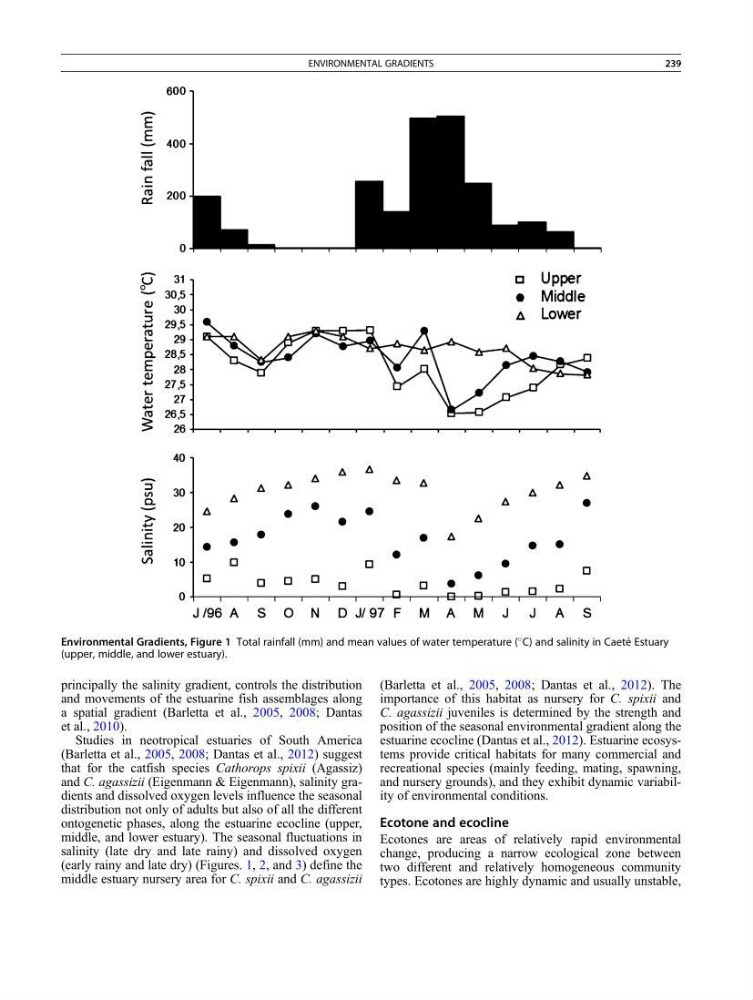
principally the salinity gradient, controls the distribution
and movements of the estuarine fish assemblages along
a spatial gradient (Barletta et al., 2005, 2008; Dantas
et al., 2010).
Studies in neotropical estuaries of South America
(Barletta et al., 2005, 2008; Dantas et al., 2012) suggest
that for the catfish species Cathorops spixii (Agassiz)
and C. agassizii (Eigenmann & Eigenmann), salinity gradients and dissolved oxygen levels influence the seasonal
distribution not only of adults but also of all the different
ontogenetic phases, along the estuarine ecocline (upper,
middle, and lower estuary). The seasonal fluctuations in
salinity (late dry and late rainy) and dissolved oxygen
(early rainy and late dry) (Figures. 1, 2, and 3) define the
middle estuary nursery area for C. spixii and C. agassizii
(Barletta et al., 2005, 2008; Dantas et al., 2012). The
importance of this habitat as nursery for C. spixii and
C. agassizii juveniles is determined by the strength and
position of the seasonal environmental gradient along the
estuarine ecocline (Dantas et al., 2012). Estuarine ecosystems provide critical habitats for many commercial and
recreational species (mainly feeding, mating, spawning,
and nursery grounds), and they exhibit dynamic variability of environmental conditions.
Ecotone and ecocline
Ecotones are areas of relatively rapid environmental
change, producing a narrow ecological zone between
two different and relatively homogeneous community
types. Ecotones are highly dynamic and usually unstable,
Environmental Gradients, Figure 1 Total rainfall (mm) and mean values of water temperature (
C) and salinity in Caete ´ Estuary
(upper, middle, and lower estuary).
ENVIRONMENTAL GRADIENTS
239
and movements of the estuarine fish assemblages along
a spatial gradient (Barletta et al., 2005, 2008; Dantas
et al., 2010).
Studies in neotropical estuaries of South America
(Barletta et al., 2005, 2008; Dantas et al., 2012) suggest
that for the catfish species Cathorops spixii (Agassiz)
and C. agassizii (Eigenmann & Eigenmann), salinity gradients and dissolved oxygen levels influence the seasonal
distribution not only of adults but also of all the different
ontogenetic phases, along the estuarine ecocline (upper,
middle, and lower estuary). The seasonal fluctuations in
salinity (late dry and late rainy) and dissolved oxygen
(early rainy and late dry) (Figures. 1, 2, and 3) define the
middle estuary nursery area for C. spixii and C. agassizii
(Barletta et al., 2005, 2008; Dantas et al., 2012). The
importance of this habitat as nursery for C. spixii and
C. agassizii juveniles is determined by the strength and
position of the seasonal environmental gradient along the
estuarine ecocline (Dantas et al., 2012). Estuarine ecosystems provide critical habitats for many commercial and
recreational species (mainly feeding, mating, spawning,
and nursery grounds), and they exhibit dynamic variability of environmental conditions.
Ecotone and ecocline
Ecotones are areas of relatively rapid environmental
change, producing a narrow ecological zone between
two different and relatively homogeneous community
types. Ecotones are highly dynamic and usually unstable,
Environmental Gradients, Figure 1 Total rainfall (mm) and mean values of water temperature (
C) and salinity in Caete ´ Estuary
(upper, middle, and lower estuary).
ENVIRONMENTAL GRADIENTS
239