

demersal fish communities in the main channel of the
Paranaguá estuary (South Brazil – tropical and subtropical
transition zone) before, during, and after dredging
(Barletta et al., 2008, 2010) showed evidence of impacts.
The authors concluded that, in this estuary, during dredging, significant differences were observed in fish species,
species composition (biodiversity), Genidens genidens
(Cuvier), and C. spixii (density and biomass). Most of
these species had the highest densities and biomasses in
the main channel of the estuary during the dredging process. However, Cynoscion leiarchus (Cuvier) and
Menticirrhus americanus (L.) had the lowest density and
biomass values during and after the dredging process.
These results strongly suggest that dredging had an influence on the fish assemblage composition and its distribution in the estuary.
Summary
Environmental gradients in estuaries are directly linked to
the seasonal and diel fluctuations of freshwater discharge
from rivers and tidal action that influence abiotic and
biotic changes and generate ecoclines (Barletta et al.,
2008). These abiotic parameters affect the biotic communities inhabiting estuaries that must adapt to the variable
environmental conditions. Fishes, for example, must have
a strong eurythermohaline capacity to tolerate frequent
fluctuations of salinity and temperature. Moreover, some
anthropogenic factors that can cause changes in estuarine
gradients, such as dredging of waterways and removal of
riparian vegetation, result in significant sediment and
nutrient inputs that can impact the systems (Barletta
et al., 2010).
Bibliography
Attrill, M. J., and Rundle, S. D., 2002. Ecotone or ecocline: ecological boundaries in estuaries. Estuarine, Coastal and Shelf Science, 55, 929–936.
Barletta, M., and Blaber, S. J. M., 2007. Comparison of fish assemblage and guilds in tropical habitats of the Embley (Indo-West
Pacific) and Caeté (Western Atlantic) Estuaries. Bulletin of
Marine Science, 80(3), 647–680.
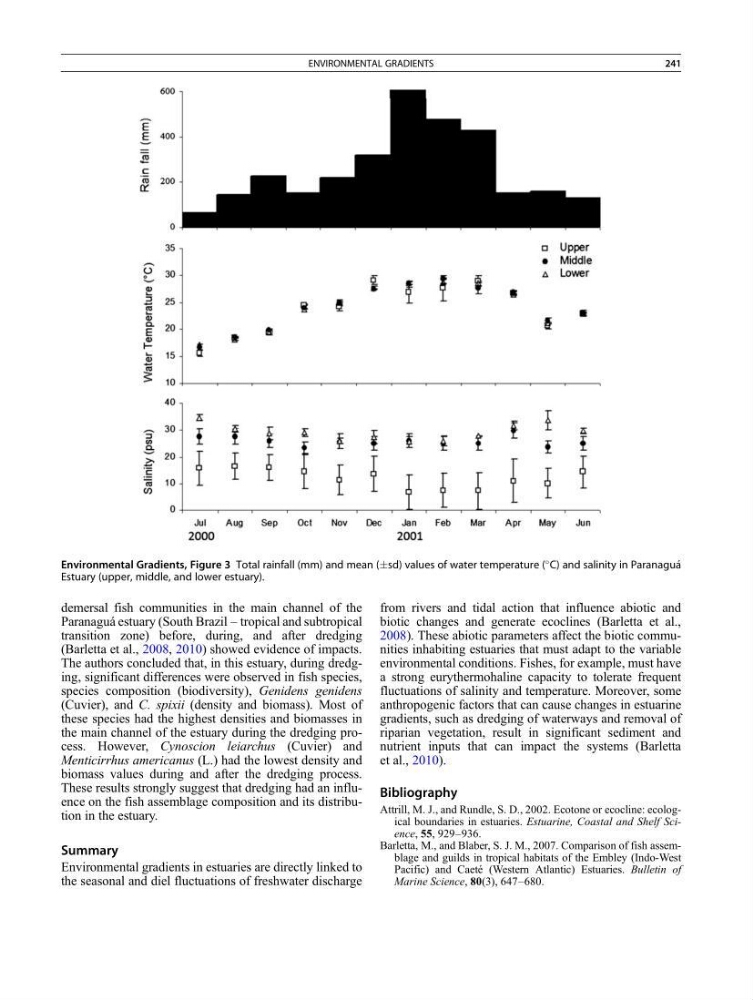
Environmental Gradients, Figure 3 Total rainfall (mm) and mean (Æsd) values of water temperature (
C) and salinity in Paranagua ´
Estuary (upper, middle, and lower estuary).
ENVIRONMENTAL GRADIENTS
241
Paranaguá estuary (South Brazil – tropical and subtropical
transition zone) before, during, and after dredging
(Barletta et al., 2008, 2010) showed evidence of impacts.
The authors concluded that, in this estuary, during dredging, significant differences were observed in fish species,
species composition (biodiversity), Genidens genidens
(Cuvier), and C. spixii (density and biomass). Most of
these species had the highest densities and biomasses in
the main channel of the estuary during the dredging process. However, Cynoscion leiarchus (Cuvier) and
Menticirrhus americanus (L.) had the lowest density and
biomass values during and after the dredging process.
These results strongly suggest that dredging had an influence on the fish assemblage composition and its distribution in the estuary.
Summary
Environmental gradients in estuaries are directly linked to
the seasonal and diel fluctuations of freshwater discharge
from rivers and tidal action that influence abiotic and
biotic changes and generate ecoclines (Barletta et al.,
2008). These abiotic parameters affect the biotic communities inhabiting estuaries that must adapt to the variable
environmental conditions. Fishes, for example, must have
a strong eurythermohaline capacity to tolerate frequent
fluctuations of salinity and temperature. Moreover, some
anthropogenic factors that can cause changes in estuarine
gradients, such as dredging of waterways and removal of
riparian vegetation, result in significant sediment and
nutrient inputs that can impact the systems (Barletta
et al., 2010).
Bibliography
Attrill, M. J., and Rundle, S. D., 2002. Ecotone or ecocline: ecological boundaries in estuaries. Estuarine, Coastal and Shelf Science, 55, 929–936.
Barletta, M., and Blaber, S. J. M., 2007. Comparison of fish assemblage and guilds in tropical habitats of the Embley (Indo-West
Pacific) and Caeté (Western Atlantic) Estuaries. Bulletin of
Marine Science, 80(3), 647–680.
Environmental Gradients, Figure 3 Total rainfall (mm) and mean (Æsd) values of water temperature (
C) and salinity in Paranagua ´
Estuary (upper, middle, and lower estuary).
ENVIRONMENTAL GRADIENTS
241