

Application to estuaries
Estuaries are highly dynamic systems with respect to
nutrients. Nutrients are changing in estuaries due to nutrient pollution, on the one hand, but concerted efforts for
nutrient reduction, on the other, at least in some systems.
Although eutrophication is occurring globally, nutrient
export from coastal watersheds is not evenly distributed,
leading to highly varying N and P loads to coastal waters
(Seitzinger et al., 2005; Glibert et al., 2006; Howarth,
2008). The consequence of these alterations in global
N and P is that many receiving waters are now not only
enriched with nutrients, but also these nutrients are being
delivered in a different stoichiometric proportion than in
decades past. Ecological stoichiometry applications in
estuaries are even more complex because biogeochemical
pathways, together with homeostatic control, serve to provide the mechanism(s) whereby nutrient dynamics support trophodynamic structure (Glibert, 2012). Positive
reinforcing feedbacks of biogeochemistry and homeostasis shift ecosystems to new stable states; such shifts can
be gradual or abrupt, and communities may not return to
their original state once the disturbance (in this case,
altered nutrient loads) is removed. In eutrophic systems,
increased algal productivity may lead to depressed water
column oxygen which, in turn, may result in increased
recycling of N and P by changes in redox potential or
pH (Kemp et al., 2005; Glibert et al., 2011; Glibert,
2012; Gao et al., 2012). These fluxes will then positively
reinforce an ecosystems degradation trajectory, as
suggested to be the case for the Chesapeake Bay (Kemp
et al., 2005). In contrast, in systems with a smaller nutrient
load, less algae in the water column, higher light, and
higher redox potential may help to reinforce higher rates
of nitrification and denitrification, leading to nutrient
removal and potentially eutrophication reversal (Kemp
et al., 2005).
Summary and conclusions
In sum, ecological stoichiometry theory describes how
food quality affects food web dynamics by defining not
only the pathway of flow of needed elements by consumers but also the pathways by which “excess” nutrients
are recycled, further altering nutrient availability for lower
trophic levels. Ecological stoichiometry has several
important implications for the health and sustainability
of aquatic systems. Stoichiometric imbalances may accelerate transformations of nutrients or may alter the processes by which nutrients are cycled in the ecosystem
and thus nutrient availability or form for primary producers (Elser and Hamilton, 2007). When food quality is
linked to food web outcome, feedback effects and nutrient
biogeochemical processes may play large roles in species
success. Moreover, ecological stoichiometry bears significantly on the debate of whether aquatic ecosystem restoration efforts should focus on P removal, N removal, or
both (e.g., Carpenter, 2008; Conley et al., 2009; Doney,
2010 and references therein). Single nutrient removal
strategies can drive ecosystems into states of stoichiometric imbalance. Imbalances in stoichiometry may destabilize the dynamics of consumers, shifting systems to new
conditions. Single nutrient removal strategies may have
unintended consequences for aquatic ecosystems.
Bibliography
Boersma, M., Aberle, N., Hantzsche, F. M., Shoo, K. L., Wiltshire,
K. H., and Malzahn, A. M., 2008. Nutritional limitation travels
up the food chain. International Review Hydrobiology, 93,
479–488.
Carpenter, S. R., 2008. Phosphorus control is critical to mitigating
eutrophication. Proceedings of the National Academy of Sciences (U.S.A.), 105, 11039–11040.
Conley, D. J., Paerl, H. W., Howarth, R. W., Boesch, D. F.,
Seitzinger, S. P., Havens, K. E., Lancelot, C., and Likens,
G. E., 2009. Controlling eutrophication: nitrogen and phosphorus. Science, 323, 1014–1015.
Doney, S. C., 2010. The growing human footprint on coastal and
open ocean biogeochemistry. Science, 328, 1512.
Elser, J. J., and Hamilton, A., 2007. Stoichiometry and the new biology: the future is now. PLoS Biology, 5(7), e181.
Finkel, Z. V., Beardall, J., Flynn, K. J., Quiqq, A., Rees, T. A., and
Raven, J. A., 2010. Phytoplankton in a changing world: cells size
and elemental stoichiometry. Journal of Plankton Research, 32,
119–137.
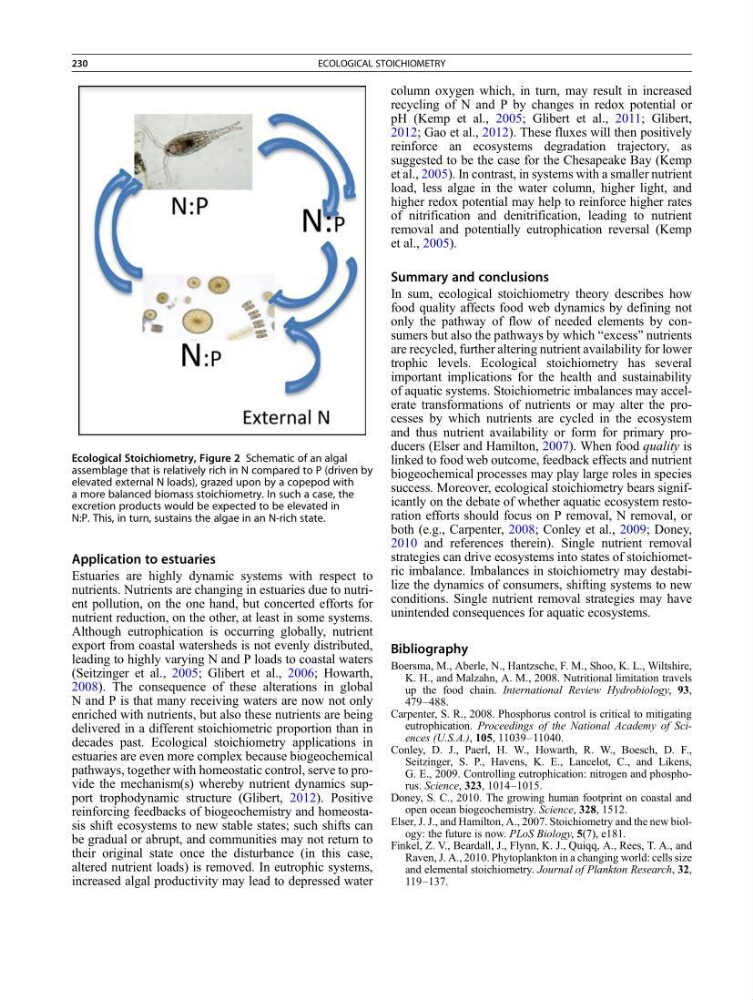
Ecological Stoichiometry, Figure 2 Schematic of an algal
assemblage that is relatively rich in N compared to P (driven by
elevated external N loads), grazed upon by a copepod with
a more balanced biomass stoichiometry. In such a case, the
excretion products would be expected to be elevated in
N:P. This, in turn, sustains the algae in an N-rich state.
230
ECOLOGICAL STOICHIOMETRY
Estuaries are highly dynamic systems with respect to
nutrients. Nutrients are changing in estuaries due to nutrient pollution, on the one hand, but concerted efforts for
nutrient reduction, on the other, at least in some systems.
Although eutrophication is occurring globally, nutrient
export from coastal watersheds is not evenly distributed,
leading to highly varying N and P loads to coastal waters
(Seitzinger et al., 2005; Glibert et al., 2006; Howarth,
2008). The consequence of these alterations in global
N and P is that many receiving waters are now not only
enriched with nutrients, but also these nutrients are being
delivered in a different stoichiometric proportion than in
decades past. Ecological stoichiometry applications in
estuaries are even more complex because biogeochemical
pathways, together with homeostatic control, serve to provide the mechanism(s) whereby nutrient dynamics support trophodynamic structure (Glibert, 2012). Positive
reinforcing feedbacks of biogeochemistry and homeostasis shift ecosystems to new stable states; such shifts can
be gradual or abrupt, and communities may not return to
their original state once the disturbance (in this case,
altered nutrient loads) is removed. In eutrophic systems,
increased algal productivity may lead to depressed water
column oxygen which, in turn, may result in increased
recycling of N and P by changes in redox potential or
pH (Kemp et al., 2005; Glibert et al., 2011; Glibert,
2012; Gao et al., 2012). These fluxes will then positively
reinforce an ecosystems degradation trajectory, as
suggested to be the case for the Chesapeake Bay (Kemp
et al., 2005). In contrast, in systems with a smaller nutrient
load, less algae in the water column, higher light, and
higher redox potential may help to reinforce higher rates
of nitrification and denitrification, leading to nutrient
removal and potentially eutrophication reversal (Kemp
et al., 2005).
Summary and conclusions
In sum, ecological stoichiometry theory describes how
food quality affects food web dynamics by defining not
only the pathway of flow of needed elements by consumers but also the pathways by which “excess” nutrients
are recycled, further altering nutrient availability for lower
trophic levels. Ecological stoichiometry has several
important implications for the health and sustainability
of aquatic systems. Stoichiometric imbalances may accelerate transformations of nutrients or may alter the processes by which nutrients are cycled in the ecosystem
and thus nutrient availability or form for primary producers (Elser and Hamilton, 2007). When food quality is
linked to food web outcome, feedback effects and nutrient
biogeochemical processes may play large roles in species
success. Moreover, ecological stoichiometry bears significantly on the debate of whether aquatic ecosystem restoration efforts should focus on P removal, N removal, or
both (e.g., Carpenter, 2008; Conley et al., 2009; Doney,
2010 and references therein). Single nutrient removal
strategies can drive ecosystems into states of stoichiometric imbalance. Imbalances in stoichiometry may destabilize the dynamics of consumers, shifting systems to new
conditions. Single nutrient removal strategies may have
unintended consequences for aquatic ecosystems.
Bibliography
Boersma, M., Aberle, N., Hantzsche, F. M., Shoo, K. L., Wiltshire,
K. H., and Malzahn, A. M., 2008. Nutritional limitation travels
up the food chain. International Review Hydrobiology, 93,
479–488.
Carpenter, S. R., 2008. Phosphorus control is critical to mitigating
eutrophication. Proceedings of the National Academy of Sciences (U.S.A.), 105, 11039–11040.
Conley, D. J., Paerl, H. W., Howarth, R. W., Boesch, D. F.,
Seitzinger, S. P., Havens, K. E., Lancelot, C., and Likens,
G. E., 2009. Controlling eutrophication: nitrogen and phosphorus. Science, 323, 1014–1015.
Doney, S. C., 2010. The growing human footprint on coastal and
open ocean biogeochemistry. Science, 328, 1512.
Elser, J. J., and Hamilton, A., 2007. Stoichiometry and the new biology: the future is now. PLoS Biology, 5(7), e181.
Finkel, Z. V., Beardall, J., Flynn, K. J., Quiqq, A., Rees, T. A., and
Raven, J. A., 2010. Phytoplankton in a changing world: cells size
and elemental stoichiometry. Journal of Plankton Research, 32,
119–137.
Ecological Stoichiometry, Figure 2 Schematic of an algal
assemblage that is relatively rich in N compared to P (driven by
elevated external N loads), grazed upon by a copepod with
a more balanced biomass stoichiometry. In such a case, the
excretion products would be expected to be elevated in
N:P. This, in turn, sustains the algae in an N-rich state.
230
ECOLOGICAL STOICHIOMETRY