

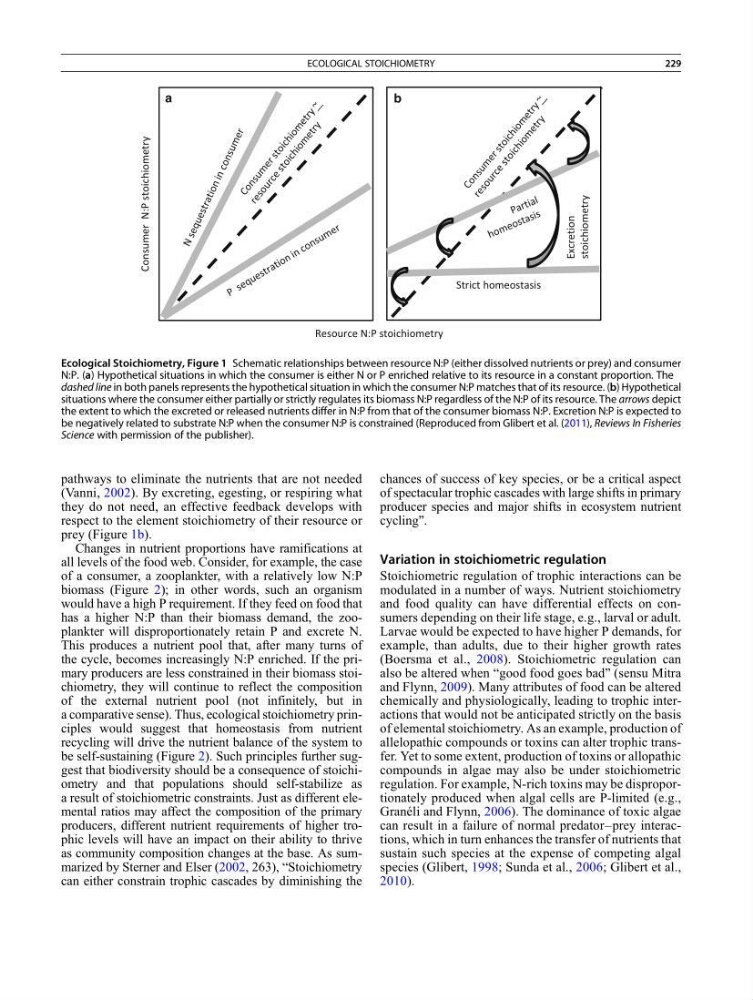
pathways to eliminate the nutrients that are not needed
(Vanni, 2002). By excreting, egesting, or respiring what
they do not need, an effective feedback develops with
respect to the element stoichiometry of their resource or
prey (Figure 1b).
Changes in nutrient proportions have ramifications at
all levels of the food web. Consider, for example, the case
of a consumer, a zooplankter, with a relatively low N:P
biomass (Figure 2); in other words, such an organism
would have a high P requirement. If they feed on food that
has a higher N:P than their biomass demand, the zooplankter will disproportionately retain P and excrete N.
This produces a nutrient pool that, after many turns of
the cycle, becomes increasingly N:P enriched. If the primary producers are less constrained in their biomass stoichiometry, they will continue to reflect the composition
of the external nutrient pool (not infinitely, but in
a comparative sense). Thus, ecological stoichiometry principles would suggest that homeostasis from nutrient
recycling will drive the nutrient balance of the system to
be self-sustaining (Figure 2). Such principles further suggest that biodiversity should be a consequence of stoichiometry and that populations should self-stabilize as
a result of stoichiometric constraints. Just as different elemental ratios may affect the composition of the primary
producers, different nutrient requirements of higher trophic levels will have an impact on their ability to thrive
as community composition changes at the base. As summarized by Sterner and Elser (2002, 263), “Stoichiometry
can either constrain trophic cascades by diminishing the
chances of success of key species, or be a critical aspect
of spectacular trophic cascades with large shifts in primary
producer species and major shifts in ecosystem nutrient
cycling”.
Variation in stoichiometric regulation
Stoichiometric regulation of trophic interactions can be
modulated in a number of ways. Nutrient stoichiometry
and food quality can have differential effects on consumers depending on their life stage, e.g., larval or adult.
Larvae would be expected to have higher P demands, for
example, than adults, due to their higher growth rates
(Boersma et al., 2008). Stoichiometric regulation can
also be altered when “good food goes bad” (sensu Mitra
and Flynn, 2009). Many attributes of food can be altered
chemically and physiologically, leading to trophic interactions that would not be anticipated strictly on the basis
of elemental stoichiometry. As an example, production of
allelopathic compounds or toxins can alter trophic transfer. Yet to some extent, production of toxins or allopathic
compounds in algae may also be under stoichiometric
regulation. For example, N-rich toxins may be disproportionately produced when algal cells are P-limited (e.g.,
Granéli and Flynn, 2006). The dominance of toxic algae
can result in a failure of normal predator–prey interactions, which in turn enhances the transfer of nutrients that
sustain such species at the expense of competing algal
species (Glibert, 1998; Sunda et al., 2006; Glibert et al.,
2010).
Resource N:P stoichiometry
Consumer N:P stoichiometry
a
Strict homeostasis
b
Excretion
stoichiometry
Ecological Stoichiometry, Figure 1 Schematic relationships between resource N:P (either dissolved nutrients or prey) and consumer
N:P. (a) Hypothetical situations in which the consumer is either N or P enriched relative to its resource in a constant proportion. The
dashed line in both panels represents the hypothetical situation in which the consumer N:P matches that of its resource. (b) Hypothetical
situations where the consumer either partially or strictly regulates its biomass N:P regardless of the N:P of its resource. The arrows depict
the extent to which the excreted or released nutrients differ in N:P from that of the consumer biomass N:P. Excretion N:P is expected to
be negatively related to substrate N:P when the consumer N:P is constrained (Reproduced from Glibert et al. (2011), Reviews In Fisheries
Science with permission of the publisher).
ECOLOGICAL STOICHIOMETRY
229
(Vanni, 2002). By excreting, egesting, or respiring what
they do not need, an effective feedback develops with
respect to the element stoichiometry of their resource or
prey (Figure 1b).
Changes in nutrient proportions have ramifications at
all levels of the food web. Consider, for example, the case
of a consumer, a zooplankter, with a relatively low N:P
biomass (Figure 2); in other words, such an organism
would have a high P requirement. If they feed on food that
has a higher N:P than their biomass demand, the zooplankter will disproportionately retain P and excrete N.
This produces a nutrient pool that, after many turns of
the cycle, becomes increasingly N:P enriched. If the primary producers are less constrained in their biomass stoichiometry, they will continue to reflect the composition
of the external nutrient pool (not infinitely, but in
a comparative sense). Thus, ecological stoichiometry principles would suggest that homeostasis from nutrient
recycling will drive the nutrient balance of the system to
be self-sustaining (Figure 2). Such principles further suggest that biodiversity should be a consequence of stoichiometry and that populations should self-stabilize as
a result of stoichiometric constraints. Just as different elemental ratios may affect the composition of the primary
producers, different nutrient requirements of higher trophic levels will have an impact on their ability to thrive
as community composition changes at the base. As summarized by Sterner and Elser (2002, 263), “Stoichiometry
can either constrain trophic cascades by diminishing the
chances of success of key species, or be a critical aspect
of spectacular trophic cascades with large shifts in primary
producer species and major shifts in ecosystem nutrient
cycling”.
Variation in stoichiometric regulation
Stoichiometric regulation of trophic interactions can be
modulated in a number of ways. Nutrient stoichiometry
and food quality can have differential effects on consumers depending on their life stage, e.g., larval or adult.
Larvae would be expected to have higher P demands, for
example, than adults, due to their higher growth rates
(Boersma et al., 2008). Stoichiometric regulation can
also be altered when “good food goes bad” (sensu Mitra
and Flynn, 2009). Many attributes of food can be altered
chemically and physiologically, leading to trophic interactions that would not be anticipated strictly on the basis
of elemental stoichiometry. As an example, production of
allelopathic compounds or toxins can alter trophic transfer. Yet to some extent, production of toxins or allopathic
compounds in algae may also be under stoichiometric
regulation. For example, N-rich toxins may be disproportionately produced when algal cells are P-limited (e.g.,
Granéli and Flynn, 2006). The dominance of toxic algae
can result in a failure of normal predator–prey interactions, which in turn enhances the transfer of nutrients that
sustain such species at the expense of competing algal
species (Glibert, 1998; Sunda et al., 2006; Glibert et al.,
2010).
Resource N:P stoichiometry
Consumer N:P stoichiometry
a
Strict homeostasis
b
Excretion
stoichiometry
Ecological Stoichiometry, Figure 1 Schematic relationships between resource N:P (either dissolved nutrients or prey) and consumer
N:P. (a) Hypothetical situations in which the consumer is either N or P enriched relative to its resource in a constant proportion. The
dashed line in both panels represents the hypothetical situation in which the consumer N:P matches that of its resource. (b) Hypothetical
situations where the consumer either partially or strictly regulates its biomass N:P regardless of the N:P of its resource. The arrows depict
the extent to which the excreted or released nutrients differ in N:P from that of the consumer biomass N:P. Excretion N:P is expected to
be negatively related to substrate N:P when the consumer N:P is constrained (Reproduced from Glibert et al. (2011), Reviews In Fisheries
Science with permission of the publisher).
ECOLOGICAL STOICHIOMETRY
229