

floodplain, and on surrounding areas (Audiencia
Territorial de Valencia, 1991).
Unlike marine floods that are caused by seawater in
limited areas, coastal floods may be due to a variety of different causes, and they may affect much larger coastal
zones. When such floods are directly sourced to pluvial
or fluvial waters, persistent high sea level is the main
cause of the flood duration.
Historically, structural coasts were selected for settlements mainly because of security, health, safety, and economic reasons. However, sedimentary coasts offered
greater productivity, and these areas soon attracted large
populations to their plain littoral/deltaic hillocks. Mediterranean seaside (“maritime”) cities were always located
beside a castled rock-hill (e.g., Athens, Haifa, Genoa,
Malaga, and Monaco), whereas coastal plain cities were
established on the landward side of relatively dry and high
grounds (e.g., Rome on its seven hills, Valencia or Alexandria on delta hillocks, Venice on a relict barrier island of
the Po Delta, etc.).
Coastal cities and towns often spread into lowland areas.
Enormous conurbations are at a huge risk of flooding today
as a result. The case of New Orleans is paradigmatic: its
older settlements barely suffered from floods caused by
Hurricane Katrina, meanwhile most of its later developments and lower quarters were catastrophically flooded.
The great European delta formed at the outlet of the Elm,
Rhine, and Meuse rivers has required drastic transformations to protect large cities from flood risk.
Flood risk can never be totally eradicated. Therefore,
each vulnerable coastal development now requires a risk
management plan to deal with the hazard. Flood risk has
become a datum for analysis and resiliency management.
Bibliography
Audiencia Territorial de Valencia, 1991. Criminal Sentence
56/1982, about Tous dam failure. October 23, 1990. Valencia.
Diez, J. J., Paz, R., Esteban, M. D., López-Gutiérrez, J. S., and
Negro, V., 2011. Urban coastal flooding and climate change.
Journal of Coastal Research, SI 64, 205–209. Szczecin, Poland.
Diez, J. J., Esteban, M. D., López-Gutiérrez, J. S., and Negro, V.,
2012. Meteocean influence on inland and coastal floods in the
east of Spain. Journal of Coastal Research (Online), ISSN
1551–5036, Palm Beach, FL.
Cross-references
Climate Change
Coastal Erosion Control
Shoreline Changes
Submerged Coasts
Submergent Shoreline
Uplifted Coasts
COASTAL SQUEEZE
Luciana S. Esteves
Faculty of Science and Technology, Talbot Campus,
Bournemouth University, Poole, Dorset, UK
Definition
Coastal squeeze refers to the loss of intertidal habitats due
to rising sea levels along coastlines fixed by hard engineering structures. The term coastal squeeze should not
be used to refer to losses due to natural processes (Pontee,
2013).
Natural coasts can dynamically adjust to changing
meteorological and climatic conditions. In natural systems, rising sea levels usually result in a landward movement of habitats (Figure 1a, b). Salt marshes, for
example, depending on a number of interacting physical
and biotic variables, can migrate inland and accrete vertically, naturally adjusting to sea-level rise. The natural
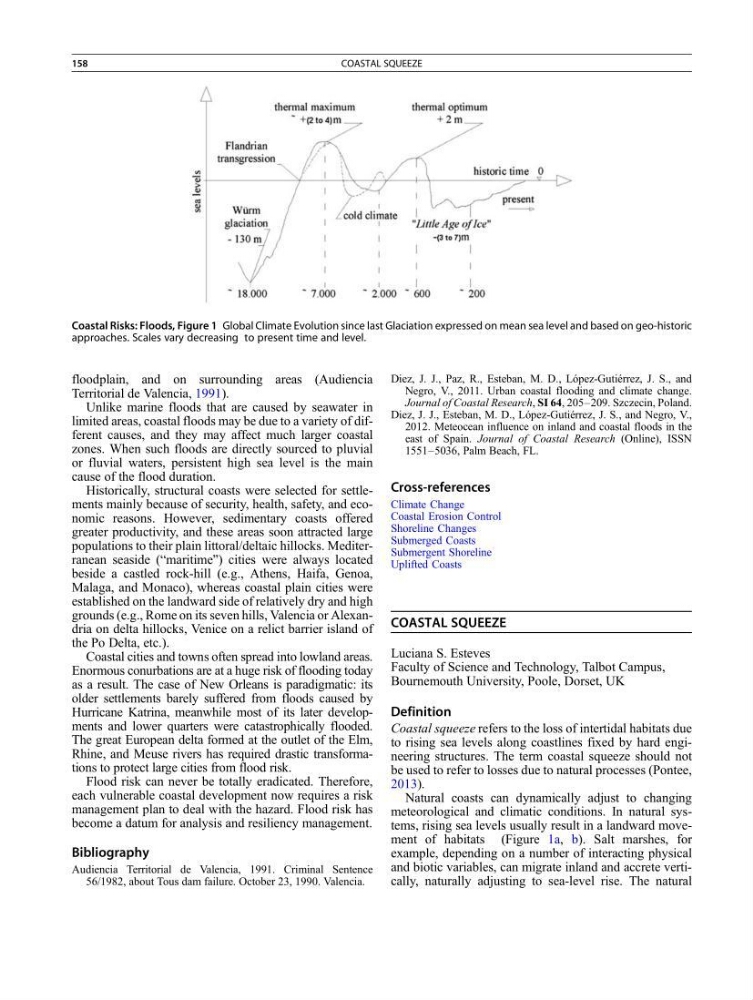
Coastal Risks: Floods, Figure 1 Global Climate Evolution since last Glaciation expressed on mean sea level and based on geo-historic
approaches. Scales vary decreasing to present time and level.
158
COASTAL SQUEEZE
Territorial de Valencia, 1991).
Unlike marine floods that are caused by seawater in
limited areas, coastal floods may be due to a variety of different causes, and they may affect much larger coastal
zones. When such floods are directly sourced to pluvial
or fluvial waters, persistent high sea level is the main
cause of the flood duration.
Historically, structural coasts were selected for settlements mainly because of security, health, safety, and economic reasons. However, sedimentary coasts offered
greater productivity, and these areas soon attracted large
populations to their plain littoral/deltaic hillocks. Mediterranean seaside (“maritime”) cities were always located
beside a castled rock-hill (e.g., Athens, Haifa, Genoa,
Malaga, and Monaco), whereas coastal plain cities were
established on the landward side of relatively dry and high
grounds (e.g., Rome on its seven hills, Valencia or Alexandria on delta hillocks, Venice on a relict barrier island of
the Po Delta, etc.).
Coastal cities and towns often spread into lowland areas.
Enormous conurbations are at a huge risk of flooding today
as a result. The case of New Orleans is paradigmatic: its
older settlements barely suffered from floods caused by
Hurricane Katrina, meanwhile most of its later developments and lower quarters were catastrophically flooded.
The great European delta formed at the outlet of the Elm,
Rhine, and Meuse rivers has required drastic transformations to protect large cities from flood risk.
Flood risk can never be totally eradicated. Therefore,
each vulnerable coastal development now requires a risk
management plan to deal with the hazard. Flood risk has
become a datum for analysis and resiliency management.
Bibliography
Audiencia Territorial de Valencia, 1991. Criminal Sentence
56/1982, about Tous dam failure. October 23, 1990. Valencia.
Diez, J. J., Paz, R., Esteban, M. D., López-Gutiérrez, J. S., and
Negro, V., 2011. Urban coastal flooding and climate change.
Journal of Coastal Research, SI 64, 205–209. Szczecin, Poland.
Diez, J. J., Esteban, M. D., López-Gutiérrez, J. S., and Negro, V.,
2012. Meteocean influence on inland and coastal floods in the
east of Spain. Journal of Coastal Research (Online), ISSN
1551–5036, Palm Beach, FL.
Cross-references
Climate Change
Coastal Erosion Control
Shoreline Changes
Submerged Coasts
Submergent Shoreline
Uplifted Coasts
COASTAL SQUEEZE
Luciana S. Esteves
Faculty of Science and Technology, Talbot Campus,
Bournemouth University, Poole, Dorset, UK
Definition
Coastal squeeze refers to the loss of intertidal habitats due
to rising sea levels along coastlines fixed by hard engineering structures. The term coastal squeeze should not
be used to refer to losses due to natural processes (Pontee,
2013).
Natural coasts can dynamically adjust to changing
meteorological and climatic conditions. In natural systems, rising sea levels usually result in a landward movement of habitats (Figure 1a, b). Salt marshes, for
example, depending on a number of interacting physical
and biotic variables, can migrate inland and accrete vertically, naturally adjusting to sea-level rise. The natural
Coastal Risks: Floods, Figure 1 Global Climate Evolution since last Glaciation expressed on mean sea level and based on geo-historic
approaches. Scales vary decreasing to present time and level.
158
COASTAL SQUEEZE