

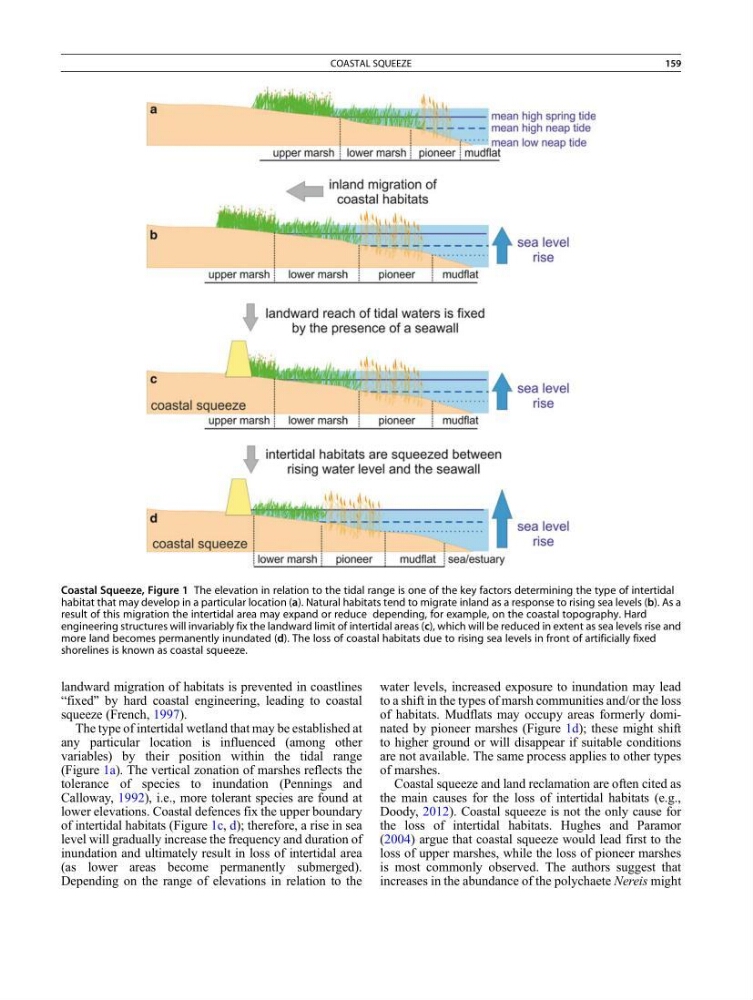
landward migration of habitats is prevented in coastlines
“fixed” by hard coastal engineering, leading to coastal
squeeze (French, 1997).
The type of intertidal wetland that may be established at
any particular location is influenced (among other
variables) by their position within the tidal range
(Figure 1a). The vertical zonation of marshes reflects the
tolerance of species to inundation (Pennings and
Calloway, 1992), i.e., more tolerant species are found at
lower elevations. Coastal defences fix the upper boundary
of intertidal habitats (Figure 1c, d); therefore, a rise in sea
level will gradually increase the frequency and duration of
inundation and ultimately result in loss of intertidal area
(as lower areas become permanently submerged).
Depending on the range of elevations in relation to the
water levels, increased exposure to inundation may lead
to a shift in the types of marsh communities and/or the loss
of habitats. Mudflats may occupy areas formerly dominated by pioneer marshes (Figure 1d); these might shift
to higher ground or will disappear if suitable conditions
are not available. The same process applies to other types
of marshes.
Coastal squeeze and land reclamation are often cited as
the main causes for the loss of intertidal habitats (e.g.,
Doody, 2012). Coastal squeeze is not the only cause for
the loss of intertidal habitats. Hughes and Paramor
(2004) argue that coastal squeeze would lead first to the
loss of upper marshes, while the loss of pioneer marshes
is most commonly observed. The authors suggest that
increases in the abundance of the polychaete Nereis might
Coastal Squeeze, Figure 1 The elevation in relation to the tidal range is one of the key factors determining the type of intertidal
habitat that may develop in a particular location (a). Natural habitats tend to migrate inland as a response to rising sea levels (b). As a
result of this migration the intertidal area may expand or reduce depending, for example, on the coastal topography. Hard
engineering structures will invariably fix the landward limit of intertidal areas (c), which will be reduced in extent as sea levels rise and
more land becomes permanently inundated (d). The loss of coastal habitats due to rising sea levels in front of artificially fixed
shorelines is known as coastal squeeze.
COASTAL SQUEEZE
159
“fixed” by hard coastal engineering, leading to coastal
squeeze (French, 1997).
The type of intertidal wetland that may be established at
any particular location is influenced (among other
variables) by their position within the tidal range
(Figure 1a). The vertical zonation of marshes reflects the
tolerance of species to inundation (Pennings and
Calloway, 1992), i.e., more tolerant species are found at
lower elevations. Coastal defences fix the upper boundary
of intertidal habitats (Figure 1c, d); therefore, a rise in sea
level will gradually increase the frequency and duration of
inundation and ultimately result in loss of intertidal area
(as lower areas become permanently submerged).
Depending on the range of elevations in relation to the
water levels, increased exposure to inundation may lead
to a shift in the types of marsh communities and/or the loss
of habitats. Mudflats may occupy areas formerly dominated by pioneer marshes (Figure 1d); these might shift
to higher ground or will disappear if suitable conditions
are not available. The same process applies to other types
of marshes.
Coastal squeeze and land reclamation are often cited as
the main causes for the loss of intertidal habitats (e.g.,
Doody, 2012). Coastal squeeze is not the only cause for
the loss of intertidal habitats. Hughes and Paramor
(2004) argue that coastal squeeze would lead first to the
loss of upper marshes, while the loss of pioneer marshes
is most commonly observed. The authors suggest that
increases in the abundance of the polychaete Nereis might
Coastal Squeeze, Figure 1 The elevation in relation to the tidal range is one of the key factors determining the type of intertidal
habitat that may develop in a particular location (a). Natural habitats tend to migrate inland as a response to rising sea levels (b). As a
result of this migration the intertidal area may expand or reduce depending, for example, on the coastal topography. Hard
engineering structures will invariably fix the landward limit of intertidal areas (c), which will be reduced in extent as sea levels rise and
more land becomes permanently inundated (d). The loss of coastal habitats due to rising sea levels in front of artificially fixed
shorelines is known as coastal squeeze.
COASTAL SQUEEZE
159