

the world, coral reefs are found raised above their modern
counterparts and, as such, often provide important insights
into reef structure and history.
The morphology and genesis of coral reefs vary significantly. On the basis of their form, reefs may be divided
into atoll reefs, barrier reefs, and fringing reefs (Nunn,
1994). Barrier and atoll reefs are older, often being
composed of reefs of many different ages; reef upgrowth
during postglacial periods has been followed by subaerial
exposure, and erosion during the glacial periods followed
by renewed upgrowth.
Fringing reefs are juvenile and the youngest and most
ephemeral of the three forms, and they grow outwards from
a coast. They are located close to the land and indeed cannot
exist very far away from the land. Unlike atoll reefs and barrier reefs, most fringing reefs are formed as discrete units
during the recent period of postglacial sea-level rise. Most
of them began growing from shallow depths on the flanks
of a tropical coastline when ocean-water temperatures at
the end of the glacial period became suitable for reef growth
(Neumann and MacIntyre, 1985). Fringing reefs are mostly
affected by humans.
Atolls
Coral atolls, dispersed widely throughout the warm waters
of the tropical Pacific and Indian Oceans, are among the
world’s most impressive biogenic landforms (Nunn,
2010). The classic exposition of atoll origin was first
explained by Charles Darwin in 1836, where he observed
a barrier reef surrounding Mo’orea Island during his visit
to the Keeling Islands. Darwin set out his theory of atoll
development which involved the upward growth of
a coral reef in response to the subsidence of its foundations
(Darwin, 1842). Darwin’s elegant theory was founded on
the premise of a subsiding volcanic island and the
corresponding upward growth of friging and barrier coral
reefs keeping pace with the rising relative sea levels (Terry
and Goff, 2013). Darwin suggested that it was the
tendency of ancient volcanic islands in the oceans to
subside, but their coral fringe could stay alive only if it
was able to grow upward at the same rate. Thus, modern
atoll reefs are only veneers of living coral growing atop
a coral framework composed largely of the skeletal
remains of dead hermatypic (reef-building) corals.
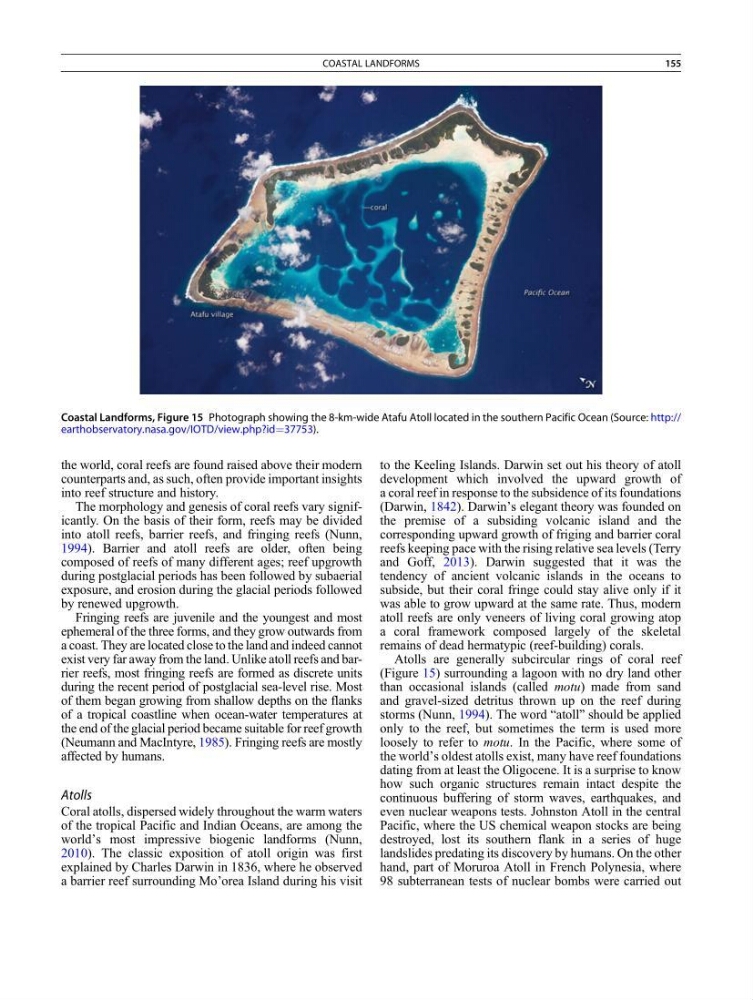
Atolls are generally subcircular rings of coral reef
(Figure 15) surrounding a lagoon with no dry land other
than occasional islands (called motu) made from sand
and gravel-sized detritus thrown up on the reef during
storms (Nunn, 1994). The word “atoll” should be applied
only to the reef, but sometimes the term is used more
loosely to refer to motu. In the Pacific, where some of
the world’s oldest atolls exist, many have reef foundations
dating from at least the Oligocene. It is a surprise to know
how such organic structures remain intact despite the
continuous buffering of storm waves, earthquakes, and
even nuclear weapons tests. Johnston Atoll in the central
Pacific, where the US chemical weapon stocks are being
destroyed, lost its southern flank in a series of huge
landslides predating its discovery by humans. On the other
hand, part of Moruroa Atoll in French Polynesia, where
98 subterranean tests of nuclear bombs were carried out
Coastal Landforms, Figure 15 Photograph showing the 8-km-wide Atafu Atoll located in the southern Pacific Ocean (Source: http://
earthobservatory.nasa.gov/IOTD/view.php?id¼37753).
COASTAL LANDFORMS
155
counterparts and, as such, often provide important insights
into reef structure and history.
The morphology and genesis of coral reefs vary significantly. On the basis of their form, reefs may be divided
into atoll reefs, barrier reefs, and fringing reefs (Nunn,
1994). Barrier and atoll reefs are older, often being
composed of reefs of many different ages; reef upgrowth
during postglacial periods has been followed by subaerial
exposure, and erosion during the glacial periods followed
by renewed upgrowth.
Fringing reefs are juvenile and the youngest and most
ephemeral of the three forms, and they grow outwards from
a coast. They are located close to the land and indeed cannot
exist very far away from the land. Unlike atoll reefs and barrier reefs, most fringing reefs are formed as discrete units
during the recent period of postglacial sea-level rise. Most
of them began growing from shallow depths on the flanks
of a tropical coastline when ocean-water temperatures at
the end of the glacial period became suitable for reef growth
(Neumann and MacIntyre, 1985). Fringing reefs are mostly
affected by humans.
Atolls
Coral atolls, dispersed widely throughout the warm waters
of the tropical Pacific and Indian Oceans, are among the
world’s most impressive biogenic landforms (Nunn,
2010). The classic exposition of atoll origin was first
explained by Charles Darwin in 1836, where he observed
a barrier reef surrounding Mo’orea Island during his visit
to the Keeling Islands. Darwin set out his theory of atoll
development which involved the upward growth of
a coral reef in response to the subsidence of its foundations
(Darwin, 1842). Darwin’s elegant theory was founded on
the premise of a subsiding volcanic island and the
corresponding upward growth of friging and barrier coral
reefs keeping pace with the rising relative sea levels (Terry
and Goff, 2013). Darwin suggested that it was the
tendency of ancient volcanic islands in the oceans to
subside, but their coral fringe could stay alive only if it
was able to grow upward at the same rate. Thus, modern
atoll reefs are only veneers of living coral growing atop
a coral framework composed largely of the skeletal
remains of dead hermatypic (reef-building) corals.
Atolls are generally subcircular rings of coral reef
(Figure 15) surrounding a lagoon with no dry land other
than occasional islands (called motu) made from sand
and gravel-sized detritus thrown up on the reef during
storms (Nunn, 1994). The word “atoll” should be applied
only to the reef, but sometimes the term is used more
loosely to refer to motu. In the Pacific, where some of
the world’s oldest atolls exist, many have reef foundations
dating from at least the Oligocene. It is a surprise to know
how such organic structures remain intact despite the
continuous buffering of storm waves, earthquakes, and
even nuclear weapons tests. Johnston Atoll in the central
Pacific, where the US chemical weapon stocks are being
destroyed, lost its southern flank in a series of huge
landslides predating its discovery by humans. On the other
hand, part of Moruroa Atoll in French Polynesia, where
98 subterranean tests of nuclear bombs were carried out
Coastal Landforms, Figure 15 Photograph showing the 8-km-wide Atafu Atoll located in the southern Pacific Ocean (Source: http://
earthobservatory.nasa.gov/IOTD/view.php?id¼37753).
COASTAL LANDFORMS
155