

may evolve from them. Trough blowouts are generally
more elongate, with deeper deflation floors and basins
and with steeper, longer erosional lateral walls or slopes.
Parabolic dunes are typically U- and V-shaped dunes
characterized by short to elongate, trailing ridges which
terminate downwind in U- or V-shaped depositional lobes.
The depositional lobes may be simple, relatively featureless sandsheets, or textured with a variety of dune forms
(e.g., transverse dunes, barchanoidal dunes, etc.).
Transgressive dune fields are well developed on high
wind and wave energy coasts with significant sediment
supply and in all climatic regions. Transgressive dune
fields and sheets are aeolian sand deposits formed by the
downwind or alongshore movement of sand over vegetated to semi-vegetated terrain. Such sheets and dune
fields may range from quite small (hundreds of meters in
alongshore and landward extent) to megadune size fields.
They may be completely unvegetated, partially vegetated,
or fully vegetated (Nordstrom et al., 1990). Dune fields are
covered with a variety of superimposed dune forms. They
have also been termed mobile dunes, migratory dunes,
mendano, and machair.
Coral reefs
Corals are organisms that secrete a calcareous exoskeleton
and are major contributors to a coral reef. Coral reefs are
natural structures of calcium carbonate made largely from
the skeletons of hard corals and coralline algae. Some
modern reefs have been forming for millions of years
and can stretch for hundreds of kilometers off tropical
coasts.
Reefs can be broadly classified as spatially heterogeneous, three-dimensional structures which have morphological form that is different from that of the underlying
substrata. The term reef has been used to classify
a whole host of organic and inorganic structures including
stone reefs, oyster reefs, coral reefs, atolls, and algal reefs.
Reefs are found in temperate to tropical marine ecosystems, with the most prominent reef types, corals and atolls,
being found in tropical and subtropical zones. Algal reefs
and bioherms are commonly found in more moderate
climatic zones, such as the Mediterranean. In temperate
regions, reefs are often more like bioherms or biostromes
in structure.
Coral reefs are found mainly between 25
N and 25
S
latitudes. The reef-building (herm atypic) corals
prefer sea-surface temperatures between 25 and
29
C. Hermatypic corals mostly occur in the “photic”
zone, where sufficient sunlight can penetrate for their
symbiotic algae for photosynthesize. The distribution of
fossil coral reefs suggests that sea-surface temperatures
have constrained their spread since their appearance in
the early Triassic (Birkeland, 1997). Coral reefs were
alternately exposed and drowned as temperatures and sea
levels oscillated during the Quaternary. During glacial
periods, when sea levels were low, the distribution of coral
reefs was much less and in marginal areas of the modern
coral seas (like the Hawaiian Islands), the reefs died out
entirely (Grigg, 1988). Owing to cooler temperatures,
coral reefs grew at slower rates, and many were comparatively ephemeral. As temperatures increased and sea
levels rose at the end of the glacial periods, reefs gradually
became reestablished across wider areas of the seas.
Depending on oceanographic factors, upward-growing
coral reefs were either able to “keep up” with rising
postglacial sea level or form a drowned reef (Neumann
and MacIntyre, 1985). Drowned reefs occur in many parts
of the Pacific and Indian Oceans. Most of the coral reefs
have failed to keep up with rising sea level associated with
climate change and sea-level history, paleolatitude, seawater temperature, and light (Flood, 2001). In many parts of
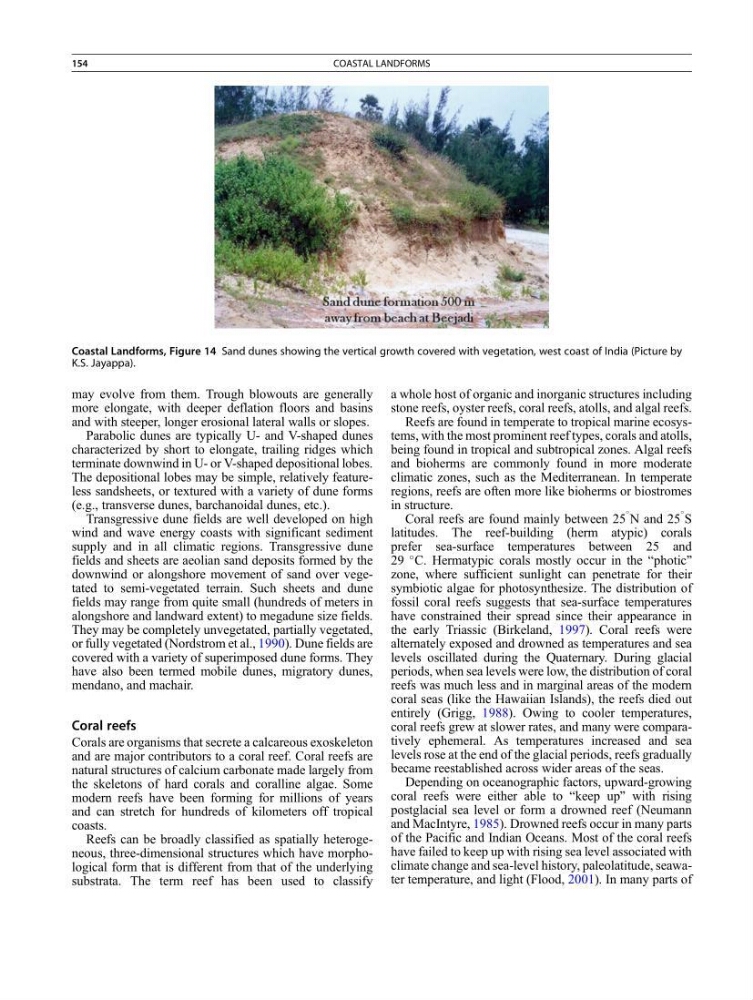
Coastal Landforms, Figure 14 Sand dunes showing the vertical growth covered with vegetation, west coast of India (Picture by
K.S. Jayappa).
154
COASTAL LANDFORMS
more elongate, with deeper deflation floors and basins
and with steeper, longer erosional lateral walls or slopes.
Parabolic dunes are typically U- and V-shaped dunes
characterized by short to elongate, trailing ridges which
terminate downwind in U- or V-shaped depositional lobes.
The depositional lobes may be simple, relatively featureless sandsheets, or textured with a variety of dune forms
(e.g., transverse dunes, barchanoidal dunes, etc.).
Transgressive dune fields are well developed on high
wind and wave energy coasts with significant sediment
supply and in all climatic regions. Transgressive dune
fields and sheets are aeolian sand deposits formed by the
downwind or alongshore movement of sand over vegetated to semi-vegetated terrain. Such sheets and dune
fields may range from quite small (hundreds of meters in
alongshore and landward extent) to megadune size fields.
They may be completely unvegetated, partially vegetated,
or fully vegetated (Nordstrom et al., 1990). Dune fields are
covered with a variety of superimposed dune forms. They
have also been termed mobile dunes, migratory dunes,
mendano, and machair.
Coral reefs
Corals are organisms that secrete a calcareous exoskeleton
and are major contributors to a coral reef. Coral reefs are
natural structures of calcium carbonate made largely from
the skeletons of hard corals and coralline algae. Some
modern reefs have been forming for millions of years
and can stretch for hundreds of kilometers off tropical
coasts.
Reefs can be broadly classified as spatially heterogeneous, three-dimensional structures which have morphological form that is different from that of the underlying
substrata. The term reef has been used to classify
a whole host of organic and inorganic structures including
stone reefs, oyster reefs, coral reefs, atolls, and algal reefs.
Reefs are found in temperate to tropical marine ecosystems, with the most prominent reef types, corals and atolls,
being found in tropical and subtropical zones. Algal reefs
and bioherms are commonly found in more moderate
climatic zones, such as the Mediterranean. In temperate
regions, reefs are often more like bioherms or biostromes
in structure.
Coral reefs are found mainly between 25
N and 25
S
latitudes. The reef-building (herm atypic) corals
prefer sea-surface temperatures between 25 and
29
C. Hermatypic corals mostly occur in the “photic”
zone, where sufficient sunlight can penetrate for their
symbiotic algae for photosynthesize. The distribution of
fossil coral reefs suggests that sea-surface temperatures
have constrained their spread since their appearance in
the early Triassic (Birkeland, 1997). Coral reefs were
alternately exposed and drowned as temperatures and sea
levels oscillated during the Quaternary. During glacial
periods, when sea levels were low, the distribution of coral
reefs was much less and in marginal areas of the modern
coral seas (like the Hawaiian Islands), the reefs died out
entirely (Grigg, 1988). Owing to cooler temperatures,
coral reefs grew at slower rates, and many were comparatively ephemeral. As temperatures increased and sea
levels rose at the end of the glacial periods, reefs gradually
became reestablished across wider areas of the seas.
Depending on oceanographic factors, upward-growing
coral reefs were either able to “keep up” with rising
postglacial sea level or form a drowned reef (Neumann
and MacIntyre, 1985). Drowned reefs occur in many parts
of the Pacific and Indian Oceans. Most of the coral reefs
have failed to keep up with rising sea level associated with
climate change and sea-level history, paleolatitude, seawater temperature, and light (Flood, 2001). In many parts of
Coastal Landforms, Figure 14 Sand dunes showing the vertical growth covered with vegetation, west coast of India (Picture by
K.S. Jayappa).
154
COASTAL LANDFORMS