

indication of both the coastal sediment availability and net
longshore-directed, wave-generated transport potential.
Coastal configuration also plays an important role in the
formation of spits (Carter, 1988). Spits are found on an
irregular coastline where sediment availability and wave
power allow a constructional smoothing of the coastline.
Sand-dominated spits are the most common, whereas
gravel-dominated spits occur in mid-upper latitudes,
where gravel is a major component of coastal sediments.
As spits are essentially a product of breaking wave activity, mud-dominated spits are unlikely to be observed.
The presence of a spit generates a back-spit energy lee
with low-energy currents and fine sediment stores (tidal
banks and marshes).
Spits develop where wave refraction cannot accommodate the sudden changes of coastal trend and when rapid
reduction in breaker approach angle reduces the longshore
drift rate to zero at this point. This allows beach deposition
to overshoot the directional shift in coastline. The spit
builds from this depositional nucleus, and its orientation
is a function of wave refraction accommodating to the
changing nearshore bathymetry induced by the presence
of the spit (Carter, 1988). Spits show a sequence of
planform changes that are related to variation in both sediment supply and longshore transport potential and are
best developed when nearshore wave approach is angled
along the spit. A spit is connected to the coast and its proximal sediment source by the neck, while a spit extension
occurs at the spit’s distal end or terminus. A spit is usually
the subaerial expression of a larger submarine feature, the
distal position of which is the spit ramp. Ramp deposition
controls spit growth and usually has a high fine sediment
Coastal Landforms, Figure 8 Chenier plains separated laterally by other cheniers, indicating low wave energy and low gradient
coasts.
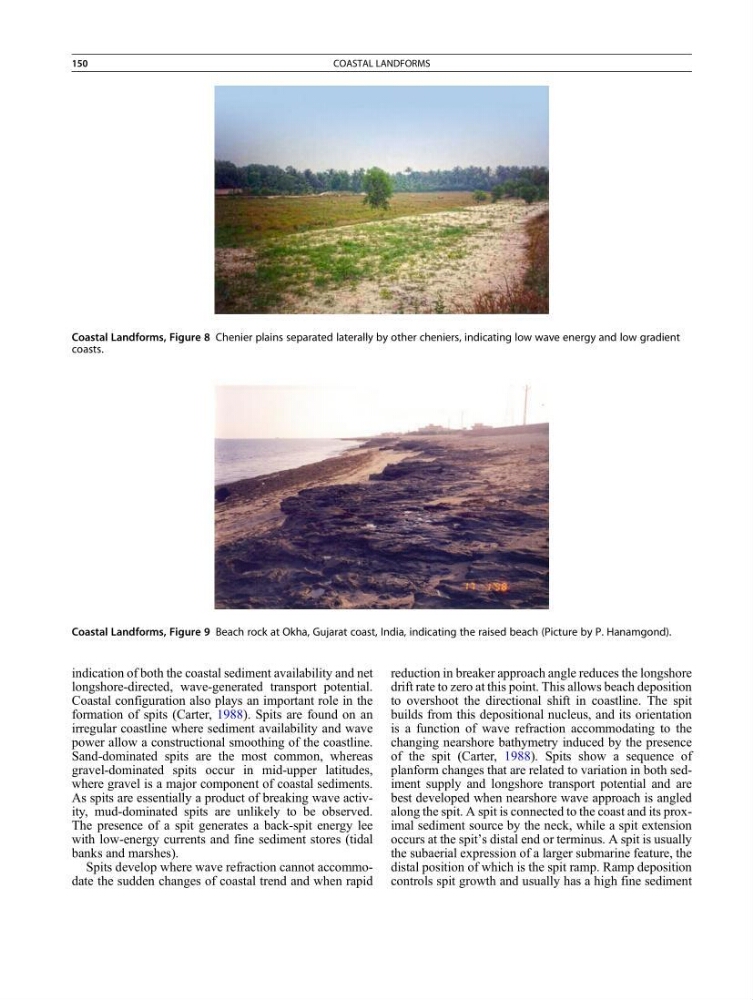
Coastal Landforms, Figure 9 Beach rock at Okha, Gujarat coast, India, indicating the raised beach (Picture by P. Hanamgond).
150
COASTAL LANDFORMS
longshore-directed, wave-generated transport potential.
Coastal configuration also plays an important role in the
formation of spits (Carter, 1988). Spits are found on an
irregular coastline where sediment availability and wave
power allow a constructional smoothing of the coastline.
Sand-dominated spits are the most common, whereas
gravel-dominated spits occur in mid-upper latitudes,
where gravel is a major component of coastal sediments.
As spits are essentially a product of breaking wave activity, mud-dominated spits are unlikely to be observed.
The presence of a spit generates a back-spit energy lee
with low-energy currents and fine sediment stores (tidal
banks and marshes).
Spits develop where wave refraction cannot accommodate the sudden changes of coastal trend and when rapid
reduction in breaker approach angle reduces the longshore
drift rate to zero at this point. This allows beach deposition
to overshoot the directional shift in coastline. The spit
builds from this depositional nucleus, and its orientation
is a function of wave refraction accommodating to the
changing nearshore bathymetry induced by the presence
of the spit (Carter, 1988). Spits show a sequence of
planform changes that are related to variation in both sediment supply and longshore transport potential and are
best developed when nearshore wave approach is angled
along the spit. A spit is connected to the coast and its proximal sediment source by the neck, while a spit extension
occurs at the spit’s distal end or terminus. A spit is usually
the subaerial expression of a larger submarine feature, the
distal position of which is the spit ramp. Ramp deposition
controls spit growth and usually has a high fine sediment
Coastal Landforms, Figure 8 Chenier plains separated laterally by other cheniers, indicating low wave energy and low gradient
coasts.
Coastal Landforms, Figure 9 Beach rock at Okha, Gujarat coast, India, indicating the raised beach (Picture by P. Hanamgond).
150
COASTAL LANDFORMS