

In general, shingle coasts have received less scientific
attention than sandy and muddy shorelines, as they are
much less common worldwide. However, recently there
has been an increasing awareness of the geomorphologic,
ecological, and engineering significance of shingle coasts
in the contexts of sea-level change, flood defense, and
habitat conservation (Packham et al., 2001).
Beach cusps
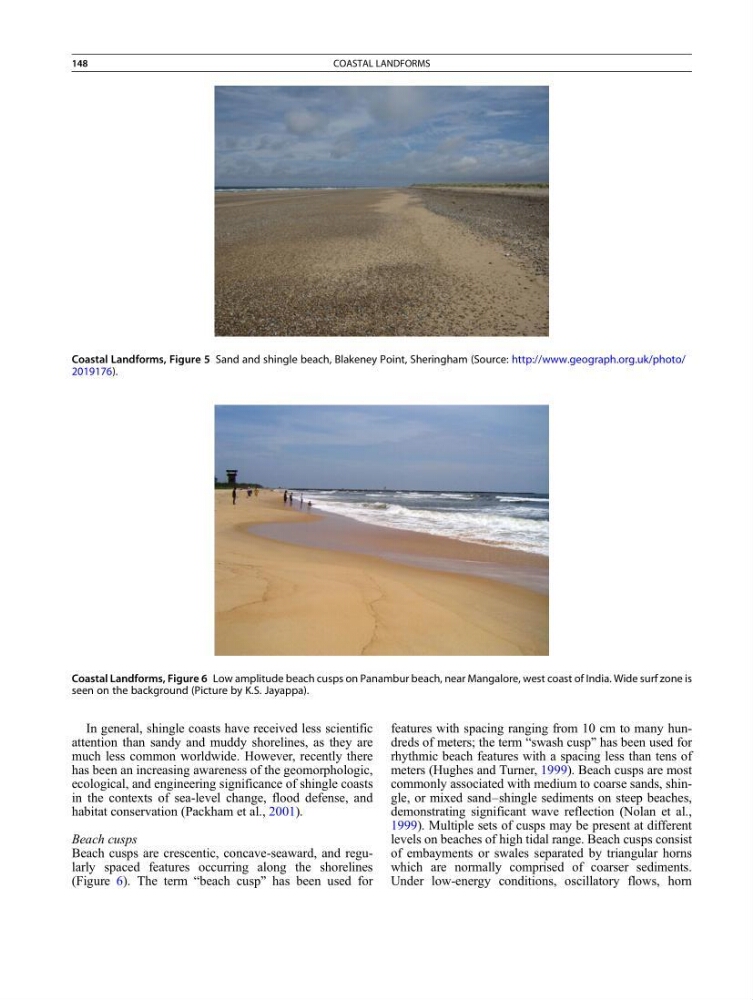
Beach cusps are crescentic, concave-seaward, and regularly spaced features occurring along the shorelines
(Figure 6). The term “beach cusp” has been used for
features with spacing ranging from 10 cm to many hundreds of meters; the term “swash cusp” has been used for
rhythmic beach features with a spacing less than tens of
meters (Hughes and Turner, 1999). Beach cusps are most
commonly associated with medium to coarse sands, shingle, or mixed sand–shingle sediments on steep beaches,
demonstrating significant wave reflection (Nolan et al.,
1999). Multiple sets of cusps may be present at different
levels on beaches of high tidal range. Beach cusps consist
of embayments or swales separated by triangular horns
which are normally comprised of coarser sediments.
Under low-energy conditions, oscillatory flows, horn
Coastal Landforms, Figure 5 Sand and shingle beach, Blakeney Point, Sheringham (Source: http://www.geograph.org.uk/photo/
2019176).
Coastal Landforms, Figure 6 Low amplitude beach cusps on Panambur beach, near Mangalore, west coast of India. Wide surf zone is
seen on the background (Picture by K.S. Jayappa).
148
COASTAL LANDFORMS
attention than sandy and muddy shorelines, as they are
much less common worldwide. However, recently there
has been an increasing awareness of the geomorphologic,
ecological, and engineering significance of shingle coasts
in the contexts of sea-level change, flood defense, and
habitat conservation (Packham et al., 2001).
Beach cusps
Beach cusps are crescentic, concave-seaward, and regularly spaced features occurring along the shorelines
(Figure 6). The term “beach cusp” has been used for
features with spacing ranging from 10 cm to many hundreds of meters; the term “swash cusp” has been used for
rhythmic beach features with a spacing less than tens of
meters (Hughes and Turner, 1999). Beach cusps are most
commonly associated with medium to coarse sands, shingle, or mixed sand–shingle sediments on steep beaches,
demonstrating significant wave reflection (Nolan et al.,
1999). Multiple sets of cusps may be present at different
levels on beaches of high tidal range. Beach cusps consist
of embayments or swales separated by triangular horns
which are normally comprised of coarser sediments.
Under low-energy conditions, oscillatory flows, horn
Coastal Landforms, Figure 5 Sand and shingle beach, Blakeney Point, Sheringham (Source: http://www.geograph.org.uk/photo/
2019176).
Coastal Landforms, Figure 6 Low amplitude beach cusps on Panambur beach, near Mangalore, west coast of India. Wide surf zone is
seen on the background (Picture by K.S. Jayappa).
148
COASTAL LANDFORMS