

their behavior far more complex than that of non-cohesive
sands. Flocculated sediments typically settle from suspension far more rapidly than their constituent mineral particles, and the stability of natural muddy deposits is
governed not only by physical processes but also by the
activity of a rich and diverse biota (Paterson, 1997).
Beaches
Beach is a wave-dominated accumulation of sediment
located between wave base and the upper swash limit.
A beach system is a product of the interaction of waves,
tide, and sediment, and hence, beaches exist in a wide
spectrum of wave, tide, and sediment combinations and
geological settings. Beach systems occur in all tide ranges,
in all latitudes, and in all climates. Beaches composed of
fine sand through boulders may range from low-energy
to high-energy systems exposed to persistent 2–3-m-high
swell which breaks across wide surf zones. All beaches
contain three dynamic zones – wave shoaling, wave
breaking, and swash–backwash. The wave shoaling zone
extends from the modal wave base where average waves
can entrain and move sediment shoreward, to the outer
breakpoint. The wave shoaling zone is dominated by
asymmetrical wave orbital motions which produce
a concave upward profile. It extends out to depths of
30 m or more which may lie 2–3 km offshore on highenergy coasts, while on low-energy coasts, it may only
extend to low tide – a few meters from the shore. The surf
zone, located between the breakpoint and shoreline, has
the greatest potential for complex dynamic processes and
resulting topography and bedforms. The width of the surf
zone depends on the surf zone gradient, a function of sand
size and wave height. The width may vary from a few
meters on a steep reflective beach, typically 50–100-mwide on a single bar intermediate beach, and up to several
hundred meters on a high-energy dissipative beach. Surf
zone topographic features include shore-parallel bars and
troughs with waves breaking over the bars and reforming
in the troughs. Surf zone bedforms reflect the changing
velocity and direction of currents and depth of water and
range from flat bed over the shallow bars to wave orbital
and shore perpendicular current ripples in the troughs, to
shore-parallel seaward migrating ripples in the rip channels (Short, 1979).
Beaches are of three types, which refer to the
morphodynamic character of a beach system: wavedominated, tide-modified, and tide-dominated beaches.
Wave-dominated beaches occur where waves are high relative to the tide range. This can be defined quantitatively
by the relative tide range (Masselink and Short, 1993)
RTR ¼ TR=Hb
ð1Þ
where TR is the spring tide range and Hb the average
breaker wave height. When RTR < 3, beaches are tide
dominated; when 3 < RTR < 15, they are tide modified;
and, when the RTR > 15, they become tide dominated.
Shingle beach
The term “shingle” has been used to describe sediments
composed of mainly rounded pebbles, larger in diameter
than sand (>2 mm) but smaller than boulders
(<200 mm) (Figure 5). In many locations, shingle is
mixed with sand, silt, clay, or organic debris, resulting in
a “mixed” sediment beach (Kirk 1980), but all shingle
and boulder beaches can be regarded as different types
of “coarse clastic” beach (Carter and Orford, 1991).
Shingle coasts form in wave-dominated locations where
suitably sized material is available, and they occur in high
latitudes and temperate shores, which were affected by
Quaternary glaciation.
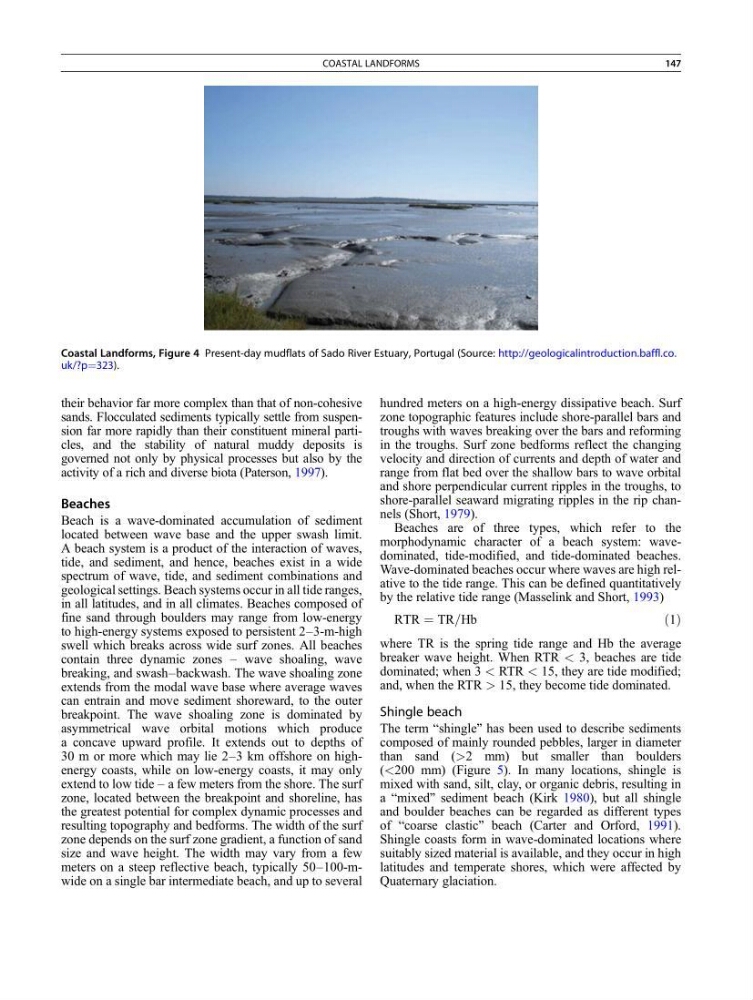
Coastal Landforms, Figure 4 Present-day mudflats of Sado River Estuary, Portugal (Source: http://geologicalintroduction.baffl.co.
uk/?p¼323).
COASTAL LANDFORMS
147
sands. Flocculated sediments typically settle from suspension far more rapidly than their constituent mineral particles, and the stability of natural muddy deposits is
governed not only by physical processes but also by the
activity of a rich and diverse biota (Paterson, 1997).
Beaches
Beach is a wave-dominated accumulation of sediment
located between wave base and the upper swash limit.
A beach system is a product of the interaction of waves,
tide, and sediment, and hence, beaches exist in a wide
spectrum of wave, tide, and sediment combinations and
geological settings. Beach systems occur in all tide ranges,
in all latitudes, and in all climates. Beaches composed of
fine sand through boulders may range from low-energy
to high-energy systems exposed to persistent 2–3-m-high
swell which breaks across wide surf zones. All beaches
contain three dynamic zones – wave shoaling, wave
breaking, and swash–backwash. The wave shoaling zone
extends from the modal wave base where average waves
can entrain and move sediment shoreward, to the outer
breakpoint. The wave shoaling zone is dominated by
asymmetrical wave orbital motions which produce
a concave upward profile. It extends out to depths of
30 m or more which may lie 2–3 km offshore on highenergy coasts, while on low-energy coasts, it may only
extend to low tide – a few meters from the shore. The surf
zone, located between the breakpoint and shoreline, has
the greatest potential for complex dynamic processes and
resulting topography and bedforms. The width of the surf
zone depends on the surf zone gradient, a function of sand
size and wave height. The width may vary from a few
meters on a steep reflective beach, typically 50–100-mwide on a single bar intermediate beach, and up to several
hundred meters on a high-energy dissipative beach. Surf
zone topographic features include shore-parallel bars and
troughs with waves breaking over the bars and reforming
in the troughs. Surf zone bedforms reflect the changing
velocity and direction of currents and depth of water and
range from flat bed over the shallow bars to wave orbital
and shore perpendicular current ripples in the troughs, to
shore-parallel seaward migrating ripples in the rip channels (Short, 1979).
Beaches are of three types, which refer to the
morphodynamic character of a beach system: wavedominated, tide-modified, and tide-dominated beaches.
Wave-dominated beaches occur where waves are high relative to the tide range. This can be defined quantitatively
by the relative tide range (Masselink and Short, 1993)
RTR ¼ TR=Hb
ð1Þ
where TR is the spring tide range and Hb the average
breaker wave height. When RTR < 3, beaches are tide
dominated; when 3 < RTR < 15, they are tide modified;
and, when the RTR > 15, they become tide dominated.
Shingle beach
The term “shingle” has been used to describe sediments
composed of mainly rounded pebbles, larger in diameter
than sand (>2 mm) but smaller than boulders
(<200 mm) (Figure 5). In many locations, shingle is
mixed with sand, silt, clay, or organic debris, resulting in
a “mixed” sediment beach (Kirk 1980), but all shingle
and boulder beaches can be regarded as different types
of “coarse clastic” beach (Carter and Orford, 1991).
Shingle coasts form in wave-dominated locations where
suitably sized material is available, and they occur in high
latitudes and temperate shores, which were affected by
Quaternary glaciation.
Coastal Landforms, Figure 4 Present-day mudflats of Sado River Estuary, Portugal (Source: http://geologicalintroduction.baffl.co.
uk/?p¼323).
COASTAL LANDFORMS
147