

landforms of muddy coasts – salt marshes, mangrove
swamps, and tidal flats – are often well developed under
macrotidal conditions (Hayes, 1975). Enormous quantities
of muddy sediment are supplied by some of the world’s
major rivers, and their estuaries and deltas often feature
extensive shore-attached mud banks. Consequent to the
development of wide estuarine mouths, a lot of seawater
enters through them during high tide and submerges
low-lying flats adjacent to the river mouth forming tidal
flats. Both estuarine and open coast mud banks are highly
dynamic landforms, which exhibit seasonal variability in
response to variations in river flow and wave energy.
Fine sediments in suspension can be transported over
long distances by coastal currents. These fine particles
undergo flocculation and, once they are flocculated, settle
from suspension rapidly giving rise to muddy deposits/
mudflats near estuarine/river mouths. Flocculation is
influenced by a variety of factors, notably salinity, fluid
shear, and suspended sediment concentration (Lick and
Huang, 1993). The effect of these processes may vary over
quite short spatial and temporal scales, especially in estuaries, where mixing of freshwater and saltwater occurs and
where marked variation in flow intensity occurs at tidal
timescales. The cohesive nature of muddy sediments makes
Coastal Landforms, Figure 2 Well-developed shore-attached transverse bars and adjacent deeper rip channels at Lighthouse Beach,
New South Wales (Short, 1979) (Source: http://www.ozcoasts.gov.au/conceptual_mods/beaches/wdb.jsp).
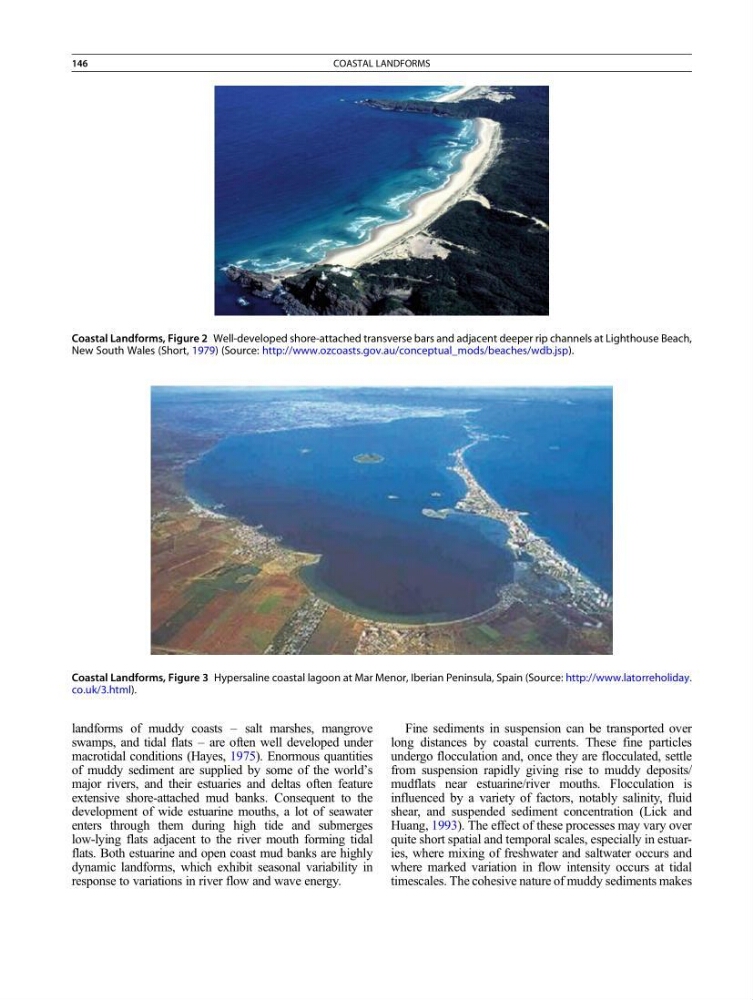
Coastal Landforms, Figure 3 Hypersaline coastal lagoon at Mar Menor, Iberian Peninsula, Spain (Source: http://www.latorreholiday.
co.uk/3.html).
146
COASTAL LANDFORMS
swamps, and tidal flats – are often well developed under
macrotidal conditions (Hayes, 1975). Enormous quantities
of muddy sediment are supplied by some of the world’s
major rivers, and their estuaries and deltas often feature
extensive shore-attached mud banks. Consequent to the
development of wide estuarine mouths, a lot of seawater
enters through them during high tide and submerges
low-lying flats adjacent to the river mouth forming tidal
flats. Both estuarine and open coast mud banks are highly
dynamic landforms, which exhibit seasonal variability in
response to variations in river flow and wave energy.
Fine sediments in suspension can be transported over
long distances by coastal currents. These fine particles
undergo flocculation and, once they are flocculated, settle
from suspension rapidly giving rise to muddy deposits/
mudflats near estuarine/river mouths. Flocculation is
influenced by a variety of factors, notably salinity, fluid
shear, and suspended sediment concentration (Lick and
Huang, 1993). The effect of these processes may vary over
quite short spatial and temporal scales, especially in estuaries, where mixing of freshwater and saltwater occurs and
where marked variation in flow intensity occurs at tidal
timescales. The cohesive nature of muddy sediments makes
Coastal Landforms, Figure 2 Well-developed shore-attached transverse bars and adjacent deeper rip channels at Lighthouse Beach,
New South Wales (Short, 1979) (Source: http://www.ozcoasts.gov.au/conceptual_mods/beaches/wdb.jsp).
Coastal Landforms, Figure 3 Hypersaline coastal lagoon at Mar Menor, Iberian Peninsula, Spain (Source: http://www.latorreholiday.
co.uk/3.html).
146
COASTAL LANDFORMS