

• Coastal dynamics, effectiveness of erosion control measures, erosion phenomena, and spatial and temporal
scales
On this basis, the resulting project will be the “optimum
solution,” chosen in continuity with existing management
policies, protection measures, and related operational procedures, such as institutional arrangement, operational
responsibilities, and financing.
Conclusions
Natural and anthropogenic factors cause alterations in
coastal sediment transport equilibrium, thus resulting in
coastal erosion, with ecological and financial loss. Furthermore, cultural identity, resources, and recreational
coastal land use are strongly compromised or lost.
Hard and soft control measures are effective tools for
mitigating such phenomena. Hard stabilization methods
in particular mainly consist of concrete and rock structures
such as groins, revetments, breakwaters, etc., while soft
methods consist of shoreline protection measures based
on beach nourishment and the planting of vegetation, thus
allowing recreational tourist areas to be developed. Good
practices in the planning and management of coastal areas
are also effective coastal erosion control measures and
important targets for many states. The choice of stabilization methods should be the “optimal” method among possible solutions and should be selected starting from
a hydrodynamic, environmental, social, and cultural site
characterization. Finally, the combined use of different
stabilization methods enables considerable coastal erosion
control objectives to be achieved.
Bibliography
Basco, D. R., and Pope, J., 2004. Groin functional design guidance
from the coastal engineering manual. Journal of Coastal
Research, (Special Issue 33) 121–130.
Department of Boating and Waterways and State Coastal
Conservancy, 2002. California beach restoration study,
ch. 4, pp. 3–6.
Eronat, A. H., 1999. Altinova Madra Creek region coastal erosion
study. In Proceedings of the MEDCOAST 99 – EMECS 99 Joint
Conference: Land – Ocean Interactions – Managing Coastal
Ecosystems, Vol. 3, pp. 1525–1540.
EUROSION, 2004. Living with coastal erosion in Europe: sediment
and space for sustainability. A guide to coastal erosion management practices in Europe. Report.
Fathallah, S., and Gueddari, M., 2001. Sedimentary processes and
shoreline changes along the Sousse Coast, Eastern Tunisia. In
Proceedings of the Fifth International Conference on the Mediterranean Coastal Environment, Vol. 3, pp. 1457–1466.
Fredsøe, J., and Deigaard, R., 1994. Mechanical of Coastal Sediment Transport. Singapore: World Scientific Publishing.
Herbich, J. B., 1991. Coastal and Ocean Engineering. Houston:
Gulf Publishing Company.
Kana, T. W., White, T. E., and McKee, P. A., 2004. Management
and engineering guidelines from groin rehabilitation. Journal
of Coastal Research (Special Issue 33), 57–82.
Khalil, S., 1997. Critical problems of the Egyptian Mediterranean
coastal zones. In Proceedings of the Third International Conference on the Mediterranean Coastal Environment, MEDCOAST
97, Vol. 1, pp. 513–521.
Loizidou X. I., and Iacovou, N. G., 1999. Anthropogenic
coastal erosion and shoreline management in Cyprus. In
Proceedings of the MEDCOAST’99-EMECS 99 Joint Conference:
Land – Ocean Interactions -Managing Coastal Ecosystems,
Vol. 3, pp. 1501–1509.
Medina, J. M., and Lopez, J. S., 1997. Strong erosion scenario due
to disequilibrium of solid transport rate: the case of Torrox
Beach(Malaga). In Proceedings of the Second International
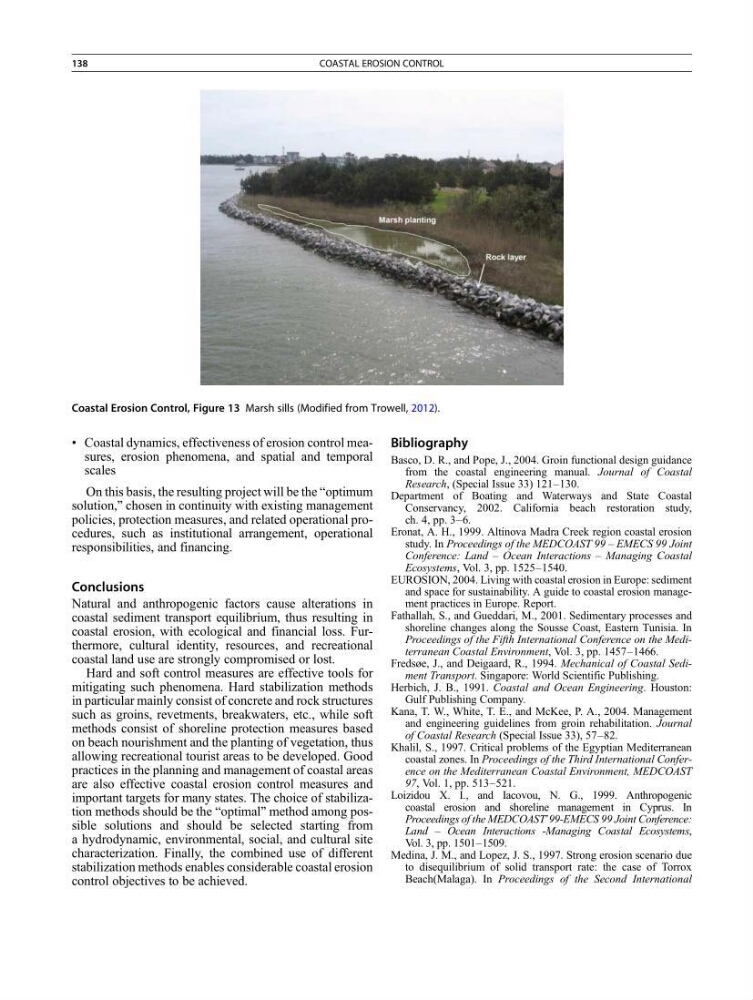
Coastal Erosion Control, Figure 13 Marsh sills (Modified from Trowell, 2012).
138
COASTAL EROSION CONTROL
scales
On this basis, the resulting project will be the “optimum
solution,” chosen in continuity with existing management
policies, protection measures, and related operational procedures, such as institutional arrangement, operational
responsibilities, and financing.
Conclusions
Natural and anthropogenic factors cause alterations in
coastal sediment transport equilibrium, thus resulting in
coastal erosion, with ecological and financial loss. Furthermore, cultural identity, resources, and recreational
coastal land use are strongly compromised or lost.
Hard and soft control measures are effective tools for
mitigating such phenomena. Hard stabilization methods
in particular mainly consist of concrete and rock structures
such as groins, revetments, breakwaters, etc., while soft
methods consist of shoreline protection measures based
on beach nourishment and the planting of vegetation, thus
allowing recreational tourist areas to be developed. Good
practices in the planning and management of coastal areas
are also effective coastal erosion control measures and
important targets for many states. The choice of stabilization methods should be the “optimal” method among possible solutions and should be selected starting from
a hydrodynamic, environmental, social, and cultural site
characterization. Finally, the combined use of different
stabilization methods enables considerable coastal erosion
control objectives to be achieved.
Bibliography
Basco, D. R., and Pope, J., 2004. Groin functional design guidance
from the coastal engineering manual. Journal of Coastal
Research, (Special Issue 33) 121–130.
Department of Boating and Waterways and State Coastal
Conservancy, 2002. California beach restoration study,
ch. 4, pp. 3–6.
Eronat, A. H., 1999. Altinova Madra Creek region coastal erosion
study. In Proceedings of the MEDCOAST 99 – EMECS 99 Joint
Conference: Land – Ocean Interactions – Managing Coastal
Ecosystems, Vol. 3, pp. 1525–1540.
EUROSION, 2004. Living with coastal erosion in Europe: sediment
and space for sustainability. A guide to coastal erosion management practices in Europe. Report.
Fathallah, S., and Gueddari, M., 2001. Sedimentary processes and
shoreline changes along the Sousse Coast, Eastern Tunisia. In
Proceedings of the Fifth International Conference on the Mediterranean Coastal Environment, Vol. 3, pp. 1457–1466.
Fredsøe, J., and Deigaard, R., 1994. Mechanical of Coastal Sediment Transport. Singapore: World Scientific Publishing.
Herbich, J. B., 1991. Coastal and Ocean Engineering. Houston:
Gulf Publishing Company.
Kana, T. W., White, T. E., and McKee, P. A., 2004. Management
and engineering guidelines from groin rehabilitation. Journal
of Coastal Research (Special Issue 33), 57–82.
Khalil, S., 1997. Critical problems of the Egyptian Mediterranean
coastal zones. In Proceedings of the Third International Conference on the Mediterranean Coastal Environment, MEDCOAST
97, Vol. 1, pp. 513–521.
Loizidou X. I., and Iacovou, N. G., 1999. Anthropogenic
coastal erosion and shoreline management in Cyprus. In
Proceedings of the MEDCOAST’99-EMECS 99 Joint Conference:
Land – Ocean Interactions -Managing Coastal Ecosystems,
Vol. 3, pp. 1501–1509.
Medina, J. M., and Lopez, J. S., 1997. Strong erosion scenario due
to disequilibrium of solid transport rate: the case of Torrox
Beach(Malaga). In Proceedings of the Second International
Coastal Erosion Control, Figure 13 Marsh sills (Modified from Trowell, 2012).
138
COASTAL EROSION CONTROL