

it from reaching the upland (Rogers and Skrabal, 2001).
An added value of this strategy is its ability to promote
the creation of natural habitats.
Planting vegetation
Vegetation plays an important role in promoting shoreline
stabilization, reducing wave and current energy, and trapping incoherent sediment in radical apparatuses. Thus,
planting vegetation is considered a shoreline stabilization
method, although its effectiveness is strongly site
specific. In fact, planting vegetation generally allows good
erosion control to be achieved in low-energy environments, such as in estuarine tidal zones, while on the contrary, in high-energy environment, vegetation seems
ineffective. Finally, there should be a preference for the
planting of native species.
Nonstructural measures
Policy and planning techniques
Policy and planning techniques for erosion control relate
to strategies for coastal area use and anthropogenic pressure control, based on the introduction of sustainable
coastal area management development logic. In fact,
man’s use of coastal and estuarine areas for promoting
economic activities generally requires intensive development and accelerated estuarine area modification processes, often leading to natural equilibrium alteration and
increased vulnerability. Policy planning techniques
involve a large number of factors, the majority of which
are described herein.
Firstly, estuarine area management project measures
are based on specific environmental policies, legislations
(e.g., European Bird, 1979 and Habitats, 1992 Directives,
Natura 2000 ecological networks of protected areas to
name but a few), and project management development.
The latter is generally based on “prevention” and “protection” measures, attending to primary coastal erosion risk
management and consisting of both structural and
nonstructural measures (Safecoast, 2008). Examples of
“prevention” strategies are relocation, zoning, space allocation and reservation, coastal erosion risk education,
and communication and raising awareness. Examples of
“protection” strategies are based on building and
maintaining structures for erosion control (such as breakwaters, nourishment and groins).
Good project management should be based on a precise
site evaluation and decision logic systems, with focus on
the following aspects (Safecoast, 2008):
• Physical and environmental characteristics
• Economic and ecological values, assessed by stakeholders and others, such as engineers, scientists, politicians, land use planners, and the public affected
• Historical and cultural background
• Policy measures and a general set of rules capable of
identifying different scenarios (e.g., land use restriction)
Coastal Erosion Control, Figure 12 Gabions: definition sketch.
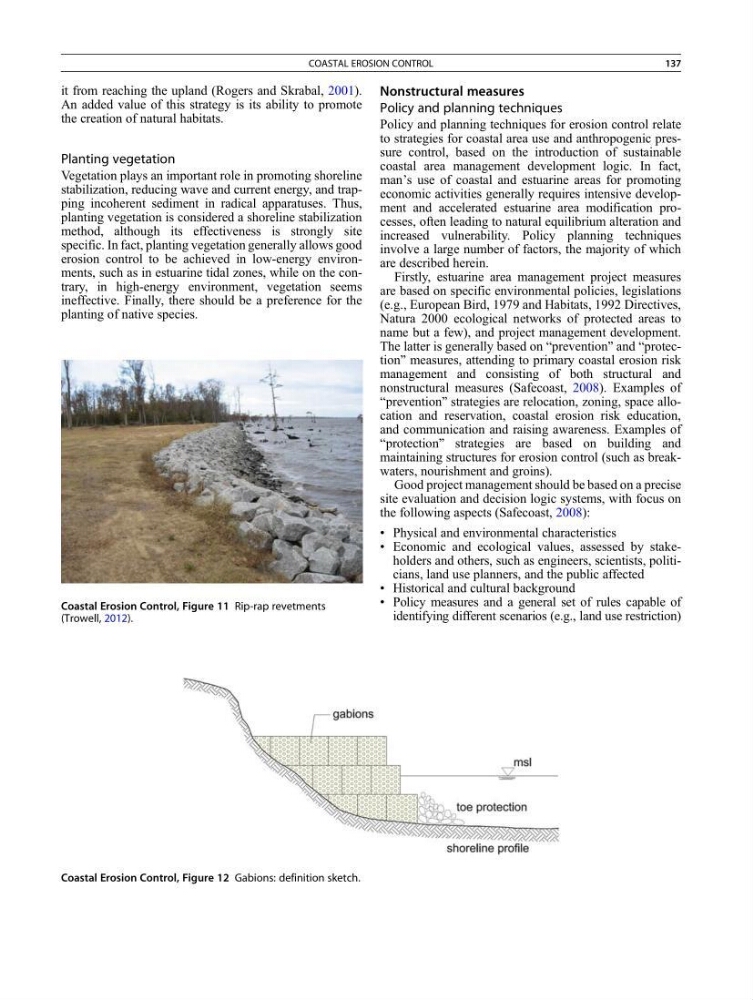
Coastal Erosion Control, Figure 11 Rip-rap revetments
(Trowell, 2012).
COASTAL EROSION CONTROL
137
An added value of this strategy is its ability to promote
the creation of natural habitats.
Planting vegetation
Vegetation plays an important role in promoting shoreline
stabilization, reducing wave and current energy, and trapping incoherent sediment in radical apparatuses. Thus,
planting vegetation is considered a shoreline stabilization
method, although its effectiveness is strongly site
specific. In fact, planting vegetation generally allows good
erosion control to be achieved in low-energy environments, such as in estuarine tidal zones, while on the contrary, in high-energy environment, vegetation seems
ineffective. Finally, there should be a preference for the
planting of native species.
Nonstructural measures
Policy and planning techniques
Policy and planning techniques for erosion control relate
to strategies for coastal area use and anthropogenic pressure control, based on the introduction of sustainable
coastal area management development logic. In fact,
man’s use of coastal and estuarine areas for promoting
economic activities generally requires intensive development and accelerated estuarine area modification processes, often leading to natural equilibrium alteration and
increased vulnerability. Policy planning techniques
involve a large number of factors, the majority of which
are described herein.
Firstly, estuarine area management project measures
are based on specific environmental policies, legislations
(e.g., European Bird, 1979 and Habitats, 1992 Directives,
Natura 2000 ecological networks of protected areas to
name but a few), and project management development.
The latter is generally based on “prevention” and “protection” measures, attending to primary coastal erosion risk
management and consisting of both structural and
nonstructural measures (Safecoast, 2008). Examples of
“prevention” strategies are relocation, zoning, space allocation and reservation, coastal erosion risk education,
and communication and raising awareness. Examples of
“protection” strategies are based on building and
maintaining structures for erosion control (such as breakwaters, nourishment and groins).
Good project management should be based on a precise
site evaluation and decision logic systems, with focus on
the following aspects (Safecoast, 2008):
• Physical and environmental characteristics
• Economic and ecological values, assessed by stakeholders and others, such as engineers, scientists, politicians, land use planners, and the public affected
• Historical and cultural background
• Policy measures and a general set of rules capable of
identifying different scenarios (e.g., land use restriction)
Coastal Erosion Control, Figure 12 Gabions: definition sketch.
Coastal Erosion Control, Figure 11 Rip-rap revetments
(Trowell, 2012).
COASTAL EROSION CONTROL
137