

difference lies in their functional aspects (U.S. Army
Corps of Engineers, 1984). In fact, revetments are stone
or concrete structures built adjacent to the shoreline and
are designed to protect the underlying soil from erosion.
A larger stone layer is generally placed on the frontwater,
with a smaller layer filter placed below it. The latter prevents underlying soil washing, while the main erosion protection is guaranteed by the upper stone layer.
Seawalls are primarily designed to protect the shore
against wave action; bulkheads are retaining walls
designed to provide protection in low-to-moderate wave
energy environments. More specifically, seawalls are massive concrete or stone, vertical or sloped structures
(Figure 6), with rubble, curved, or stepped face. A combination stepped-curved face may also be constructed.
Revetment and seawall slopes should be no steeper than
1:3, and the length of the structure should be carefully
selected to avoid erosion of the adjacent coastline.
Bulkheads (Figure 7) are designed to protect adjacent
upland areas and to retain the soil behind them.
A sufficiently large embedded wall is required, and tie
rods may be used to increase the stability of the structure.
Toe protection is required for all these structures so as to
prevent local scour.
Groins
Groins are long, narrow coastal structures used both on
open beaches and in estuaries, altering nearshore tidal
flow patterns and deflecting currents. They are placed
perpendicular or slightly perpendicular to the shoreline
(Figure 8). Such structures are generally constructed in
groups, so that compartments between adjacent groins
can be identified, trapping sediments in each of them and
extending coast longevity.
Groins are most effective when long-shore currents prevail in one direction.
Generally, two kinds of groins (Figure 9) can be distinguished (van Rijn, 2010; van Rijn, 2011):
• Impermeable, high-crested structures, usually made of
sheet piling or concrete structures. Crest levels are 1 m
above MSL (mean sea level). A full long-shore current
block is expected, so that the sand within each compartment is retained. A typical sawtooth shoreline profile
should be created, thus increasing groin spacing.
• Permeable, low-crested structures, with crest level
between MLW (mean low water) and MHW (mean high
water). These structures act as flow resistance, reducing
the littoral drift in the inner surf zone. A regular shoreline should be created.
Groins should only be constructed along coasts
with recession rates in excess of 2 m/year. Their length
should moreover be extended over the inner surf zone
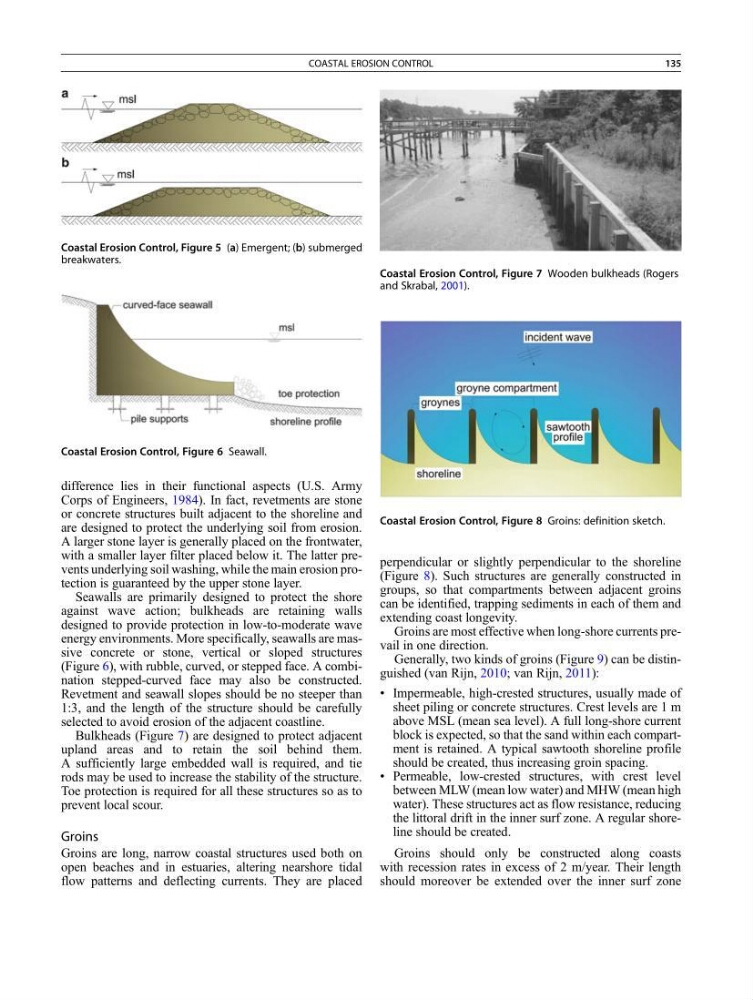
Coastal Erosion Control, Figure 5 (a) Emergent; (b) submerged
breakwaters.
Coastal Erosion Control, Figure 6 Seawall.
Coastal Erosion Control, Figure 7 Wooden bulkheads (Rogers
and Skrabal, 2001).
Coastal Erosion Control, Figure 8 Groins: definition sketch.
COASTAL EROSION CONTROL
135
Corps of Engineers, 1984). In fact, revetments are stone
or concrete structures built adjacent to the shoreline and
are designed to protect the underlying soil from erosion.
A larger stone layer is generally placed on the frontwater,
with a smaller layer filter placed below it. The latter prevents underlying soil washing, while the main erosion protection is guaranteed by the upper stone layer.
Seawalls are primarily designed to protect the shore
against wave action; bulkheads are retaining walls
designed to provide protection in low-to-moderate wave
energy environments. More specifically, seawalls are massive concrete or stone, vertical or sloped structures
(Figure 6), with rubble, curved, or stepped face. A combination stepped-curved face may also be constructed.
Revetment and seawall slopes should be no steeper than
1:3, and the length of the structure should be carefully
selected to avoid erosion of the adjacent coastline.
Bulkheads (Figure 7) are designed to protect adjacent
upland areas and to retain the soil behind them.
A sufficiently large embedded wall is required, and tie
rods may be used to increase the stability of the structure.
Toe protection is required for all these structures so as to
prevent local scour.
Groins
Groins are long, narrow coastal structures used both on
open beaches and in estuaries, altering nearshore tidal
flow patterns and deflecting currents. They are placed
perpendicular or slightly perpendicular to the shoreline
(Figure 8). Such structures are generally constructed in
groups, so that compartments between adjacent groins
can be identified, trapping sediments in each of them and
extending coast longevity.
Groins are most effective when long-shore currents prevail in one direction.
Generally, two kinds of groins (Figure 9) can be distinguished (van Rijn, 2010; van Rijn, 2011):
• Impermeable, high-crested structures, usually made of
sheet piling or concrete structures. Crest levels are 1 m
above MSL (mean sea level). A full long-shore current
block is expected, so that the sand within each compartment is retained. A typical sawtooth shoreline profile
should be created, thus increasing groin spacing.
• Permeable, low-crested structures, with crest level
between MLW (mean low water) and MHW (mean high
water). These structures act as flow resistance, reducing
the littoral drift in the inner surf zone. A regular shoreline should be created.
Groins should only be constructed along coasts
with recession rates in excess of 2 m/year. Their length
should moreover be extended over the inner surf zone
Coastal Erosion Control, Figure 5 (a) Emergent; (b) submerged
breakwaters.
Coastal Erosion Control, Figure 6 Seawall.
Coastal Erosion Control, Figure 7 Wooden bulkheads (Rogers
and Skrabal, 2001).
Coastal Erosion Control, Figure 8 Groins: definition sketch.
COASTAL EROSION CONTROL
135