

permeability/impermeability, overtopping, etc. The main
hard structures are described below.
Breakwaters
Breakwaters (Figure 4) are structures designed to protect
shorelines from erosion by shielding waves (i.e., reducing
incident wave energy) and changing littoral transport conditions. These structures can be directly connected to the
shoreline or constructed shore-parallel, respectively,
attached or detached. In the first case, breakwaters act as
a revetment, protecting adjacent upland areas against
scour induced by waves and currents, while detached
breakwaters act by allowing sand accumulation from
the original shoreline to the landward breakwater.
Such sand accumulation is called a “tombolo” or “salient,”
depending on whether or not the breakwater is reached
by sand. Accretionary beach features are characterized
by a dimensionless ratio X/B (Herbich, 1991),
X representing the breakwater length and B the breakwater
distance from the original shoreline. For X/B > 1,
sediment deposition and accumulation behind breakwater
forms until the shoreline is connected to the structure
(permanent tombolo), while for X/B < 1, sediment forms
from the shoreline in the lee of the structure, without
reaching the breakwater (salient). Since sediment transport phenomena are in equilibrium, sand accumulation
leads to the formation of an erosion zone. With reference
to design and construction aspects, breakwaters can be
classified as follows: (1) rock or concrete units with trapezoidal cross sections, (2) prefabricated triangular-shaped
concrete units, and (3) sand-filled containers (caissons)
with geotextile units.
Breakwaters can be emergent and submerged,
depending on crest position with respect to water level,
namely, if the crest is positioned entirely below or above
mean sea level (Figure 5). Both emergent and submerged
breakwaters have a strong impact on sediment fluxes and
on morphodynamic evolution, the latter depending on
structure-induced waves, circulation fields, and wave
overtopping. In order to avoid negative morphological
effects, such as local scours, these aspects should be preliminarily and carefully analyzed. Lastly, it should be
pointed out that during storm conditions, breakwater cannot stop or dissipate most of the waves, which result in low
effectiveness, and thus other methods such as supplementary nourishment may be required.
Revetments, seawalls and bulkheads
Revetments, seawalls, and bulkheads are shore-parallel
structures built adjacent to the shoreline. The main
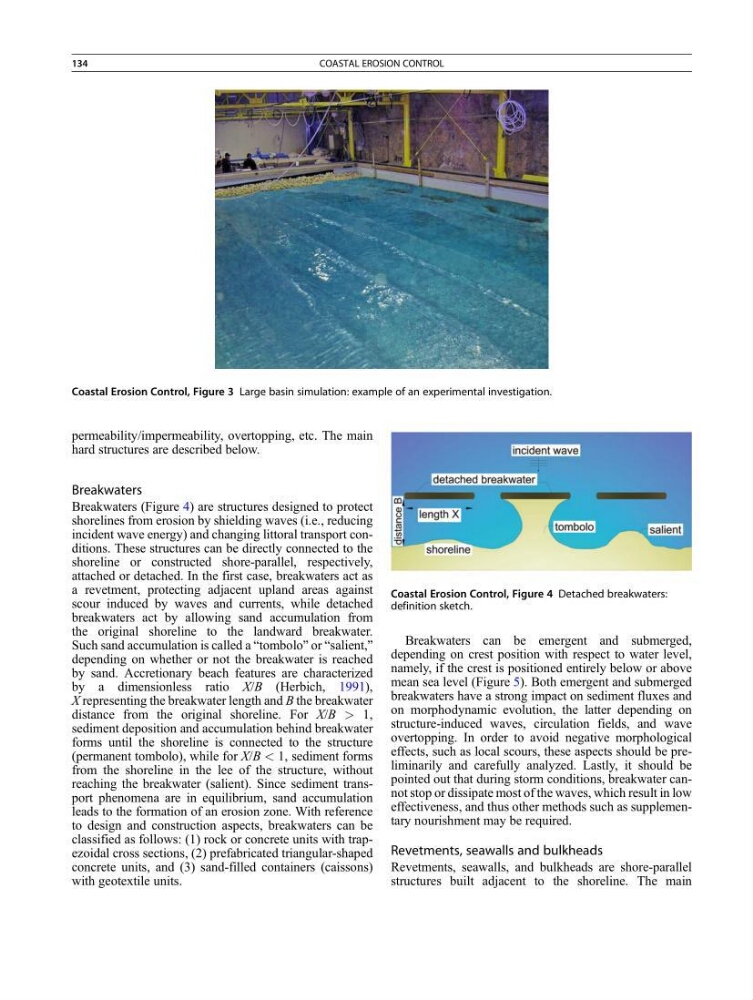
Coastal Erosion Control, Figure 3 Large basin simulation: example of an experimental investigation.
Coastal Erosion Control, Figure 4 Detached breakwaters:
definition sketch.
134
COASTAL EROSION CONTROL
hard structures are described below.
Breakwaters
Breakwaters (Figure 4) are structures designed to protect
shorelines from erosion by shielding waves (i.e., reducing
incident wave energy) and changing littoral transport conditions. These structures can be directly connected to the
shoreline or constructed shore-parallel, respectively,
attached or detached. In the first case, breakwaters act as
a revetment, protecting adjacent upland areas against
scour induced by waves and currents, while detached
breakwaters act by allowing sand accumulation from
the original shoreline to the landward breakwater.
Such sand accumulation is called a “tombolo” or “salient,”
depending on whether or not the breakwater is reached
by sand. Accretionary beach features are characterized
by a dimensionless ratio X/B (Herbich, 1991),
X representing the breakwater length and B the breakwater
distance from the original shoreline. For X/B > 1,
sediment deposition and accumulation behind breakwater
forms until the shoreline is connected to the structure
(permanent tombolo), while for X/B < 1, sediment forms
from the shoreline in the lee of the structure, without
reaching the breakwater (salient). Since sediment transport phenomena are in equilibrium, sand accumulation
leads to the formation of an erosion zone. With reference
to design and construction aspects, breakwaters can be
classified as follows: (1) rock or concrete units with trapezoidal cross sections, (2) prefabricated triangular-shaped
concrete units, and (3) sand-filled containers (caissons)
with geotextile units.
Breakwaters can be emergent and submerged,
depending on crest position with respect to water level,
namely, if the crest is positioned entirely below or above
mean sea level (Figure 5). Both emergent and submerged
breakwaters have a strong impact on sediment fluxes and
on morphodynamic evolution, the latter depending on
structure-induced waves, circulation fields, and wave
overtopping. In order to avoid negative morphological
effects, such as local scours, these aspects should be preliminarily and carefully analyzed. Lastly, it should be
pointed out that during storm conditions, breakwater cannot stop or dissipate most of the waves, which result in low
effectiveness, and thus other methods such as supplementary nourishment may be required.
Revetments, seawalls and bulkheads
Revetments, seawalls, and bulkheads are shore-parallel
structures built adjacent to the shoreline. The main
Coastal Erosion Control, Figure 3 Large basin simulation: example of an experimental investigation.
Coastal Erosion Control, Figure 4 Detached breakwaters:
definition sketch.
134
COASTAL EROSION CONTROL