

Rip-rap, gabions, paved-lining revetments, groins,
marsh sills, and planting vegetation are generally effective
for river bank protection, while in wave-exposed areas,
coastal erosion control measures should be chosen
depending on whether cross-shore or long-shore transport
is dominant, with a preference for shorel-parallel structures (such as revetments, attached and detached breakwaters) or perpendicular structures (such as groins),
respectively. Furthermore, good coastal planning and
management practices that promote land use rehabilitation
targets and eco-sustainable tourism are also suitable
coastal erosion control measures. Lastly, the choice of erosion control method is strongly dependant on the environmental, social, and cultural characteristics of the areas
concerned and on legislative, policy, and economic
aspects. Thus, the combination of different methods is
often an effective strategy.
Structural measures: hard stabilization
Hard stabilization methods are based on protective structures designed to stabilize the shore and to prevent waves
and tides from reaching the area or to trap sediment. Such
structures typically act by reducing incident wave energy
and changing flow-field circulation. Stabilization effectiveness is strongly dependant on wave exposure, the latter
being influenced by structure inclination and orientation
(e.g., perpendicular or parallel to the coastline),
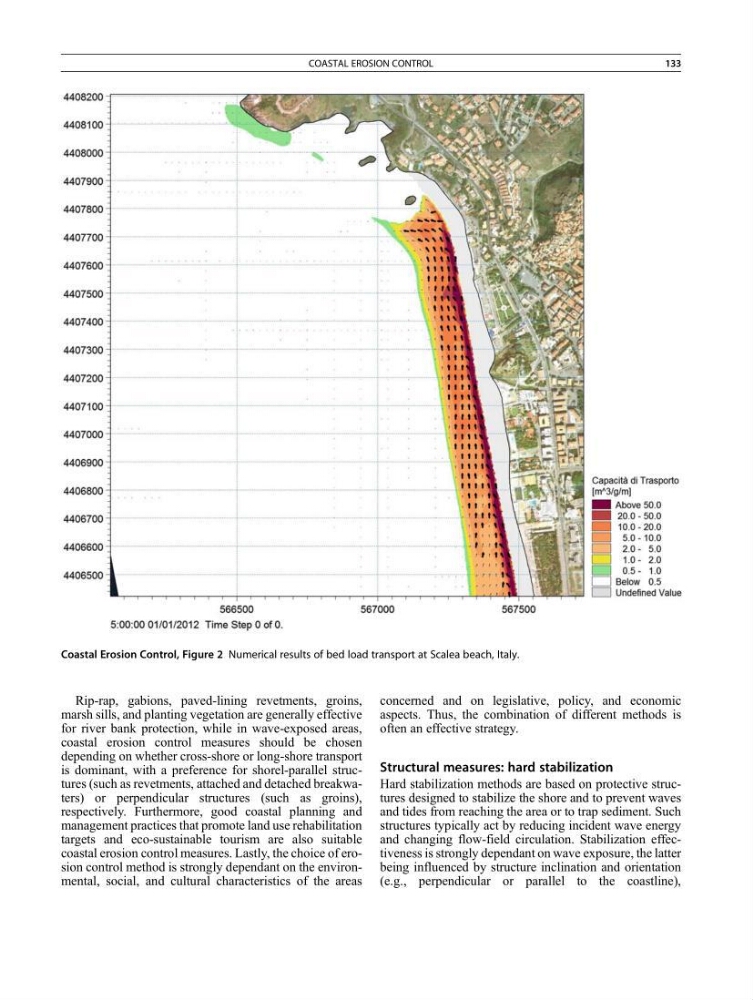
Coastal Erosion Control, Figure 2 Numerical results of bed load transport at Scalea beach, Italy.
COASTAL EROSION CONTROL
133
marsh sills, and planting vegetation are generally effective
for river bank protection, while in wave-exposed areas,
coastal erosion control measures should be chosen
depending on whether cross-shore or long-shore transport
is dominant, with a preference for shorel-parallel structures (such as revetments, attached and detached breakwaters) or perpendicular structures (such as groins),
respectively. Furthermore, good coastal planning and
management practices that promote land use rehabilitation
targets and eco-sustainable tourism are also suitable
coastal erosion control measures. Lastly, the choice of erosion control method is strongly dependant on the environmental, social, and cultural characteristics of the areas
concerned and on legislative, policy, and economic
aspects. Thus, the combination of different methods is
often an effective strategy.
Structural measures: hard stabilization
Hard stabilization methods are based on protective structures designed to stabilize the shore and to prevent waves
and tides from reaching the area or to trap sediment. Such
structures typically act by reducing incident wave energy
and changing flow-field circulation. Stabilization effectiveness is strongly dependant on wave exposure, the latter
being influenced by structure inclination and orientation
(e.g., perpendicular or parallel to the coastline),
Coastal Erosion Control, Figure 2 Numerical results of bed load transport at Scalea beach, Italy.
COASTAL EROSION CONTROL
133