

Diaz and Rosenberg, 1995; Lenihan and Peterson, 1998;
Lenihan, 1999; Breitburg et al., 2009), higher-relief reefs
prove to be more successful than low-relief or no-relief
reefs (discussed in Coen and Luckenbach, 2000) in the Gulf
of Mexico (e.g., Gregalis et al., 2009), the southeastern
USA (e.g., Lenihan and Peterson, 1998; Lenihan, 1999),
as well as the mid-Atlantic USA (e.g., Luckenbach et al.,
1999; Woods et al., 2005; Schulte et al., 2009).
Mapping
In many areas, major efforts have taken place with new
imagery and related mapping (Figure 7, ASMFC, 2007;
SCDNR, 2008; Kennedy et al., 2011; La Peyre et al.,
2014a) or will be underway (e.g., RESTORE funding for
the Gulf of Mexico) to assess the current status and
eventually trends for triaging these recovery efforts that
require their mapping (Grizzle et al., 2005, 2008b; Powers
et al. 2010) for later detection and, if possible, storage
in a GIS geodatabase (see http://www.dnr.sc.gov/GIS/
descoysterbed.html; Gambordella et al., 2007; SCDNR,
2008; Ross and Luckenbach, 2009, http://www.oysterrestoration.org/oyster-restoration-research-reports/).
Aquaculture
Aquaculture is playing an ever increasing role in the
enhancement or restoration of native and nonnative
bivalves and more generally molluscs in North America
(see Figure 17) (Manzi and Castagna, 1989; Dumbauld
et al., 2009; Shumway, 2011) and of late as a potential tool
for other nonconsumptive “ecosystem services” for
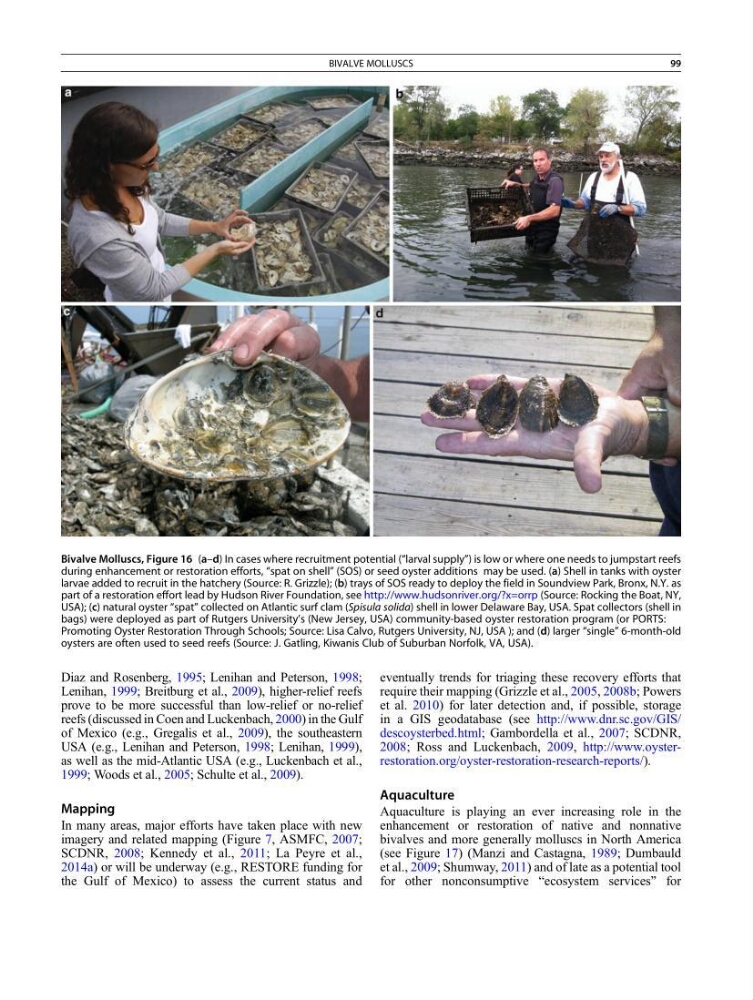
Bivalve Molluscs, Figure 16 (a–d) In cases where recruitment potential (“larval supply”) is low or where one needs to jumpstart reefs
during enhancement or restoration efforts, “spat on shell” (SOS) or seed oyster additions may be used. (a) Shell in tanks with oyster
larvae added to recruit in the hatchery (Source: R. Grizzle); (b) trays of SOS ready to deploy the field in Soundview Park, Bronx, N.Y. as
part of a restoration effort lead by Hudson River Foundation, see http://www.hudsonriver.org/?x=orrp (Source: Rocking the Boat, NY,
USA); (c) natural oyster “spat” collected on Atlantic surf clam (Spisula solida) shell in lower Delaware Bay, USA. Spat collectors (shell in
bags) were deployed as part of Rutgers University’s (New Jersey, USA) community-based oyster restoration program (or PORTS:
Promoting Oyster Restoration Through Schools; Source: Lisa Calvo, Rutgers University, NJ, USA ); and (d) larger “single” 6-month-old
oysters are often used to seed reefs (Source: J. Gatling, Kiwanis Club of Suburban Norfolk, VA, USA).
BIVALVE MOLLUSCS
99
Lenihan, 1999; Breitburg et al., 2009), higher-relief reefs
prove to be more successful than low-relief or no-relief
reefs (discussed in Coen and Luckenbach, 2000) in the Gulf
of Mexico (e.g., Gregalis et al., 2009), the southeastern
USA (e.g., Lenihan and Peterson, 1998; Lenihan, 1999),
as well as the mid-Atlantic USA (e.g., Luckenbach et al.,
1999; Woods et al., 2005; Schulte et al., 2009).
Mapping
In many areas, major efforts have taken place with new
imagery and related mapping (Figure 7, ASMFC, 2007;
SCDNR, 2008; Kennedy et al., 2011; La Peyre et al.,
2014a) or will be underway (e.g., RESTORE funding for
the Gulf of Mexico) to assess the current status and
eventually trends for triaging these recovery efforts that
require their mapping (Grizzle et al., 2005, 2008b; Powers
et al. 2010) for later detection and, if possible, storage
in a GIS geodatabase (see http://www.dnr.sc.gov/GIS/
descoysterbed.html; Gambordella et al., 2007; SCDNR,
2008; Ross and Luckenbach, 2009, http://www.oysterrestoration.org/oyster-restoration-research-reports/).
Aquaculture
Aquaculture is playing an ever increasing role in the
enhancement or restoration of native and nonnative
bivalves and more generally molluscs in North America
(see Figure 17) (Manzi and Castagna, 1989; Dumbauld
et al., 2009; Shumway, 2011) and of late as a potential tool
for other nonconsumptive “ecosystem services” for
Bivalve Molluscs, Figure 16 (a–d) In cases where recruitment potential (“larval supply”) is low or where one needs to jumpstart reefs
during enhancement or restoration efforts, “spat on shell” (SOS) or seed oyster additions may be used. (a) Shell in tanks with oyster
larvae added to recruit in the hatchery (Source: R. Grizzle); (b) trays of SOS ready to deploy the field in Soundview Park, Bronx, N.Y. as
part of a restoration effort lead by Hudson River Foundation, see http://www.hudsonriver.org/?x=orrp (Source: Rocking the Boat, NY,
USA); (c) natural oyster “spat” collected on Atlantic surf clam (Spisula solida) shell in lower Delaware Bay, USA. Spat collectors (shell in
bags) were deployed as part of Rutgers University’s (New Jersey, USA) community-based oyster restoration program (or PORTS:
Promoting Oyster Restoration Through Schools; Source: Lisa Calvo, Rutgers University, NJ, USA ); and (d) larger “single” 6-month-old
oysters are often used to seed reefs (Source: J. Gatling, Kiwanis Club of Suburban Norfolk, VA, USA).
BIVALVE MOLLUSCS
99