

future restoration success (Lipcius et al., 2008; Lipcius and
Ralph, 2011).
Critical for successful restoration efforts are clear goals,
related metrics, and success criteria and designs
(Weinstein et al., 1997) that are rigorous with adequate
monitoring (Coen and Luckenbach, 2000; Coen et al.,
2004; NRC, 2010; Kennedy et al., 2011; Baggett et al.,
2014; Powers and Boyer 2014). Monitoring also allows
for adaptive management of the restoration process in
the event efforts also beyond the initial restoration activities are required (Coen et al., 2004; Kennedy et al.,
2011; Baggett et al., 2014). Past efforts also suggest that
at least four or more years are required to begin to assess
long-term success (reviewed in Baggett et al., 2014).
Shell budgets for subtidal oyster reefs in the northeastern USA have been calculated and used to assess reef shell
trajectories and the likelihood of long-term restoration
success (Powell et al., 2006, 2012; Waldbusser et al.,
2013). Intertidal evaluations of natural oyster reef changes
and restoration success metrics can be more easily
assessed using a number of approaches (Grizzle et al.,
2002; Coen et al., 2004, 2011b; Powers et al., 2009;
Baggett et al., 2014). For a large number of restoration
footprints in North Carolina, Powers et al. (2009) determined that intertidal success was much greater than that
observed for subtidal restoration efforts, but this finding
may be confounded by a number of potential methodological problems. More work needs to be done with regard to
success of small to large footprints (reviewed in Kennedy
et al., 2011; Baggett et al., 2014). The large-scale 2009
American Recovery and Reinvestment Act (ARRA) for
oyster reef-related projects across the Gulf of Mexico
and eastern USA may provide some of these answers.
One significant result of earlier restoration efforts
is that for most subtidal restoration, where dissolved
oxygen is a major problem (Baker and Mann, 1992;
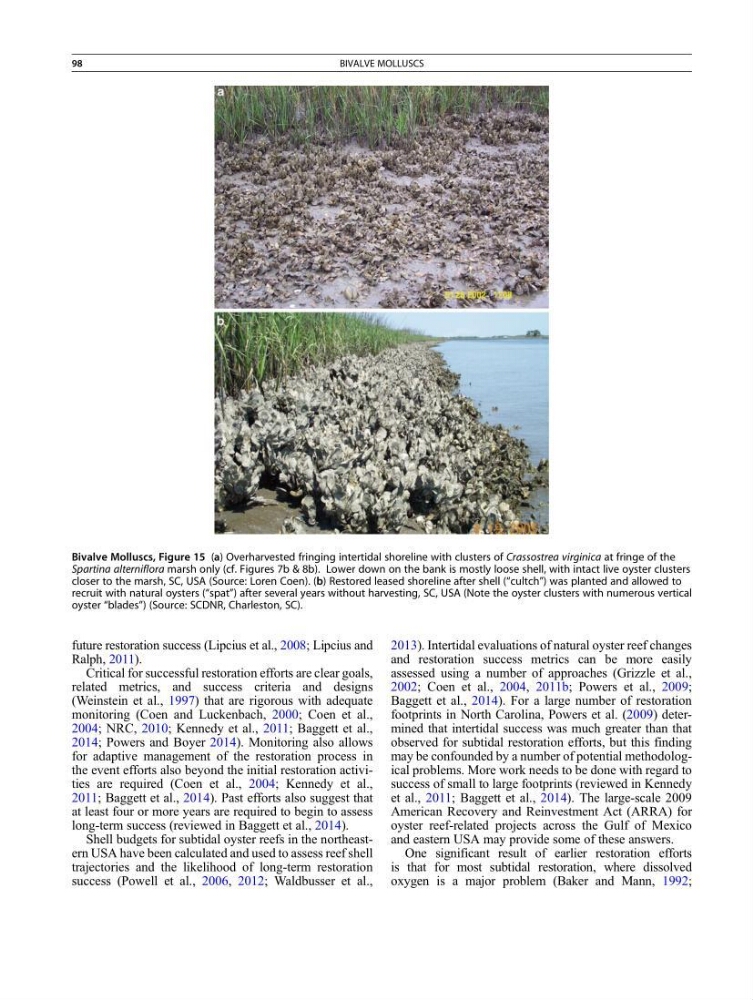
Bivalve Molluscs, Figure 15 (a) Overharvested fringing intertidal shoreline with clusters of Crassostrea virginica at fringe of the
Spartina alterniflora marsh only (cf. Figures 7b & 8b). Lower down on the bank is mostly loose shell, with intact live oyster clusters
closer to the marsh, SC, USA (Source: Loren Coen). (b) Restored leased shoreline after shell (“cultch”) was planted and allowed to
recruit with natural oysters (“spat”) after several years without harvesting, SC, USA (Note the oyster clusters with numerous vertical
oyster “blades”) (Source: SCDNR, Charleston, SC).
98
BIVALVE MOLLUSCS
Ralph, 2011).
Critical for successful restoration efforts are clear goals,
related metrics, and success criteria and designs
(Weinstein et al., 1997) that are rigorous with adequate
monitoring (Coen and Luckenbach, 2000; Coen et al.,
2004; NRC, 2010; Kennedy et al., 2011; Baggett et al.,
2014; Powers and Boyer 2014). Monitoring also allows
for adaptive management of the restoration process in
the event efforts also beyond the initial restoration activities are required (Coen et al., 2004; Kennedy et al.,
2011; Baggett et al., 2014). Past efforts also suggest that
at least four or more years are required to begin to assess
long-term success (reviewed in Baggett et al., 2014).
Shell budgets for subtidal oyster reefs in the northeastern USA have been calculated and used to assess reef shell
trajectories and the likelihood of long-term restoration
success (Powell et al., 2006, 2012; Waldbusser et al.,
2013). Intertidal evaluations of natural oyster reef changes
and restoration success metrics can be more easily
assessed using a number of approaches (Grizzle et al.,
2002; Coen et al., 2004, 2011b; Powers et al., 2009;
Baggett et al., 2014). For a large number of restoration
footprints in North Carolina, Powers et al. (2009) determined that intertidal success was much greater than that
observed for subtidal restoration efforts, but this finding
may be confounded by a number of potential methodological problems. More work needs to be done with regard to
success of small to large footprints (reviewed in Kennedy
et al., 2011; Baggett et al., 2014). The large-scale 2009
American Recovery and Reinvestment Act (ARRA) for
oyster reef-related projects across the Gulf of Mexico
and eastern USA may provide some of these answers.
One significant result of earlier restoration efforts
is that for most subtidal restoration, where dissolved
oxygen is a major problem (Baker and Mann, 1992;
Bivalve Molluscs, Figure 15 (a) Overharvested fringing intertidal shoreline with clusters of Crassostrea virginica at fringe of the
Spartina alterniflora marsh only (cf. Figures 7b & 8b). Lower down on the bank is mostly loose shell, with intact live oyster clusters
closer to the marsh, SC, USA (Source: Loren Coen). (b) Restored leased shoreline after shell (“cultch”) was planted and allowed to
recruit with natural oysters (“spat”) after several years without harvesting, SC, USA (Note the oyster clusters with numerous vertical
oyster “blades”) (Source: SCDNR, Charleston, SC).
98
BIVALVE MOLLUSCS